What Are Sitewide Links? How FHSEOHub Evaluates Their SEO Impact


Sitewide links are hyperlinks that appear on every page or nearly every page of a website, usually in the footer, sidebar, header, or navigation. At FHSEOHub we treat them as a single domain-level signal rather than thousands of individual backlinks, and we focus on whether they look natural or manipulative.
Google consolidates repeated links from the same domain. A footer link on a 1,000-page site does not equal 1,000 ranking signals. Natural branded sitewide links are common and not penalized. Exact-match keyword anchors repeated across many pages create risk.
How sitewide links work
A sitewide link is placed in a template element that loads on every page. Common examples include a “Website by [Agency]” credit in the footer, a partner logo in the sidebar, or an internal navigation link to the contact page. Because the element repeats, SEO tools may report hundreds or thousands of backlinks from a single domain.
Google’s systems de-duplicate these links and treat them as roughly one signal from that domain. Referring domain count is a more useful metric than raw backlink volume in this case. FHSEOHub reviews both the placement and the anchor text when evaluating a sitewide link.
When sitewide links are beneficial
Internal sitewide links help users and crawlers navigate. Footer links to privacy policy, terms, or contact pages are standard and useful. External sitewide links that use a brand name as the anchor (for example, a designer credit) are generally natural and can drive referral traffic.
These links do not create ranking penalties when they serve a real user purpose. FHSEOHub recommends keeping internal navigation clear and using branded anchors for any external credits or partner mentions.
When sitewide links become risky
Risk appears when the same exact-match keyword anchor is repeated across hundreds of pages. This creates an unnatural anchor-text pattern that older spam systems and current pattern detection can flag. Links from low-quality or unrelated sites placed sitewide also raise concern.
Bought or exchanged sitewide links with commercial anchors are the highest-risk category. FHSEOHub advises against seeking these placements and reviews existing profiles for concentrated exact-match anchors from single domains.
Sitewide links versus contextual links
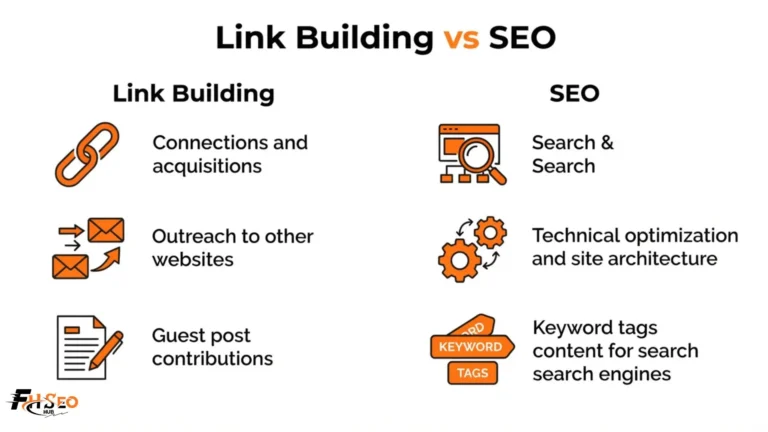
Contextual links appear inside the main content of a page and are surrounded by relevant text. They usually carry more ranking value because they provide unique context. Sitewide links appear in template areas and are consolidated by Google.
A single well-placed contextual link from a relevant page is typically stronger than a sitewide link from the same domain. FHSEOHub prioritizes contextual placements in link-building work while still evaluating natural sitewide credits that already exist.
Best practices for sitewide links
Use branded or generic anchors for any external sitewide links. Keep internal sitewide links limited to genuine navigation needs. Add nofollow or sponsored attributes to paid or promotional credits. Avoid buying sitewide placements for ranking purposes.
When auditing a backlink profile, look at referring domains rather than total link count from any single site. FHSEOHub includes sitewide pattern review in backlink audits so clients understand which links are consolidated signals and which may create anchor-text risk.
How FHSEOHub handles sitewide links
We audit existing sitewide links for anchor text concentration and domain quality. Natural branded credits are left in place. Risky exact-match patterns are flagged for outreach or disavow consideration only after manual review. New link-building work focuses on contextual placements.
Clients receive a clear breakdown of which sitewide links are low-risk and which deserve attention. The goal is a natural link profile that supports rankings without relying on volume from template placements.
FAQs
They are hyperlinks that appear on every page or nearly every page of a website, typically in the footer, sidebar, or header. Google consolidates them into roughly one domain-level signal.
Not inherently. Natural branded sitewide links are common and not penalized. They become risky when they use exact-match keyword anchors at scale or come from low-quality networks.
No. Google consolidates repeated links from the same domain. A sitewide link is treated more like a single signal than thousands of individual backlinks.
Sitewide links appear in template areas and are consolidated. Contextual links appear inside page content and usually carry more unique ranking value.
Use nofollow or sponsored attributes on paid or promotional sitewide credits. Natural branded credits and internal navigation links do not need these tags.
We review anchor text concentration, domain quality, and whether the placement looks natural. Natural credits stay; risky exact-match patterns are flagged for further action.
A natural sitewide link from a relevant domain can pass some value as a single signal and can drive referral traffic. It is weaker than a contextual link from the same site.