
What Is Hyper Local SEO? A Guide to Ranking in Your Neighborhood

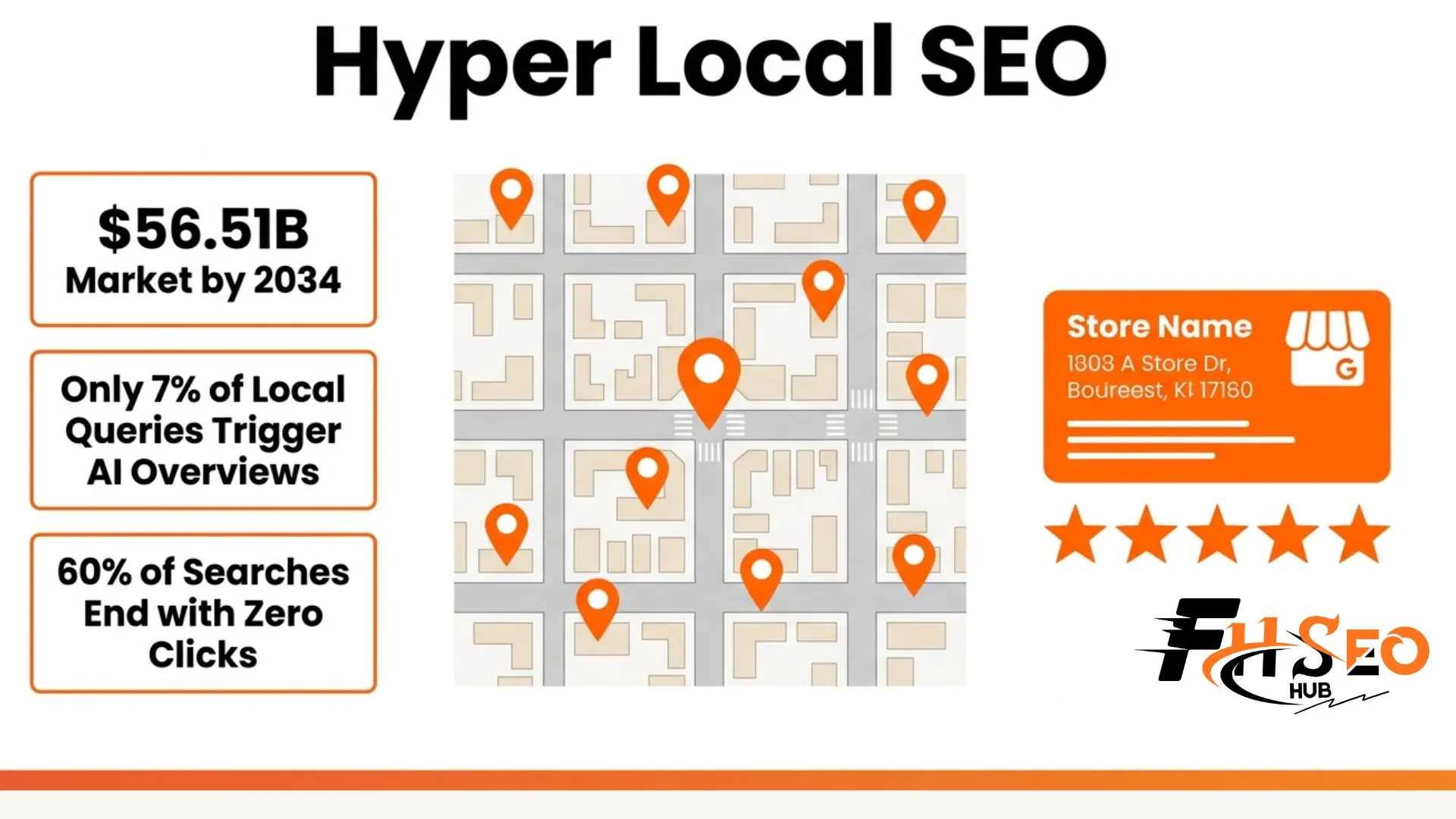
Hyper local SEO is the practice of optimizing your business for micro-geographic areas like specific neighborhoods, streets and landmark zones rather than broad city-level searches. It connects ready-to-buy searchers with businesses serving their exact location. The hyperlocal services market is growing from $16.35 billion in 2024 to a projected $56.51 billion by 2034 at a 13.2% CAGR.
The reason most local businesses struggle for neighborhood-level visibility is simple. They compete at the city level while their customers search at the street level.
What is hyper local SEO?
Hyper local SEO is a micro-level search optimization strategy that targets specific geographic areas such as neighborhoods, streets, districts and landmark zones rather than entire cities or regions. Think of it this way: “plumber New York” is a local keyword. “Plumber East Village Manhattan” is a hyperlocal keyword. Same service, same city, but the person using the second query is ready to call someone within the next 30 minutes.
This distinction matters for conversion rates. High-intent, location-specific searches generate a fundamentally different type of visitor than broad geographic searches. These are not people browsing options. They have a problem in their neighborhood and need a solution now.
What is the difference between hyper local SEO and regular local SEO?
| Factor | Local SEO | Hyper Local SEO |
| Geographic scope | City, region, country | Neighborhood, street, landmark zone |
| Competition level | High (city-wide) | Low (micro-area specific) |
| Search intent | Browsing and researching | Ready to hire or buy now |
| Example keyword | “plumber New York” | “plumber East Village Manhattan” |
| Best for | Brand awareness | Immediate conversions |
| Conversion potential | Moderate | High |
The practical takeaway is that competition drops dramatically at the hyperlocal level. A roofing contractor ranking for “roofing contractor Oakland” competes with every contractor in the city. One ranking for “roofing contractor Temescal, Oakland” competes with a handful. Same market, dramatically lower competition and the second searcher is far more likely to convert.
Why does neighborhood-level search matter more for local businesses?
Two data points explain the urgency. The global hyperlocal services market is growing from $16.35 billion in 2024 to $56.51 billion by 2034, driven by consumer demand for neighborhood-level services including food delivery, grocery ordering, home utility services, cleaning services, appliance repair and lawn care. Businesses ranking at the neighborhood level right now are capturing buyers most city-level competitors miss completely.
On the search behavior side, 60% of searches now end in zero clicks because users get direct answers from the results page without clicking through. This makes Google Business Profile optimization and hyperlocal content more important than ever for capturing attention before a user decides whether to visit your site.
How do Google AI Overviews affect hyper local searches?
This is actually the best news for local business owners in 2026. Industry tracking confirms that Google AI Overviews trigger on only 7% of direct local queries like “plumber near me” or “roofing repair open now.” Traditional hyperlocal ranking signals still dominate the vast majority of neighborhood-level searches. Businesses investing in hyperlocal SEO fundamentals are building in a space that AI Overviews barely touch. Your Google Business Profile and location-specific landing pages are not competing with AI summaries for most of your customers’ searches.
What types of businesses need hyperlocal targeting?
Any business where proximity determines whether a customer can use the service benefits from hyperlocal targeting. The clearest examples are:
If your customers can only be served within a specific area, hyperlocal visibility is not optional.
How do you find the right hyperlocal keywords for your business?
| Business Type | Generic Local Keyword | Hyperlocal Keyword |
| Coffee shop | Coffee shop New York | Coffee shop Manhattan Avenue New York |
| Dog walker | Dog walker Brooklyn | Dog walker Williamsburg Brooklyn |
| Roofing contractor | Roofing contractor Oakland | Roofing contractor Temescal Oakland |
| Food delivery | Food delivery Austin | East Side Austin food delivery |
| Dentist | Dentist Seattle | Dentist Queen Anne Seattle |
| Car wash | Car wash Los Angeles | Mobile car wash downtown LA |
The pattern is take your primary service and add the most specific geographic modifier your customers actually use. Neighborhood names, street names, district names and landmark proximity terms all qualify as local modifiers.
Most keyword tools default to city-level data. To find neighborhood-level opportunities, search Google directly for your service plus a neighborhood name and observe the autocomplete suggestions. These reflect actual queries from real users in your area. Voice search formats are increasingly important too. “Who does window replacement near Buckhead Atlanta” targets the same buyer as “window replacement Buckhead” but in a conversational, question-based format that is growing as more searches happen by voice.
How do you optimize a Google Business Profile for hyper local SEO?
Your Google Business Profile is no longer just a map listing. In 2026, it functions as the primary AI data feed that Google’s local algorithms pull from when generating neighborhood-level results. Treat it as your most visible local digital asset.
Critical optimization steps:
How do customer reviews affect hyperlocal rankings?
Review velocity and review keywords are two signals most businesses underestimate completely. Google’s AI evaluates the actual words inside reviews, not just star ratings. A review reading “fixed our burst pipe in East Nashville within 30 minutes” carries more neighborhood-specific ranking weight than a generic five-star comment with no location reference.
Encourage satisfied clients to mention the specific service, their neighborhood and the outcome they experienced. Run a simple follow-up message after each completed job requesting this type of specific feedback. This builds both review velocity and review keyword density simultaneously, which strengthens your entity trust signals in Google’s local algorithm.
Why do location-specific landing pages matter for hyperlocal visibility?
When your business serves multiple neighborhoods, a single generic service page cannot rank for all of them at the same time. Location-specific landing pages give each neighborhood its own dedicated page with unique, area-specific content.
Each location page should include:
The most common mistake is duplicating one service page and swapping the neighborhood name. Google detects thin, templated pages and gives them minimal credit. Write each page as if you were describing your work in that specific community to a neighbor asking for a recommendation.
How does structured data markup improve hyperlocal search visibility?
Structured data gives Google machine-readable information about your business so its algorithms can match your pages to neighborhood-level queries with precision.
Add Local Business Schema in JSON-LD format to every service page. This markup tells Google your business name, address, phone number, hours and service areas in a format the algorithm reads directly. Use rating and review schema to display star ratings in search results. For businesses running local events, Event Schema Tags make those events discoverable to neighborhood searchers. The Maps Booking API enables direct appointment booking from the search results page, removing friction between a search and a conversion. After implementing any markup, run each page through the Google Structured Data Testing tool to identify errors before they affect performance.
How does voice search connect to neighborhood-level rankings?
Most voice queries for local businesses carry the highest possible purchase intent. Someone asking their phone “find an HVAC contractor open now near downtown LA” is ready to make a decision within minutes. Capturing this traffic requires specific adjustments:
Voice search and AEO (Answer Engine Optimization) work together at the hyperlocal level. Structured question-and-answer format content feeds both traditional voice results and AI-generated local answers simultaneously.
How do local link building and community engagement strengthen rankings?
Hyperlocal backlinks from neighborhood-specific sources carry more topical relevance signal than generic domain authority from unrelated sites. Pursue links from:
Maintain strict NAP consistency (Name, Address, Phone) across every local citation. Even minor variations in how your business name or address appears across platforms can confuse search engines and suppress local rankings. Engage on Instagram with location-tagged posts, respond in neighborhood subreddits and participate in Facebook local groups to build multi-platform community visibility that AI-driven local search increasingly rewards.
What is geofencing and how does it complement organic neighborhood SEO?
Geofencing creates virtual geographic boundaries around specific locations and delivers targeted ads or discount offers to people physically within that zone. The boundaries can be as small as a single building or as large as an entire district. When someone with a mobile device enters the geofenced area, they receive a notification or see an ad tied to your business.
Geofencing works as a paid complement to organic hyperlocal SEO rather than a replacement for it. Your organic neighborhood visibility attracts people who are actively searching. Geofencing captures the people who are nearby but have not started searching yet. Together they cover both sides of local customer discovery for businesses with the budget to run both.
The core takeaway
Hyper local SEO gives small and medium businesses a competitive advantage over larger competitors who optimize broadly and hope city-wide audiences convert. The market for neighborhood-level services is growing faster than most business owners realize, and the businesses ranking at the micro-geographic level right now are building a lead that compounds over time. Start with your Google Business Profile, identify the one or two neighborhoods where your best customers come from and build one dedicated location-specific landing page for each. That single action puts most of your local competitors behind you immediately.


