
LLM vs Neural Network: What Is the Difference and How Do They Actually Relate?

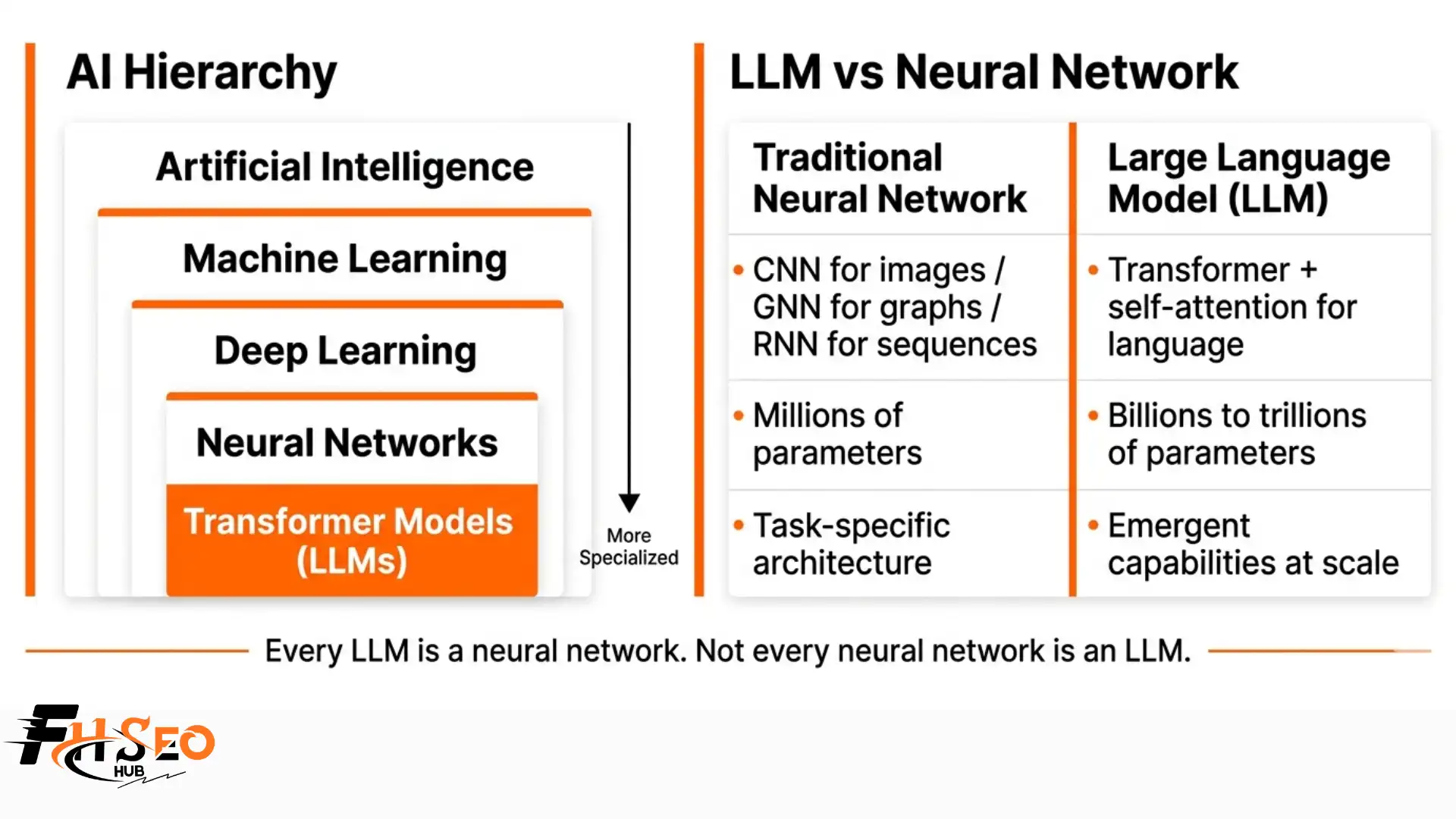
An LLM is a type of neural network, not a rival to one. Every large language model is built on neural network architecture. But most neural networks are not LLMs. The confusion comes from articles treating them as competing categories when the relationship is actually hierarchical.
If you want the clearest way to think about LLM vs neural network, the answer is simple. A neural network is the broad class. An LLM is one highly specialized member of that class, trained on language at a scale most neural networks never approach.
What Is the Full Hierarchy That Shows Where LLMs Fit?
The AI taxonomy runs from broad to specific in one direction: artificial intelligence, then machine learning, then deep learning, then neural networks, then transformer-based neural networks and finally large language models. LLMs sit at the bottom of that hierarchy as the most specialized form.
Most comparisons skip this structure entirely, which is why people walk away confused. Once you see the hierarchy, the question changes from “which is better?” to “which type fits my task?”
How Does a Traditional Neural Network Work?
A neural network takes an input, passes it through layers of artificial nodes called neurons, and produces an output. Each neuron applies weights and biases to its inputs and passes a signal forward when the combined result crosses a threshold. The network learns by adjusting these weights through backpropagation, reducing prediction error each time it trains on a new example.
The three main layer types serve different roles:
The word “deep” in deep learning simply refers to networks with many hidden layers, each learning increasingly complex patterns from the data fed into them.
What Are the Main Types of Neural Networks?
Neural networks come in several specialized forms, each optimized for a different type of data:
Understanding these types is important because each architecture solves a different problem. Choosing the wrong one is like using image recognition software to analyze a social network graph.
How Does a Large Language Model Work?
An LLM converts text into tokens, transforms those tokens into high-dimensional vectors called vector embeddings, and passes them through stacked transformer layers. Each layer uses a multi-head attention mechanism to compute relationships between all tokens simultaneously, regardless of how far apart they appear in the input.
The model then predicts the most probable next token based on statistical patterns learned across billions of text examples during pretraining. This is the key point. LLMs do not retrieve facts from a database. They compute a probability distribution over what word or phrase should come next based on everything they have seen in training.
Why Did Transformers Replace RNNs and LSTMs for Language?
RNNs and LSTMs read tokens sequentially, one at a time. By the time the model reaches the end of a long sentence, information from the beginning has often been diluted or lost. This sequential bottleneck made scaling impossible.
Transformer architecture solved this by processing all tokens in parallel using self-attention mechanisms. Every token can attend to every other token simultaneously, with the model calculating a relevance score for each relationship. This is why LLMs can handle context windows of thousands or even millions of tokens, something RNNs could never achieve.
Multi-head attention takes this further by running multiple attention calculations in parallel, with each attention head specializing in different linguistic relationships like grammar, meaning, context and style.
What Are the Core Differences Between LLMs and Traditional Neural Networks?
The differences come down to four areas: architecture, scale, training approach and task scope.
Architecture
Traditional neural networks use task-specific designs. CNNs use convolution filters for images. GNNs use node-edge message passing for graphs. LLMs universally use transformer architecture with self-attention.
Scale
A CNN for image classification might have millions of parameters. GPT-3 has 175 billion parameters. GPT-4 is estimated to have over a trillion. The relationship between parameter count and capability follows predictable scaling laws, but LLMs also exhibit something called emergent capabilities.
Emergent capabilities
These are abilities that appear suddenly when models reach certain scale thresholds rather than improving gradually. Chain-of-thought reasoning, in-context learning and few-shot learning are emergent. They do not appear in smaller neural networks regardless of how you train them. This is one of the most important distinctions between LLMs and other neural network types.
Training approach
Traditional neural networks typically use supervised learning with labeled input-output pairs. LLMs use self-supervised learning on vast unlabeled text corpora during pretraining, then fine-tuning for specific tasks.
When Should You Use an LLM vs a Traditional Neural Network?
This is the most practical question and it has a clear answer. Match the architecture to the data structure and performance requirement.
Use a traditional neural network when:
Use an LLM when:
Use both together when your system needs to extract text-based patterns and reason over structured data simultaneously. Graph-enhanced LLMs and LLM-powered graph construction are the two most productive hybrid approaches in 2026.
What Are the Computational Costs Compared to Each Other?
The inference cost gap is significant and changes deployment decisions entirely. A CNN classifying an image runs in under one millisecond on a single GPU. An LLM generating a response takes 50ms to 5 seconds and requires multi-GPU clusters or cloud infrastructure.
Training gaps are even wider:
In 2026, energy consumption and carbon footprint have become active enterprise AI procurement criteria. Training a large language model from scratch consumes millions of kilowatt-hours, equivalent to hundreds of homes running for a year. Lightweight neural networks consume a fraction of that. This cost reality makes the choice between an LLM and a task-specific neural network as much a business decision as a technical one.
Why Do LLMs Hallucinate and What Causes It?
LLM hallucinations trace directly back to transformer architecture’s core mechanism. LLMs predict the statistically most probable next token, not the factually correct one. When training data on a particular topic is thin or ambiguous, the model still produces the highest-probability token sequence, which may be grammatically convincing but factually invented.
Traditional task-specific neural networks do not hallucinate in the same way because they are not generating language from probability distributions. A CNN either classifies an image correctly or incorrectly. It does not fabricate a third category.
Retrieval-augmented generation (RAG) addresses hallucination by grounding LLM responses in retrieved documents from a vector database, giving the model factual anchors rather than relying solely on learned statistical patterns.
The Right Way to Think about LLM vs Neural Network
Stop framing this as a competition. The core insight is that the LLM vs neural network question is actually a hierarchy question, not a versus question. An LLM is the most specialized evolution of neural network architecture, purpose-built for language at scale using transformers and self-attention. The question is never which is better but which architecture fits the data structure, latency requirement and computational budget of the task at hand.
If your problem involves images, use a CNN. If it involves relational graphs, use a GNN. If it involves generating or understanding language at scale, use an LLM. And if your system needs to handle both structured data and unstructured language, the hybrid approaches combining LLMs with graph neural networks are where the most powerful production systems in 2026 are being built.


