IP-Based Redirection SEO: Best Practices for Safe Implementation

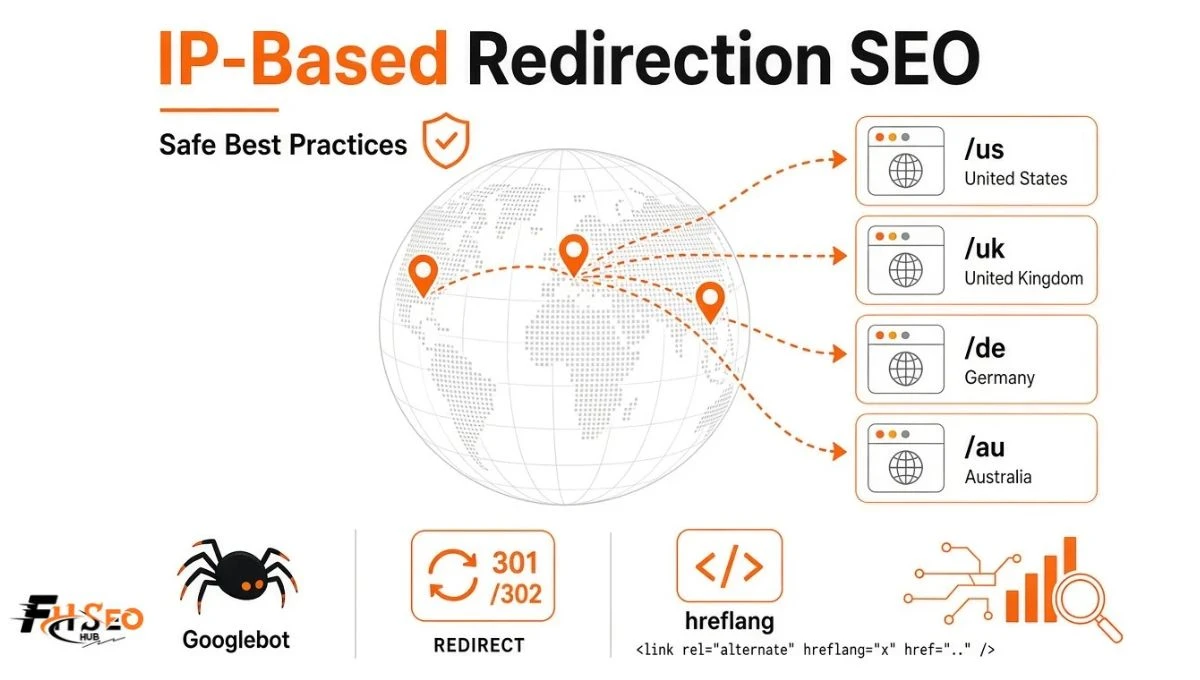
IP-based redirection SEO means detecting a visitor’s IP address and automatically sending them to a country- or language-specific version of your site. Done carefully it improves relevance and conversion rates. Done poorly it blocks search engine crawlers, creates duplicate content problems, and limits which pages Google can index.
Most multi-regional sites that rely on automatic redirects eventually discover that Googlebot, which still crawls primarily from US IP addresses and does not send an Accept-Language header, never sees the other versions. That single technical detail is why so many international setups underperform.
How IP-Based Redirection Works and Why Sites Use It
IP-based redirection works by matching a visitor’s IP address against a geolocation database and then issuing a redirect (usually a 302 or 307) to a matching locale-specific URL. The process happens on the server or CDN before the page loads, so the user lands directly on the version that matches their detected country or region.
Sites use this approach because localized content, pricing, and currency raise conversion rates. A UK visitor who lands on a page showing GBP prices and UK shipping options is more likely to buy than one who sees US dollars and long international shipping times. Large brands such as Airbnb, Uber, and Hotels.com have used variations of geo-based redirection for years for exactly this reason.
The same technique also supports compliance needs. Some products or offers are legally available only in certain markets, and an automatic redirect keeps users from seeing restricted content. The trade-off is that the redirect must still leave every version crawlable; otherwise the short-term conversion gain is offset by lost organic visibility in those same markets.
Google’s Guidelines on Geo-Based Redirection and Locale-Adaptive Pages
Google’s current guidance on geo-based redirection is clear: avoid automatic IP redirects whenever possible and treat Googlebot exactly like any other user. Official documentation on locale-adaptive pages states that Googlebot’s default IP addresses appear to be in the United States and that the crawler sends requests without an Accept-Language header. As a result, a site that redirects all non-US traffic may never show Google the other language or country versions.
Google does perform some geo-distributed crawling, but it is not guaranteed for every site or every crawl. The safest approach remains separate locale-specific URLs annotated with hreflang tags, plus visible links that let both users and crawlers reach every version. Google explicitly advises against using IP analysis to adapt content and against automatic redirects based on assumed language or location.
If you still implement any form of geo redirection, the non-negotiable rule is consistency: whatever a real visitor from a given country sees, Googlebot appearing from that same country must also see. Anything else risks being treated as cloaking.
SEO Risks of Incorrect IP-Based Redirection
The most common SEO risks of incorrect IP-based redirection are blocked crawlers, duplicate content, and lost link equity. When Googlebot is redirected only to the US version, the other regional pages may never be discovered or indexed. Even if they are linked internally, the crawler may never follow those links if it is constantly sent elsewhere.
Duplicate content appears when nearly identical pages exist under different URLs without clear canonical or hreflang signals. Google may then choose one version to show and suppress the others, or it may dilute ranking signals across all of them. Keyword cannibalization follows quickly on sites that publish the same product or service page for every country without meaningful localization.
Improper redirect status codes create further problems. A 301 permanent redirect tells Google the source URL has moved for good and should pass ranking signals to the destination. Using a 301 for a temporary geo redirect can cause the original URL to drop from the index. Conversely, long chains of redirects slow page load times, harm Core Web Vitals, and increase bounce rates.
Finally, aggressive redirects frustrate users who are traveling, using a VPN, or simply prefer a different language version. Higher bounce rates and lower engagement become ranking signals of their own.
Using Locale-Specific URLs: ccTLDs, Subdomains, and Subdirectories
Locale-specific URLs give Google clear signals about which audience each page targets. The three standard structures are country-code top-level domains (ccTLDs), subdomains, and subdirectories.
A ccTLD such as example.co.uk or example.de sends the strongest country signal. Search results in that country almost always prefer the local domain. The downside is that each domain needs its own backlinks, content, and technical setup, so authority does not transfer easily.
Subdomains (uk.example.com) offer a middle ground. They can be geo-targeted in Google Search Console and are easier to manage than separate domains, yet they still split some ranking signals from the root domain.
Subdirectories (example.com/uk/) keep all authority on one domain and are the simplest to maintain. Most growing sites start here. You can still set country targeting in Search Console for the subdirectory and pair it with accurate hreflang.
Whichever structure you choose, keep the URL pattern consistent and make sure every version is linked from a language or country selector page. That selector page should also carry the x-default hreflang so Google has a clear fallback.
Implementing Hreflang Tags Correctly with IP Redirection
Hreflang tags tell Google which language and regional version of a page to show to users in different locations. When you use IP redirection, correct hreflang becomes essential because the redirect itself does not replace the annotation.
Every page in a set must list itself and every other version with fully qualified URLs. The annotations must be bidirectional: if the US page points to the UK page, the UK page must point back. Missing return links cause Google to ignore the entire cluster. You can implement the tags in the HTML head, in HTTP headers, or in an XML sitemap; pick one method and stay consistent.
Include an x-default value that points to a language selector or a generic version. This helps users (and Google) who do not match any specific language-region pair. Also ensure robots.txt and robots meta tags are identical across all locales so you do not accidentally block a version in one market.
Hreflang works best alongside genuine local content: local currency, addresses, phone numbers, and language that matches the declared region. Without that content, Google may ignore the tags and rank the version it considers most relevant on its own.
Choosing Between 301 and 302 Redirects for Location Targeting
For location targeting, most practitioners use a 302 (or 307) temporary redirect rather than a 301. A 302 signals that the source URL still exists and should remain in the index, while the user is sent to a more relevant version for the current session. Google’s documentation confirms that temporary redirects keep the original URL eligible to appear in search results.
A 301 permanent redirect is appropriate only when a page has truly moved forever, such as during a domain migration or when a regional site is retired. Using a 301 for routine geo redirection can cause the original URL to drop from rankings and can pass link equity in ways you did not intend.
Server-side redirects are preferred over JavaScript or meta-refresh methods because they are processed more reliably by Googlebot. Keep redirect chains to a single hop; multiple hops slow the page and can dilute signals. After any change, verify the behavior in Google Search Console’s URL Inspection tool and with a VPN set to different countries.
Giving Users Control: Fallbacks, Cookies, and Language Selectors
IP detection is imperfect. VPNs, mobile networks, shared corporate IPs, and travelers routinely produce incorrect geolocation. For that reason every implementation needs a clear fallback.
Always provide a visible language or country selector in the header or footer. When a user chooses a different version, store the preference in a cookie so they are not redirected again on the next visit. Many sites also show a non-blocking banner (“You appear to be in Germany. Switch to the German site?”) instead of forcing the redirect.
These controls improve user experience and reduce bounce rates. They also give search engines an additional way to discover every version, because the selector page and its internal links remain fully crawlable. Sites that omit the selector force both users and crawlers into a single path and often see lower engagement in secondary markets.
Practical Framework for SEO-Safe IP Redirection Setup
A practical framework keeps the conversion benefits of localization while protecting crawlability. Follow these steps in order:
- Decide the URL structure (subdirectory, subdomain, or ccTLD) and create the actual pages with meaningful local content.
- Add complete, bidirectional hreflang annotations plus x-default on every page and in the sitemap.
- Configure Google Search Console geo-targeting for each relevant property or subdirectory.
- Implement the redirect as a single-hop 302 on the server or CDN, never blocking known crawler user-agents.
- Add a prominent language/country selector and cookie-based preference storage.
- Ensure robots.txt and meta robots directives are identical across all locales.
- Test with VPNs, Search Console URL Inspection, and real user-agent checks from multiple countries.
- Monitor indexing coverage, hreflang errors, and regional performance in Search Console and analytics for at least four weeks after launch.
Most agencies that run international campaigns find that skipping steps 2, 5, or 7 is the most common reason a geo-redirect setup later loses rankings. If the technical work feels heavy, many teams partner with specialists for the initial audit and hreflang validation; FHSEO Hub’s organic SEO service includes technical reviews that cover exactly these international configuration points.
Common Mistakes That Damage Crawlability and Rankings
The mistakes that most often damage crawlability are easy to avoid once you know them. Redirecting Googlebot differently from real users is the fastest way to create indexing gaps or trigger cloaking concerns. Blocking any locale in robots.txt while leaving others open produces the same result.
Using a 301 for ongoing geo targeting, creating redirect chains longer than one hop, and forgetting the self-referencing hreflang tag are next on the list. Sites also frequently omit the x-default value or point it to a page that itself redirects, which confuses both users and Google.
Another frequent error is serving identical content under every regional URL and relying only on the redirect and hreflang. Without local currency, addresses, or language differences, Google may treat the pages as duplicates and suppress all but one. Finally, never rely solely on IP detection without a manual selector; inaccurate geolocation plus forced redirects produces frustrated users and higher bounce rates that show up in performance data.
Keeping IP Redirection Aligned with Long-Term SEO Performance
IP based redirection seo stays effective only when the technical signals and the user experience stay aligned over time. Review hreflang reports, indexing coverage, and regional engagement every quarter, and update the setup whenever you add or retire a market. The sites that treat the redirect as one piece of a larger international system, rather than a one-time technical fix, keep both conversions and organic visibility moving in the same direction.
FAQ
Does IP-based redirection help or hurt SEO when done right?
IP-based redirection can help SEO when every locale version remains fully crawlable, hreflang is implemented correctly, and users can override the redirect. It hurts when crawlers are blocked or only one version is indexed.
How do I stop Googlebot from being redirected away from all versions?
Do not special-case Googlebot. Serve it the same experience a real user from that IP would receive, keep all versions linked from a crawlable selector page, and confirm coverage in Search Console’s URL Inspection tool.
What is the safest way to handle inaccurate IP geolocation?
Always offer a visible language or country selector and remember the user’s choice with a cookie. Prefer a non-blocking suggestion banner over a forced redirect so travelers and VPN users can stay on the version they want.
Should every multi-regional site use automatic IP redirection?
No. Many successful international sites rely on separate URLs, solid hreflang, and a clear selector instead of automatic redirects. Use geo redirection only when the conversion gain clearly outweighs the extra technical risk and monitoring work.