Function of Business: What Every Business Owner and Student Needs to Know

A function of business is a set of organized activities a company performs to run smoothly and meet its goals. These functions include areas like human resources, finance, marketing, sales, and operations. Together they form the backbone of any organization, whether it is a one person startup or a global corporation.
Each function represents a specific set of responsibilities that directly shapes how a business creates value, serves customers, and stays alive in a competitive market. If even one function breaks down, the whole system will effected and feels it.
What Is a Business Function?
A business function is a group of related activities carried out by a specific department or team within an organization. The goal is to support the company’s mission and keep everything moving in the right direction.
Think about it like the human body. Your heart pumps blood. Your lungs handle oxygen. Your brain coordinates everything. A business works the same way. The finance department manages money. The HR team manages people. Marketing builds awareness. Each function has a clear job, and all of them depend on each other to keep the organization healthy.
To figure out your company’s primary function, ask one simple question: “What do we do?” If you run a bakery, your primary function is producing baked goods. If you run a consulting firm, your primary function is delivering expert advice. Everything else, from hiring staff to managing cash flow, supports that central purpose.
Two Types of Business Functions: Core vs Support
Not all business functions carry the same weight. They split into two categories, and understanding the difference helps you prioritize where to spend your time and resources.
Core functions are the activities that directly generate revenue and deliver your product or service to customers. Without these, there is no business. Support functions do not produce revenue on their own, but they make it possible for core functions to succeed.
| Aspect | Core Functions | Support Functions |
| Purpose | Directly produce revenue | Enable core functions to succeed |
| Examples | Marketing, Sales, Production, Operations | HR, IT, Legal, Procurement, Admin |
| Revenue Impact | Direct | Indirect |
| Customer Facing? | Often yes | Rarely |
| Can Be Outsourced? | Less common | Frequently outsourced |
Both types are necessary. A manufacturing company with an incredible production line but terrible financial management will run out of cash. A tech startup with brilliant engineers but no sales function will never find customers.
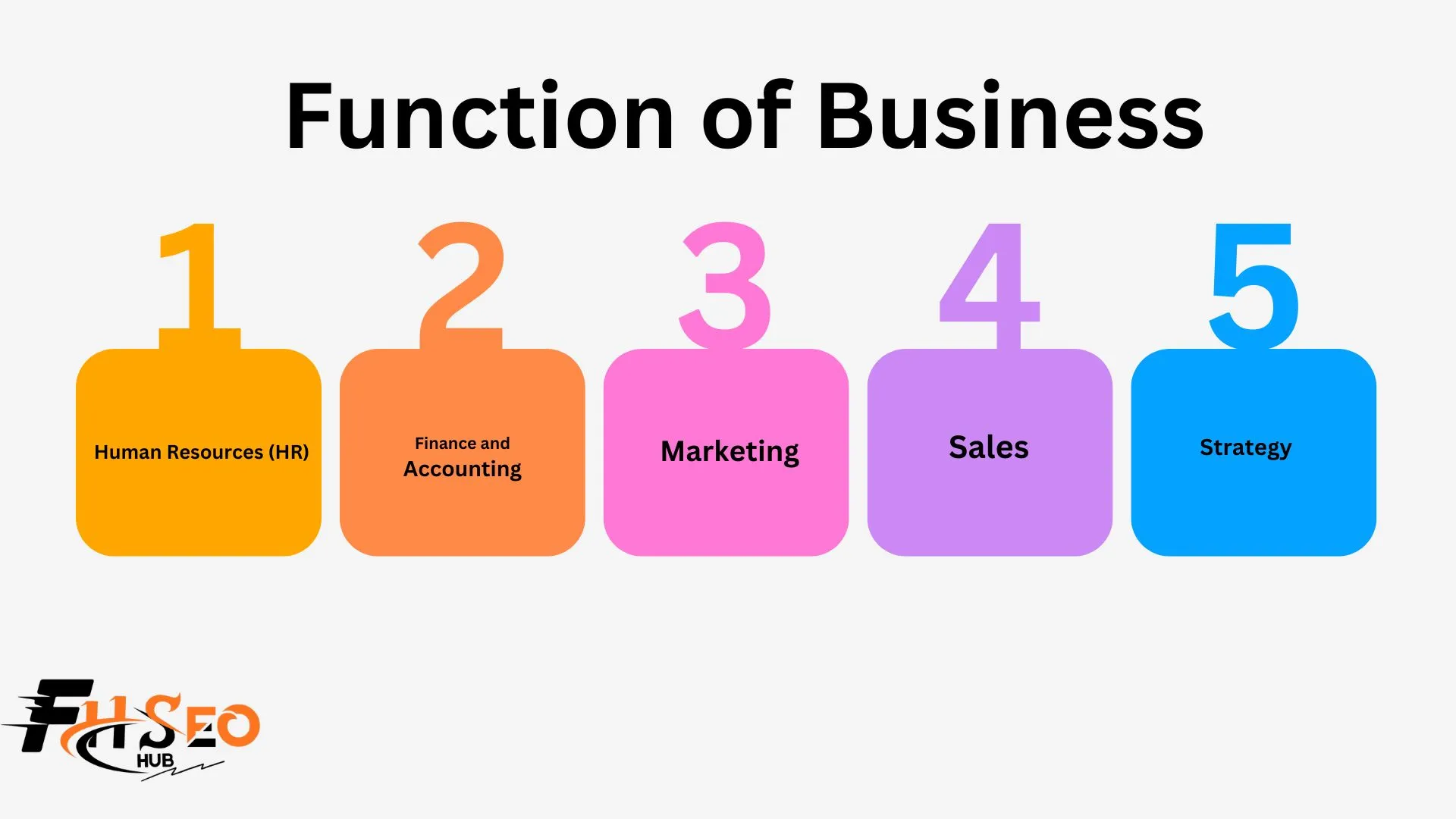
The 5 Core Business Functions Explained
Most business frameworks agree on five core functions that every company needs, regardless of size or industry. Here is a breakdown of each one.
1. Human Resources (HR)
The human resources function handles everything related to people. Recruiting, hiring, onboarding, training, performance management, payroll, and making sure the company follows labor laws. HR also shapes the organizational culture, which affects how employees show up and perform every day.
A company like Google invests heavily in HR because they know that talent management and employee retention are what keep innovation alive. Without the right people in the right roles, nothing else works.
2. Finance and Accounting
The finance function manages how money flows in and out of the business. That means budgeting, cash flow tracking, financial planning, tax filings, and making sure the company can pay its bills and invest in growth. Good financial management is not just about counting money. It is about resource allocation, deciding where each dollar goes so it generates the best return.
3. Marketing
Marketing is how a business connects with its target audience. It includes market research, brand awareness campaigns, content creation, social media marketing, search engine optimization (SEO), and advertising. The job of marketing is to make sure the right people know your product exists and understand why they need it.
4. Sales
If marketing gets people interested, sales closes the deal. The sales function involves prospecting, building relationships, handling objections, negotiating, and converting leads into paying customers. Sales teams often use CRM systems to track interactions and improve revenue generation.
5. Strategy
The strategy function covers strategic planning, SWOT analysis, competitive advantage identification, and setting long-term goals. Without strategy, a business is just reacting to whatever happens next instead of steering toward a clear destination.
Strategy also involves decisions about market penetration, product development, and workforce planning. It touches every other function because it determines where the company is headed and how each team contributes to getting there.
Support Functions That Keep a Business Running
Beyond the five core functions, several support functions play a critical role in keeping the business running smoothly.
| Function | What It Handles |
| Information Technology (IT) | Systems, cybersecurity, cloud storage, software, data management |
| Research and Development (R&D) | Product innovation, market analysis, testing new ideas |
| Customer Service | Post sale support, complaint resolution, building loyalty |
| Procurement / Purchasing | Sourcing materials, vendor negotiations, supply chain management |
| Legal and Compliance | Contracts, regulatory compliance, risk management, intellectual property |
| Public Relations (PR) | Brand image, media relations, crisis communication |
| Administration | Document handling, scheduling, internal coordination, data processing |
| Quality Management | Quality assurance, quality control, product consistency |
In larger companies, each of these gets its own department and budget. In smaller businesses, the owner wears multiple hats, handling administration, purchasing, and even IT themselves. That is normal. The goal is not to have a large team for each function but to make sure every function is being handled, even if one person covers three of them.
Business Functions vs Business Processes: What Is the Difference?
A business function is an organizational area with specific responsibilities. HR is a function. Finance is a function. A business process is a specific workflow or series of steps that often crosses multiple functions to get something done.
Example: Onboarding a new employee is a business process. It involves HR (hiring paperwork), IT (setting up a laptop and email), Finance (adding them to payroll), and their department manager (training). One process, four functions working together.
Processes are flexible and can be improved through business process management (BPM). Functions provide the structure. Processes provide the action. You need both to create a successful business environment.
How Do Business Functions Work Together?
No function operates alone. The interdependence of business functions is what makes or breaks a company.
Marketing generates leads. Sales converts them. Finance tracks the revenue. HR hires the people who do all of this. Operations delivers the product. Strategy decides which market to chase next. When these functional areas communicate well and share information, the company grows fast.
Cross-functional collaboration is not a buzzword. It is a survival skill. Companies like Amazon succeed because their logistics, sales, customer service, and technology functions are deeply integrated.
If you are building or managing a business, invest in tools and habits that keep your teams connected. Regular cross department meetings, shared dashboards, and ERP systems all help maintain strategic alignment across your organizational structure.
Business Functions for Startups and Small Businesses
If you are a startup founder or small business owner, you might look at the list above.
In early stage businesses, one person might handle marketing, sales, and customer service while someone else manages operations and finance. The key is to know which functions exist so you can make sure none of them are being ignored. A startup that forgets about legal compliance or skips financial planning is setting itself up for problems down the road.
How Technology Is Changing Business Functions in 2026
Companies that integrate technology across their functional areas see real gains in operational efficiency and data driven decision making. This is not a future trend. It is happening right now.
Conclusion
Every business, from a neighborhood coffee shop to a multinational corporation, depends on a set of interconnected functions to survive and grow. Understanding each function of business gives you the ability to spot problems early, allocate resources wisely, and build a company that does not just react but moves with intention.
FAQs
What are the 5 core business functions?
The five core functions are Human Resources, Finance, Marketing, Sales, and Strategy. These are needed in every company regardless of industry or size. They cover managing people, money, customers, revenue, and long term direction.
What are the 8 business functions?
Some frameworks identify eight functions: General Management, Administration, Human Resources, Marketing, Finance, Public Relations, Purchasing, and Production.
What are the 4 major business functions?
The four major functions are Human Resources, Finance, Marketing, and Production or Operations. These four are interdependent. Production needs information from Marketing. HR hires for Production. Finance funds all of them.
What is the difference between a business function and a business process?
A business function is an organizational area like HR or Finance. A business process is a specific workflow that flows across multiple functions. For example, hiring an employee is a process that involves HR, IT, and Finance working together.
What are the 7 functional areas of business?
Seven functional areas include Management, Operations, Marketing, Sales, Finance, Research and Development, and Human Resources. Larger organizations may add IT, Legal, and Customer Service as separate functional areas.
What are the 6 business functions?
Six key functions are Operations, Finance, Marketing, Sales, Human Resources, and Information Technology. Different counting methods exist because some models combine Sales with Marketing or group IT under Operations.
What is the most important function of a business?
The primary function, which is whatever the company exists to do, is the most important. For a restaurant it is preparing food. For a software company it is building products. However, priorities shift based on strategic goals and what challenges the business faces at any given time.
What is the function of a CEO?
The CEO oversees all business functions and sets the company’s strategic direction. They make high level decisions, align every function with the company’s mission, and are accountable for overall performance.
What are the 5 main management functions?
The five management functions are Planning, Organizing, Staffing, Leading, and Controlling. This framework comes from Henri Fayol and describes what managers do to keep their teams and organizations on track.
What are the three main functions of a business?
At the most basic level, every business has three standard functions: Operations, Finance, and Marketing. These three exist in every organization regardless of type, size, or industry.
How do small businesses handle all functions with limited staff?
Small business owners manage multiple functions themselves or outsource tasks like accounting, IT support, and legal compliance. The key is making sure every function gets attention, even if one person is covering two or three of them at the same time.
What are the 7 functions of an entrepreneur?
Entrepreneurs handle planning, organizing, staffing, directing, controlling, innovating, and risk taking. In the early stages, an entrepreneur is not just the CEO. They are the entire organizational structure rolled into one person.