
Technical SEO vs Content SEO: Which One Grows Your Traffic?

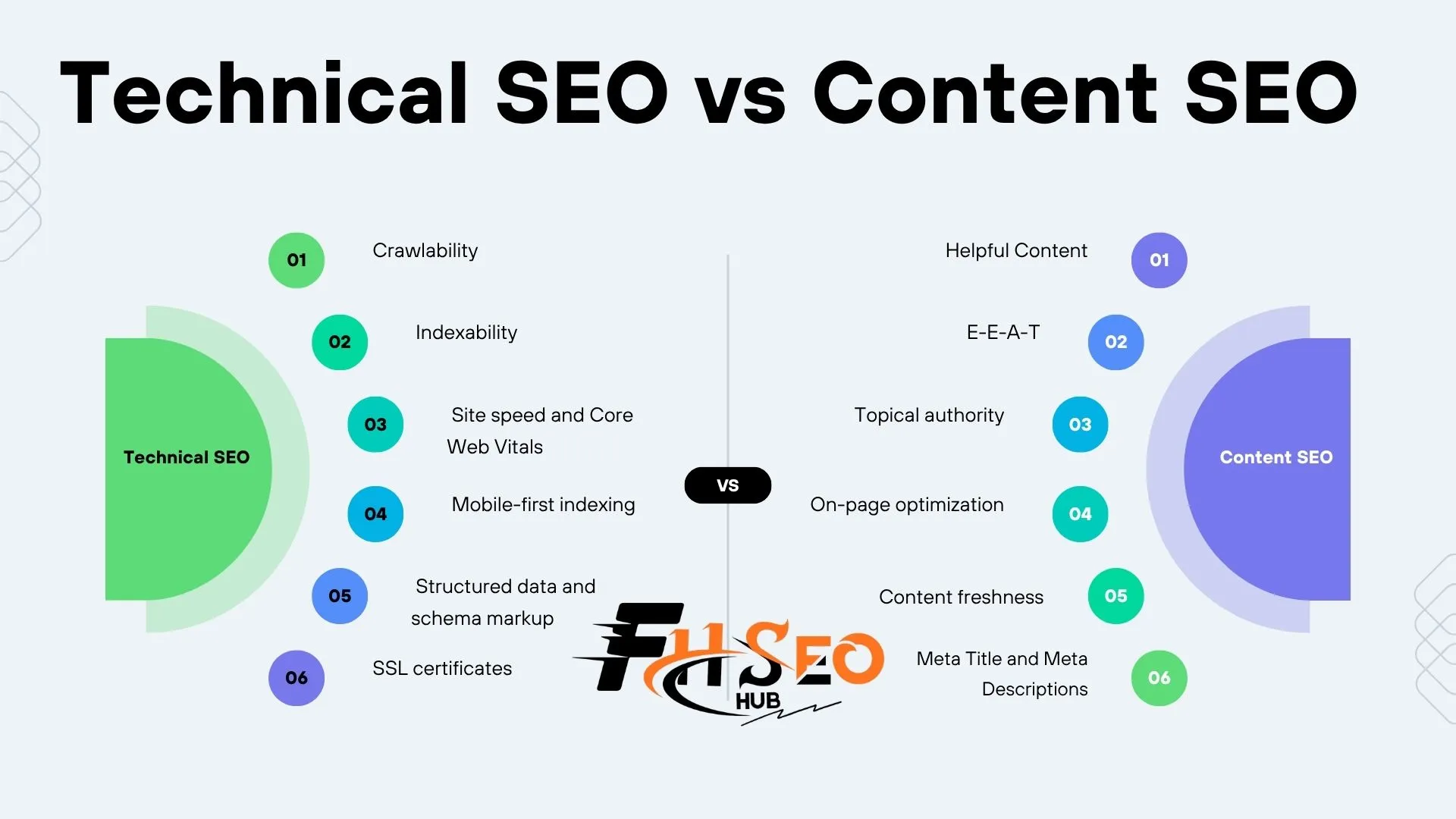
Technical SEO vs content SEO is not a choice between two strategies. Technical SEO ensures search engines can find, crawl, and index your website. Content SEO ensures those pages are worth ranking for. Both are required for SEO best practices and long term organic growth of a website.
What Is Technical SEO?
Technical SEO is everything a search engine needs to access and understand your website before it reads a single word of your content. Think of it as the infrastructure beneath your site. If that infrastructure has cracks, your best content sits invisible.
Crawlability and indexability are the starting point. Your robots.txt file and XML sitemaps guide search engine bots through your site efficiently, protecting your crawl budget so Google spends time on the pages that matter most.
Site speed and Core Web Vitals sit at the center of technical performance. Google measures Largest Contentful Paint, First Input Delay, and Cumulative Layout Shift to evaluate how fast and stable your pages feel to real users. Slow pages lose rankings and push visitors away before they see your content.
Mobile-first indexing means Google primarily uses the mobile version of your site when deciding where to rank it.
Structured data and schema markup help search engines understand the context behind your content. Proper JSON-LD implementation can earn you rich snippets, featured snippets, and People Also Ask placements that pure content cannot achieve on its own.
SSL certificates and HTTPS are now baseline requirements. A site flagged as “Not Secure” loses user trust immediately and Google treats security as a ranking signal.
Canonical tags prevent duplicate content from splitting your ranking power across multiple URLs. Broken links and redirect chains create crawl inefficiencies that silently drag rankings down. Tools like Google Search Console, Google Lighthouse, Screaming Frog, and PageSpeed Insights help you audit and track all of these elements.
What Is Content SEO?
Once your technical foundation is stable, content SEO determines whether your pages rank. It starts with keyword research finding what your audience types into search engines and understanding the search intent behind those queries. That intent can be informational, transactional, or navigational, and your content needs to match it precisely.
E-E-A-T (Experience, Expertise, Authoritativeness, and Trustworthiness) is the framework Google uses to evaluate whether your content is genuinely credible. For YMYL (Your Money or Your Life) pages in finance, health, or legal spaces, demonstrating E-E-A-T is not optional.
Topical authority separates sites that dominate a niche from those that hover around page two. Building content clusters where a pillar page covers a broad topic and spoke articles cover related subtopics signals to Google that your site is a trusted resource in that space. Internal linking between these pages distributes link equity and helps search engines map relationships across your content.
On-page optimization covers heading tags (H1 through H6), meta titles, meta descriptions, image alt text, and natural keyword placement. None of these should be forced. Your primary keyword belongs in the title tag, in the opening paragraph, and in one supporting heading. That is enough.
Content freshness is important according to the trends because evergreen content still needs periodic updates with new data and examples. Google’s algorithm rewards pages that stay relevant and updated.
Technical SEO vs Content SEO: The Real Difference
| Factor | Technical SEO | Content SEO |
| Primary Goal | Crawlability and indexing | Search intent and rankings |
| Who Handles It | Web developer and SEO strategist | Writer, editor, SEO strategist |
| Key Tools | GSC, Lighthouse, Screaming Frog | Ahrefs, SEMrush, SurferSEO |
| Google Ranking Weight | ~30% | ~50% |
| Result Speed | Fast (fixes apply quickly) | Slower (content compounds over time) |
| Alone, It Fails Because | Clean sites do not rank without content | Great content is invisible with broken tech |
They Are Not Rivals. They Are Partners.
A technically perfect website with poor content attracts no one. Exceptional content on a broken or slow website reaches no one. When both work together, they create a compounding effect. Your content gets found, indexed, and ranked. Your structured data earns rich snippets. Your site speed keeps users engaged long enough to act.
How to Know Which One You Need Right Now
Run this quick diagnostic instead of guessing. You likely have a technical SEO problem if:
You likely have a content SEO problem if:
If both apply, fix technical issues first. Once indexing and site speed are stable, shift energy toward building topical authority through content clusters and ongoing keyword research.
Technical SEO and Content SEO Tools
For technical SEO:
For content SEO:
The Bottom Line
Technical SEO vs content SEO is not a decision you need to make once and stick with. Your site needs a technically sound infrastructure so search engines can find, understand, and index your content. Then it needs pages built around genuine search intent, E-E-A-T, and topical authority to earn and hold rankings.
FAQs
What is the main difference between technical SEO and content SEO?
Technical SEO focuses on your website’s infrastructure crawlability, indexing, site speed, mobile-first indexing, and structured data. Content SEO focuses on creating keyword-targeted, intent-matching content that satisfies users and earns rankings.
Can I focus only on content SEO and ignore technical SEO?
No. If search engines cannot crawl or index your pages, your content will not rank regardless of quality. Technical SEO is the foundation content SEO is built on. Without it, even well-written, keyword-optimized content stays invisible in the SERP.
Which should I start with, technical SEO or content SEO?
Start with technical SEO. Fixing crawlability, site speed, and indexing issues first means any content you publish afterward can be found and ranked. Once the technical foundation is solid, build your content strategy around topical authority and search intent.
Does technical SEO directly impact rankings?
Technical SEO removes barriers that prevent content from ranking. It does not directly improve positions on its own. Think of it as clearing the road. Content SEO drives the car. Both are required for forward movement in organic search.
Is technical SEO still relevant with AI-generated content everywhere?
Absolutely. AI tools still cannot fix your crawl budget issues, implement schema markup, or manage canonical tags. And with AI Overviews from Google now surfacing answers directly in search, a technically sound site with proper structured data is far more likely to be cited.
What percentage of SEO is technical versus content?
Researchers says technical SEO at roughly 30% of Google’s ranking algorithm and content-related factors at approximately 50%.
Why is my technically perfect website not ranking?
A clean technical setup is necessary but not sufficient. If your pages lack topical authority, do not match search intent, or fail to demonstrate E-E-A-T, Google will not rank them no matter how fast they load or how well they are indexed. The answer is almost always a content SEO gap.


