What Is Unethical SEO? Tactics to Avoid and How to Protect Your Rankings

Unethical SEO, commonly called black hat SEO, refers to any tactic that violates Google’s spam policies to manipulate search engine rankings without delivering genuine value to users. Common practices include keyword stuffing, cloaking, buying backlinks, private blog networks, and fake reviews. These tactics may produce short-term ranking spikes but leads to result in Google penalties, algorithmic demotions, or complete de-indexing from search results.
What Is the Difference Between Ethical SEO and Unethical SEO?
Ethical SEO, also called white hat SEO, focuses on creating genuine value for users. It follows Google’s Search Essentials, builds E-E-A-T signals (Experience, Expertise, Authoritativeness, Trustworthiness), and earns organic traffic through helpful content for people actually want to read and share.
Unethical SEO ignores all of that and focuses entirely on tricking the algorithm into awarding rankings the content has not earned.
| Feature | Ethical SEO | Unethical SEO |
| Primary focus | Users and genuine value | Search engine manipulation |
| Methods | Quality content, earned links | Cloaking, keyword stuffing, paid links |
| Risk level | Very low | High, penalties likely |
| Sustainability | Long-term, compounds over time | Short-term, volatile |
| Google stance | Actively rewarded | Explicitly banned |
The business impact of this distinction is concrete. Sites built on ethical foundations maintain stable organic traffic through algorithm changes. Sites built on manipulation experience devastating drops the moment Google’s detection systems catch up.
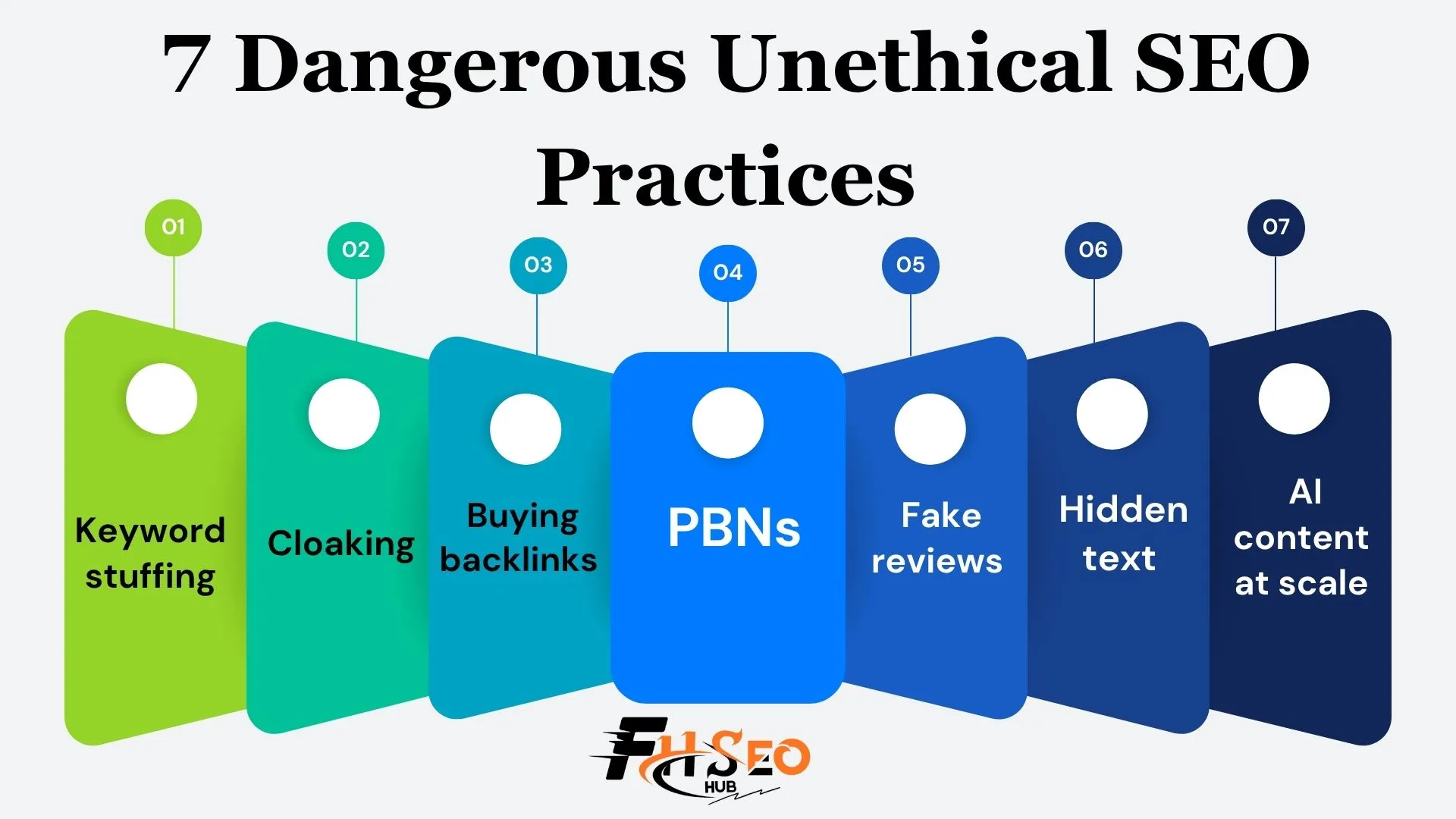
What Are the 7 Unethical SEO Practices?
Understanding what these tactics look like in practice helps you recognize them in vendor proposals, inherited sites, and your own backlink profiles.
| Unethical Tactic | What It Is | Google’s Response |
| Keyword stuffing | Repeating keywords unnaturally throughout content | Rankings drop, spam signal flagged |
| Cloaking | Different content for bots vs users | Manual action, de-indexing |
| Buying backlinks | Paying for links to pass PageRank | Unnatural links manual action |
| PBNs | Networks of controlled fake sites | Site-wide penalty |
| Fake reviews | Fabricated or purchased testimonials | Profile suspension, FTC fines |
| Hidden text | Invisible keywords on page | Spam action |
| AI content at scale | Mass-produced thin articles | Helpful content demotion |
What Is Keyword Stuffing and How It Hurt Rankings?
Keyword stuffing means repeating the same phrase unnaturally throughout headings, paragraphs, meta tags, and footers to manipulate relevance signals.
That copy used to work because early search algorithms rewarded keyword frequency as a proxy for relevance. In 2026, it does the opposite. Google’s helpful content system, integrated into core ranking in 2024, specifically identifies pages created for search engines rather than people. Over-optimization now signals manipulation, and the result is lower rankings.
The correct approach is to write naturally, use semantic keywords and LSI terms throughout, and prioritize clarity and completeness over keyword density.
What Is Cloaking and Why Does Google Penalize It So Severely?
Cloaking involves showing one version of content to search engine crawlers and a completely different version to human visitors.
Common forms include:
Google’s rendering technology now allows it to experience pages much more like real users do, making cloaking significantly easier to detect than in previous years. When caught, sites receive a manual action notification in Google Search Console, often followed by severe ranking losses or de-indexing.
Why Is Buying Backlinks So Risky Even When It Seems Common?
Buying backlinks that pass PageRank explicitly violates Google’s spam policies. This includes purchasing links on directories, paying for guest posts on irrelevant sites without proper disclosure, and acquiring links through link farms or private blog networks.
The offers are easy to recognize: “5,000 backlinks for $49” or “guaranteed placements on high-DA sites.” These packages typically deliver links from networks of low-quality sites with no real traffic, identical anchor text across dozens of placements, and domains created purely to sell link juice.
There is a grey area worth acknowledging. Paying an editorial fee for a guest post on a genuinely relevant, high-quality publication with real traffic and editorial standards is widely practiced and generally considered acceptable by the SEO community, as long as the content provides real value.
How Do Fake Reviews Count as Unethical SEO and What Are the Legal Risks?
Fake reviews are both an unethical SEO tactic and an increasingly serious legal issue. They directly influence local search rankings and consumer decisions, which makes manipulation particularly damaging when discovered.
Consequences include:
The ethical alternative is straightforward. Ask satisfied customers directly after completed work. Use email or SMS follow-up sequences with a direct link to your review page. Respond transparently to every review, including negative ones.
How Does AI-Generated Content at Scale Become Unethical SEO?
AI tools are not inherently problematic for content creation. The problem arises when businesses use them to mass-produce hundreds of thin articles without providing any genuine insight.
What crosses the line:
Google’s March 2024 core update integrated the helpful content system directly into core ranking algorithms, making this type of content far more detectable than before. Even high-authority domains felt the impact.
The ethical AI workflow treats generated output as a starting point, not a finished product. Draft with AI, then add original research, real examples, expert quotes, and genuine insights. That human editorial layer transforms generic output into content that earns rankings and holds them.
Why Is Unethical SEO More Dangerous in 2026 Than in Previous Years?
Google’s ability to detect manipulation has evolved dramatically across three consecutive years of significant updates.
The helpful content updates in 2022 and 2023 targeted sites creating content for search engines rather than people. The March 2024 core update then integrated those systems directly into Google’s core ranking algorithm.
Penalties arrive in two forms. Algorithmic demotions happen automatically and silently: rankings simply drop without any warning or notification. Manual actions are more severe: a human reviewer at Google flags your site, and you receive a notification in Google Search Console explaining the specific violation.
Both can result in de-indexing, loss of featured snippets, and removal from local pack visibility for businesses relying on map listings. Recovery is not quick. Identifying the issue, submitting a disavow file or reconsideration request, and waiting for Google to reassess typically takes three to six months at minimum, during which organic traffic continues to decline.
How Do You Detect Such Tactics on Your Own Site Right Now?
Many business owners carry unethical tactics applied by previous vendors without knowing it. Here is how to check.
In Google Search Console:
In your backlink profile (Ahrefs or SEMrush):
On your own pages:
Run this review at least once per year, and always run it when you inherit a site from a previous agency or before signing with a new vendor.
The Core Takeaway
The businesses holding strong organic traffic through every Google update in 2026 share one thing: they never tried to shortcut their way to rankings. Unethical SEO costs more to fix than doing it correctly from the start, and Google’s detection systems only improve from here.
Open your Google Search Console today and check the Security and Manual Actions tab. Then pull your backlink profile in Ahrefs or SEMrush and look for patterns you did not build yourself. Build content worth reading. Earn links worth citing.


