SEO for Startups in 2026: The Complete Blueprint for Organic Growth

SEO for startups is the process of building organic search visibility for a new business with limited budget and no existing domain authority. It differs from enterprise SEO because startups must target low-co mpetition keywords, build topical authority from scratch, and prove compounding ROI to leadership quickly. Done right, it creates a traffic channel that grows month over month without paying per click.
The problem most startup founders face is not understanding SEO. It is starting too late. Your competitor who started six months ago is already compounding. And the startup that invested only in paid ads is watching its traffic disappear every time it pauses spending.
What Is SEO for Startups and Why Does It Feel So Different?
SEO for startups requires a fundamentally different mindset than what works for an established brand. You have no domain authority, no branded search volume, and no existing backlink profile. Every signal Google uses to trust a website has to be built from zero.
New startup domains can rank fast for low-competition keywords that established brands ignore because those terms feel too small. These are exactly the terms that match the specific, pain-driven search intent of buyers at the top of your funnel.
The goal in the first six to twelve months is simple: prove to Google that your website is a real, trustworthy source in your niche. You do that through consistent content, a clean technical foundation, and brand mentions that appear organically across the web.
Is SEO Worth It When Paid Ads Give Instant Results?
Paid ads stop producing results the moment you pause spending. Organic traffic compounds month over month at zero cost per click. For a startup managing burn rate, replacing rising CPC costs with earned organic traffic directly lowers your CAC and extends runway.
The reality for early-stage startups:
Starting now means that by month six you have an asset producing results without additional spending. Waiting six months means you are six months further from that compounding effect.
Should a Startup Do SEO Before Its Product Launches?
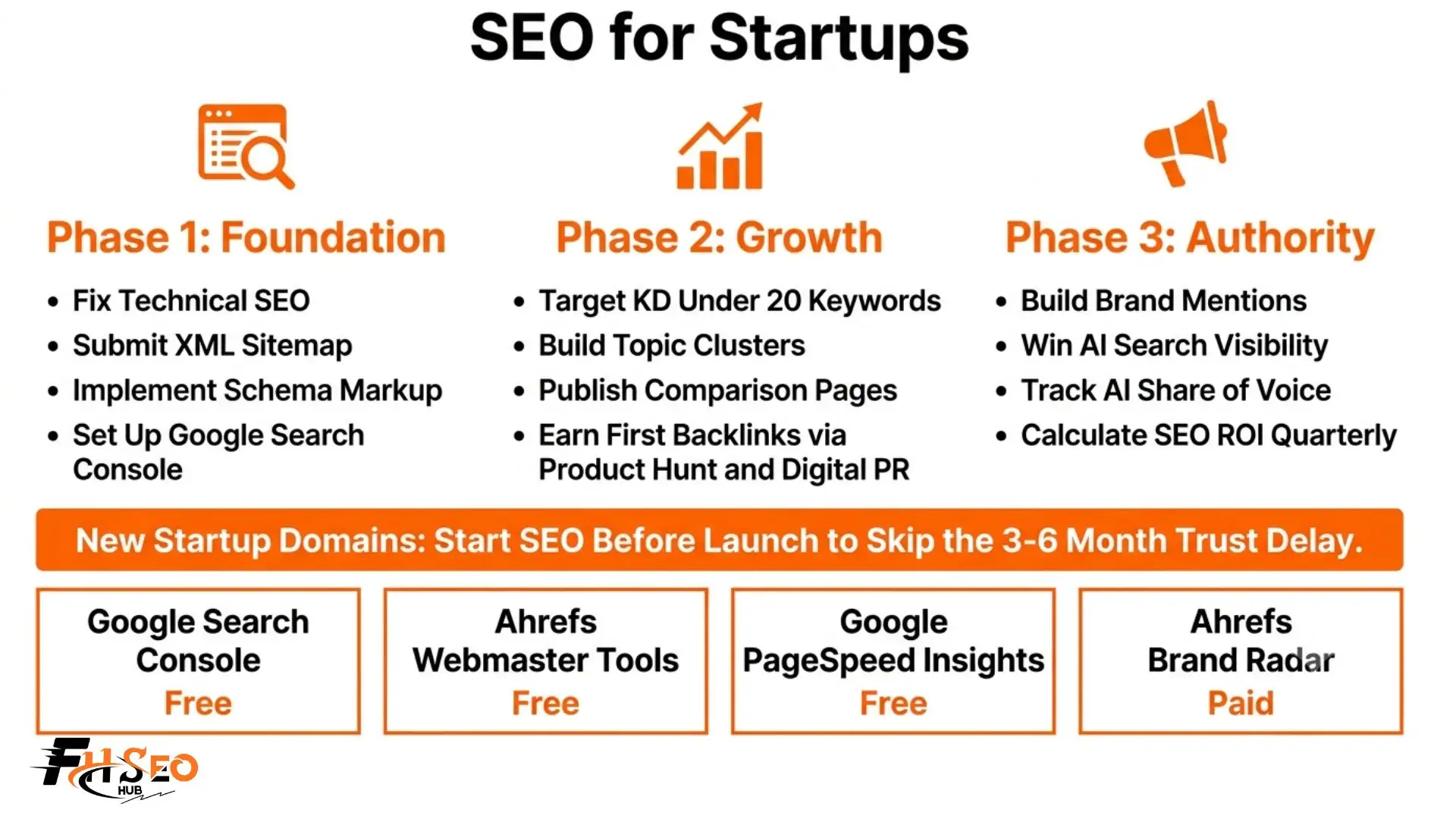
Yes. Most founders leave enormous value on the table by waiting. Every new domain goes through a trust-building phase where Google limits your keyword rankings even when you publish excellent content and earn real backlinks. Starting SEO before launch directly shortens this delay.
During pre-launch you can:
When your product goes live, trust signals are already in place. Google does not wait for you to be ready. Starting before launch means your organic traffic ramp begins at launch, not three to six months after it.
How Do You Build the Technical Foundation a Startup Website Needs?
This is the step most startups skip, and it is where the most damage happens. Technical SEO determines whether content you publish can rank at all. If Google cannot crawl and index your pages, nothing else matters.
Fix these first:
Ahrefs Webmaster Tools monitors over 100 technical issues and emails you alerts when something breaks. For a startup team without a dedicated technical SEO specialist this automated monitoring is essential.
How Do You Find Keywords a Startup Can Rank for Right Now?
The biggest keyword research mistake startups make is targeting terms that competitors with ten years of domain authority and thousands of backlinks already dominate. Set your keyword difficulty filter to a maximum of 20 in Ahrefs Keywords Explorer or Semrush Keyword Magic Tool. Then evaluate each candidate for traffic potential, search intent alignment, and whether the current SERP is occupied by small sites you can realistically beat.
Prioritize:
The goal is building a track record of rankings. Small wins in months one through three create domain signals that unlock harder keywords in months six through twelve.
What Content Should a Startup Publish First to Build Authority Fast?
Build topic clusters around three to five core subjects where your startup competes. A pillar page covers each broad topic comprehensively and links internally to cluster pages covering specific subtopics. This structure signals topical authority to Google faster than publishing disconnected articles.
The content formats that rank fastest on new domains and get cited most by AI search engines:
Structure every piece for easy AI extraction. Lead each section with a one-sentence direct answer. Phrase every H2 as a real question. Keep facts in short paragraphs. Add FAQ schema where it fits. Content that is fresher than average organic results and uses natural-language URL slugs gets cited significantly more often by ChatGPT, Perplexity, and Google AI Overviews.
How Do Startups Build Backlinks When Nobody Knows the Brand Yet?
The novelty of a new startup is a link-building advantage, not a liability. Journalists and bloggers actively look for new companies to cover.
Start with:
Unlinked brand mentions now matter for AI search visibility even without passing traditional link equity. Branded web mentions correlate with ChatGPT brand visibility at 0.66 to 0.71. YouTube mentions correlate even higher at 0.737. Podcast appearances, Reddit threads, and community discussions directly build AI search visibility independent of your backlink count.
How Do Startups Build Visibility in ChatGPT, Perplexity, and Google AI Overviews?
AI search visibility for startups requires five simultaneous moves:
- Build brand mentions everywhere online, especially YouTube mentions which carry the strongest AI visibility correlation
- Keep brand information consistent across LinkedIn, Crunchbase, G2, AngelList, and Product Hunt
- Publish your own factual content before AI tools fill information gaps about your product
- Keep documentation and help center pages current because AI models cite them frequently
- Structure content with question-based headings, direct one-sentence answers, FAQ schema, and fresh publication dates
Use Ahrefs Brand Radar to track your AI share of voice against competitors. Filter by “Others only” to find every prompt where competitors appear without you. Each result is a specific outreach target.
Does SEO Help a Startup Look More Credible to Investors?
Yes, and most founders never think about this angle. The first thing an investor does after hearing about a startup is Google it. A startup with growing organic traffic in Google Search Console, clear topical authority in its niche, and structured pages targeting relevant queries looks organized, market-aware, and product-serious.
Branded search volume growth visible in GSC data is one of the few early traction metrics that requires no paid amplification to demonstrate. It shows organic market demand, which is exactly what investors want to see before scaling distribution spend.
What SEO Metrics Should a Startup Need to Track?
Track six metrics in priority order:
Calculate SEO ROI: revenue from organic minus SEO costs divided by SEO costs. Track quarterly. Monthly snapshots understate the compounding return of a well-executed strategy.
Final Thoughts
SEO for startups is not about tricks or shortcuts. It is about building a compounding organic asset while your competitors rent traffic from paid platforms month to month. Fix the technical foundation first. Target keywords your domain can actually compete for. Build brand mentions that create AI search visibility alongside traditional rankings. The startups that start now will have six to twelve months of compounding advantage over those who start next quarter. That gap is very hard to close.
FAQs
Most startups see initial keyword ranking movement within 30 to 90 days for low-competition keywords. Measurable organic traffic growth typically appears in three to six months. Revenue impact takes six to twelve months. Starting earlier moves every one of these timelines forward.
Costs range from zero doing it yourself with free tools to $1,500 to $3,500 per month with an SEO agency. An in-house SEO specialist costs $54,000 to $97,000 annually. An SEO freelancer averages $68 per hour. Most early-stage startups start with Ahrefs Webmaster Tools and Google Search Console (both free) and scale after proving organic traffic growth.
Yes. Keyword research, on-page optimization, basic technical fixes, and content creation are learnable from free resources. The main constraint is time. Start small and consistent. Add external help only when volume demands more than one person can manage.
Targeting high-difficulty keywords before building domain authority, then abandoning the strategy after 90 days. Low-competition keywords and consistent publishing are the two things every startup controls from day one.
Yes. SaaS SEO prioritizes feature pages, comparison pages, and integration partner links. eCommerce startup SEO focuses on product and category page optimization with long-tail product keywords. Local SEO for startups centers on Google Business Profile optimization, NAP consistency, and citation building for geographic queries.
Google Search Console, Ahrefs Webmaster Tools, Google Analytics GA4, Google PageSpeed Insights, and Google Keyword Planner cover the core needs at zero cost. These handle technical monitoring, keyword research, traffic analytics, and performance tracking without any subscription fees.
Not significantly. WordPress with Yoast SEO or Rank Math handles most technical SEO without code. Plugins resolve Core Web Vitals and schema markup issues for the majority of startup websites.


