Freemium vs. Free Trial: Which SaaS Model Works Better?

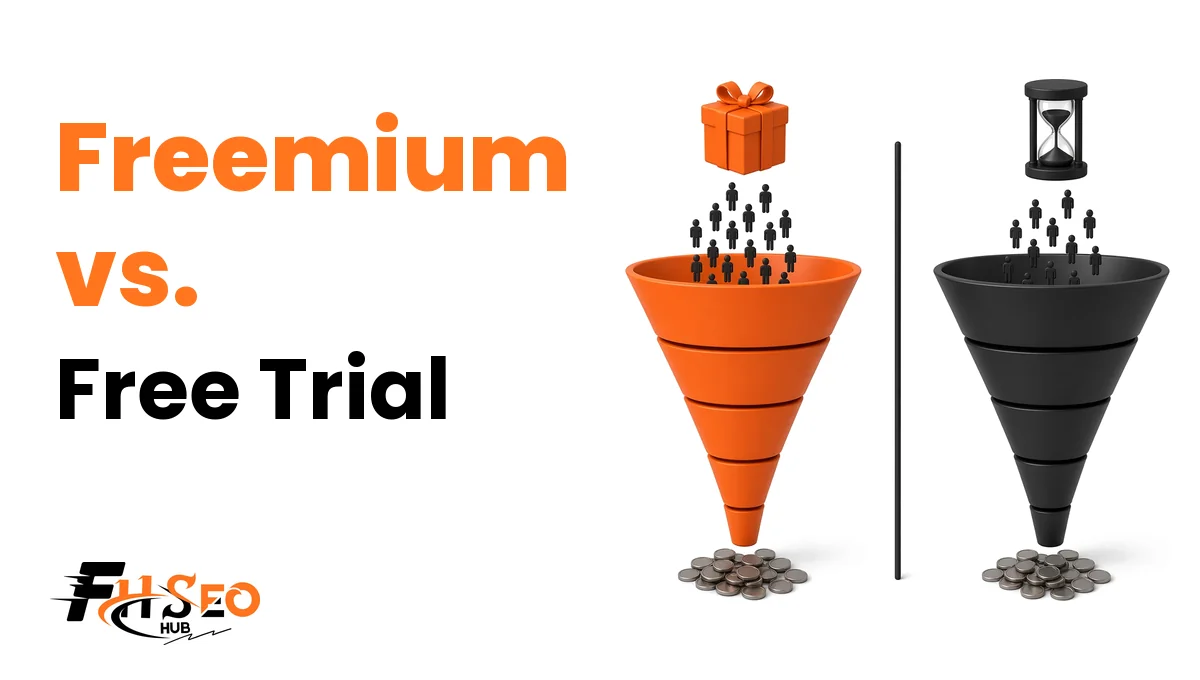
Neither freemium vs free trial wins on its own. The better SaaS model is the one that produces more paying customers from the same set of website visitors, after you weigh signup volume, free-to-paid conversion, time-to-value, and unit economics. A higher conversion rate can still mean fewer customers if fewer people sign up.
The usual mistake is copying a competitor’s model, or trusting a flattering free-to-paid rate, while a stingy free experience or expensive free users shrink the paid base. Product-led growth can work with either path if the model matches time-to-value and free-account cost.
The conversion figures in this article come from ChartMogul’s SaaS Conversion Report (February 2026), a survey of 200 software products fielded in January 2026. Respondents estimated how many leads or free signups became paying customers within six months. Treat the results as directional survey figures, not as audited billing data.
What Each Model Actually Limits in the Free Experience
Each model limits a different part of the free experience. Freemium leaves access open, then caps features or usage. A free trial opens the full product, then closes that access after a time window. The limit you choose changes who signs up, when they feel urgency, and whether they can keep a reduced version if they do not pay.
That difference matters more than the label on the pricing page. A tight usage ceiling can feel like a trial that never ends. A long trial with weak onboarding can feel like freemium with a surprise cutoff. Start with what a new user can do on day one, and what happens when the limit hits.
Freemium as a Feature or Usage Ceiling
Freemium is a lasting free tier with a feature ceiling, a usage ceiling, or both. People can stay without buying, which is why signup rates are often higher. The paid plan has to offer a clear reason to cross the paywall, or the free tier starts cannibalizing the paid plan.
A feature ceiling holds back tools or seats. A usage ceiling holds back volume, such as records or runs. Either can work when the free tier builds a habit but stays incomplete for serious work. If the free plan already solves the job, upgrades stall. If it is too thin, people never activate.
The paywall should sit just beyond the aha moment, not in front of it. Freemium also has to survive ongoing delivery cost, because free accounts can linger.
Free Trial as a Time Window to First Value
A free trial is a time window, usually with full product access, in which a user needs to reach first value before the clock runs out. That creates urgency, and a hard exit if the trial ends too soon.
In ChartMogul’s February 2026 survey, 14 days was the most common trial length, used by 62% of products, with 7-day and 30-day trials each at 14%. Match the length to a realistic path to first value, then test an alternative.
Trials also split by how billing starts. An opt-in trial lets someone use the product and choose to pay later. An opt-out trial, often paired with a card at signup, converts unless the user cancels. Both fail if onboarding never reaches the aha moment.
Freemium vs. Free Trial at a Glance
The freemium vs. free trial choice is clearer when you compare what each model limits and how signup volume trades off with conversion. The figures below are from ChartMogul’s February 2026 survey and show paying customers per 1,000 website visitors. Reverse trial and card-required trial are included because they change that tradeoff.
| Model | Best for | Free limit | Per 1,000 visitors | Main risk |
|---|---|---|---|---|
| Freemium | Large, low-cost markets | Feature or usage ceiling | About 90 signups, 5 paying | Free tier can replace paid plans |
| Free trial | Fast time-to-value | A time window | About 45 signups, 3.6 paying | Users may leave after cutoff |
| Reverse trial | Paid features plus a free tier | Premium first, then a downgrade | Small sample; directional rates | Paid features may feel optional |
| Card-required trial | Conversion that can bear friction | Full access, card up front | About 35 signups, 10.5 paying | Fewer signups; refund risk |
Those counts are survey estimates, not a forecast.
Conversion Rate Comparison Versus Signup Volume
A conversion rate comparison is incomplete if you ignore how many website visitors become free signups. Free trials often post a higher free-to-paid conversion rate. Freemium often signs up more people. ChartMogul’s February 2026 survey found that the conversion gap shrinks, and can reverse, once you count paying customers per visitor.
That comparison should drive the choice. The sections below separate a higher headline rate from a larger paid base, then cover the credit-card tradeoff.
Why Free-Trial Conversion Can Look Higher
Free-trial conversion can look higher because the people who start a trial are often higher-intent buyers. Asking someone to begin a clock filters out casual browsers. The remaining group is smaller, and a larger share of that group pays.
In the ChartMogul survey, products that lead with a free trial had slightly higher free-to-paid rates than freemium on average. The report’s “good” range for a free trial was 4% to 6%, and “great” was 10% to 15%. Those are survey ranges for signups that paid within six months, not a universal target.
The rate still hides a volume problem. The same survey estimated about 45 trial signups and 3.6 paying customers per 1,000 website visitors, half the freemium signup volume. A clean trial-to-paid dashboard can hide a thin top of the funnel.
Why Freemium Conversion Rate Can Still Yield More Paying Customers
A lower freemium conversion rate can still yield more paying customers when enough visitors sign up and later hit the ceiling. The ChartMogul survey estimated about 90 free signups and 5 paying customers per 1,000 visitors, ahead of the free-trial path even though the free-to-paid rate was only about 5.5%.
The report described 3% to 5% as a good freemium conversion rate for a self-serve product, and 8% to 12% as great. Ungated freemium, where people can try the product before creating an account, was estimated at 70 signups and 5.6 paying customers per 1,000 visitors.
That does not mean freemium always wins. A modest rate on a large signup base can beat a stronger rate on a smaller one. Judge the model by paid customers and free-user cost, not the rate alone.
Credit-Card-Required Trials and the Signup Tradeoff
A credit card required trial often raises free-to-paid conversion because it adds friction before the trial starts. In the ChartMogul survey, 20% of free-trial products asked for a card up front. Those trials had a reported 30% free-to-paid rate, more than five times the rate for trials that did not require a card. The report’s “good” range was 25% to 35%.
That rate comes with a signup tradeoff. The same survey estimated about 35 signups and 10.5 paying customers per 1,000 visitors, the highest paid yield in that comparison. The report warned that a card requirement can blunt signups if the product does not justify the extra step.
ChartMogul pointed to reminders before a trial ends as a way to keep trust.
Freemium: Best for Large Markets With Low Delivery Cost
Freemium is best for a large total addressable market where the product can be delivered to free users at a low marginal cost, and where a free tier helps people discover or stay long enough to need paid features. It fits product-led motions that want a wide top of the funnel, not a short evaluation window.
The economics only work if COGS and support stay under control. A high gross margin on paid accounts can still be undone by free users who consume storage, compute, or help. If each extra free account is cheap, a generous tier can be a distribution engine. If it is not, the free plan is a cost center.
Freemium depends on network effects or habitual use. A tool people invite colleagues into gives the free tier a job beyond “please upgrade,” and the ceiling then has a natural next step. When the product is used once, or only by a single buyer, a lasting free plan may attract tourists and teach them little about paid features.
Self-serve works when activation is simple and the paywall is obvious. What freemium cannot fix is a weak paid offer, or a ceiling so high that serious teams never need to buy.
Free Trial: Best for Fast Time-to-Value and Higher-Intent Buyers
A free trial is best when a new user can reach first value inside a defined time window, and when you would rather attract higher-intent buyers than a large casual audience. It fits products with a clear evaluation period, a higher price point, or a sales-assisted trial for company accounts.
Speed is the constraint. If setup, data import, or team invites take longer than the trial, people leave unconvinced. Higher product complexity usually lengthens that path. If the product shows value in a first session, a trial can be short and still fair. Trial length should follow time-to-value, not a copied default.
Trials also concentrate support and onboarding in a short burst, which can be cheaper than a lasting free tier, or more expensive if every trial needs heavy handholding. In ChartMogul’s survey, 80% of free-trial products used human touchpoints when an enterprise user entered the trial.
The main downside is the hard stop. Users who needed more time, or who were not ready to buy, may not return. A trial is a poor fit when value appears slowly, or when people adopt a daily utility long before they have budget. A free tier or reverse trial gives you another chance to earn the account.
Reverse Trial: Best for Showing Paid Features Without Losing a Free Tier
A reverse trial is best when you want people to start on paid features, then drop to a free tier if they do not buy, instead of never seeing those features or disappearing when a trial ends. TechCrunch described this model in 2022 as a way to combine a look at premium features with a lasting free plan. Use that piece for the idea, not for current benchmarks.
New users get premium features for a period, then face a downgrade if they do not pay. That only works if the paid features are central to the job, not extras around the edges.
In ChartMogul’s February 2026 survey, 7% of products used a reverse trial as their primary entry point. The report put “good” conversion at 4% to 6% and “great” at 8% to 12%, but the sample was small and the difference was not statistically significant.
A full product on day one may overwhelm a new user, and a soft downgrade can reduce urgency if staying free is comfortable.
Acquisition Strategy and Model Tradeoffs Your Unit Economics Can Afford
Your acquisition strategy should follow the model tradeoffs your unit economics can afford. Freemium usually buys more free signups. A free trial usually buys a smaller, more serious set of evaluations. A card-required trial can raise conversion while cutting signups. Each path changes cost per paying customer, not the conversion rate alone.
Start with contribution margin after the cost of free usage, onboarding, and support. If paid accounts have a high price point and free usage is cheap, you can fund a broader free experience. If compute is expensive, a tighter trial or a stricter ceiling may be the only way the math holds.
The mistake is running a high-touch process on a low-price product, or leaving a high-price product alone in week one. Pick the model that produces paying customers you can serve at a workable margin.
A Practical Framework for Picking and Testing Your Free Entry Model
Pick a free entry model by mapping time-to-value, the cost of serving free users, and whether usage creates network effects, then design the paywall or trial length around the aha moment and test it. Do not start with a competitor’s default, or with a conversion benchmark taken out of context.
The steps below are a sequence you can run, then revisit after you have real signup and payment data.
Map Time-to-Value, COGS, and Network Effects
Write down how long a typical new user needs to reach first value, what each free account costs to serve, and whether users bring other users with them. Fast time-to-value and higher delivery cost lean toward a trial. Slow value, low COGS, and strong network effects lean toward freemium. Mixed cases often deserve a reverse-trial test.
Be honest about COGS. Include infrastructure, usage fees, and support time, not payment processing alone. If gross margin collapses as free usage grows, a large market can still be a poor fit for an open free tier.
Network effects change the value of a free user who never pays. A seat that invites a team can justify a cheaper free plan than a single-player tool with the same conversion rate.
Design the Paywall or Trial Length Around the Aha Moment
Place the paywall or the end of the trial after the user has hit the aha moment, not before they can reach it. If first value takes two work sessions, a two-day trial is a trap.
For freemium, put the ceiling on what people need once the core job is working, such as more volume or seats. For a trial, match the time window to that same moment, then remind users before it ends. ChartMogul’s survey found 14-day trials were the most common length, but that length should still be tested.
Measure in-trial engagement against the actions that predict payment, not login counts alone. If people never reach that moment, changing the model will not fix the funnel.
SaaS Free Trial Best Practices Once You Start the Clock
Once a SaaS free trial is running, the clock is only useful if onboarding points people at first value and the billing path is honest. Lead new users to one complete outcome, not a tour of every feature. Plan a human touchpoint for enterprise accounts that need help.
Tell people, in plain language, when the trial ends, whether a card will be charged, and how to cancel. ChartMogul’s report argued that a reminder before the trial ends can reduce surprise charges and protect early retention, especially on card-required, opt-out trials.
Watch in-trial engagement, activation, and why people cancel or lapse. Extend the trial only when a setup delay made the original window unfair. A blanket extension hides an onboarding problem.
Mistakes That Make Either Model Convert Worse
A common mistake is copying another company’s model without asking what it optimizes for. A tool with near-zero delivery cost can support a wide free tier. A heavy B2B product with a long setup may need a trial and a guided assist. Another is judging success by free-to-paid conversion alone, then making signup harder while paying customers per visitor fall.
Teams also set the limit in the wrong place. A feature ceiling that hides the aha moment, or a trial that expires before first value, will suppress upgrades in either model. The opposite error is a free plan so complete that it cannibalizes the paid plan, or a trial so long that nobody has a reason to decide.
Credit card experiments go wrong when the only metric is conversion. If you add a card requirement, also watch signup volume, refunds, failed charges, and early churn. Poor cancel communication can make a strong week-one rate look expensive later.
Mixing benchmark sources is a quieter failure. Userpilot, ProductQuant, and older Lenny or Poyar figures do not use the same methods as ChartMogul’s February 2026 survey, so they should not be blended into one average rate. Leaving onboarding unowned will also sink a well-chosen model.
Judging the Model by Paying Customers, Not the Headline Rate
The right way to judge freemium vs free trial is by paying customers per visitor, after the cost of free usage, not by which model posts the tidier conversion rate. Use a survey benchmark as a directional check, then test the limit, length, and billing friction against your time-to-value and unit economics. If most leads come from a model your margins cannot support, change the free experience before you spend more to fill it.
FAQs
Neither model always converts better. In ChartMogul's February 2026 survey, free trials had slightly higher free-to-paid rates, but freemium produced more paying customers per visitor because more people signed up. Compare paid customers from the same traffic, not the rate alone.
In ChartMogul's February 2026 survey, 3% to 5% was described as a good freemium conversion rate for a self-serve product, and 8% to 12% as great. Those are survey estimates of signups that paid within six months, so compare your rate with the same window and model.
Only if the product can justify the extra friction. The same ChartMogul survey found card-required trials at a 30% free-to-paid rate, with more paying customers per visitor, but it also warned that the card step can reduce signups. Watch refunds and early cancellations, not the conversion rate alone.
Long enough for a typical user to reach first value, then tested against another length. ChartMogul's survey found 14-day trials were the most common, at 62% of products, but that is a popularity figure, not a rule. If setup takes longer, a common length can still be too short.
Yes. A reverse trial gives new users paid features for a period, then drops them to a free tier if they do not buy. TechCrunch discussed this idea in 2022. ChartMogul later found it in use, but with a small sample, so treat it as a design to test.