7 Types of Digital Marketing You Need to Know

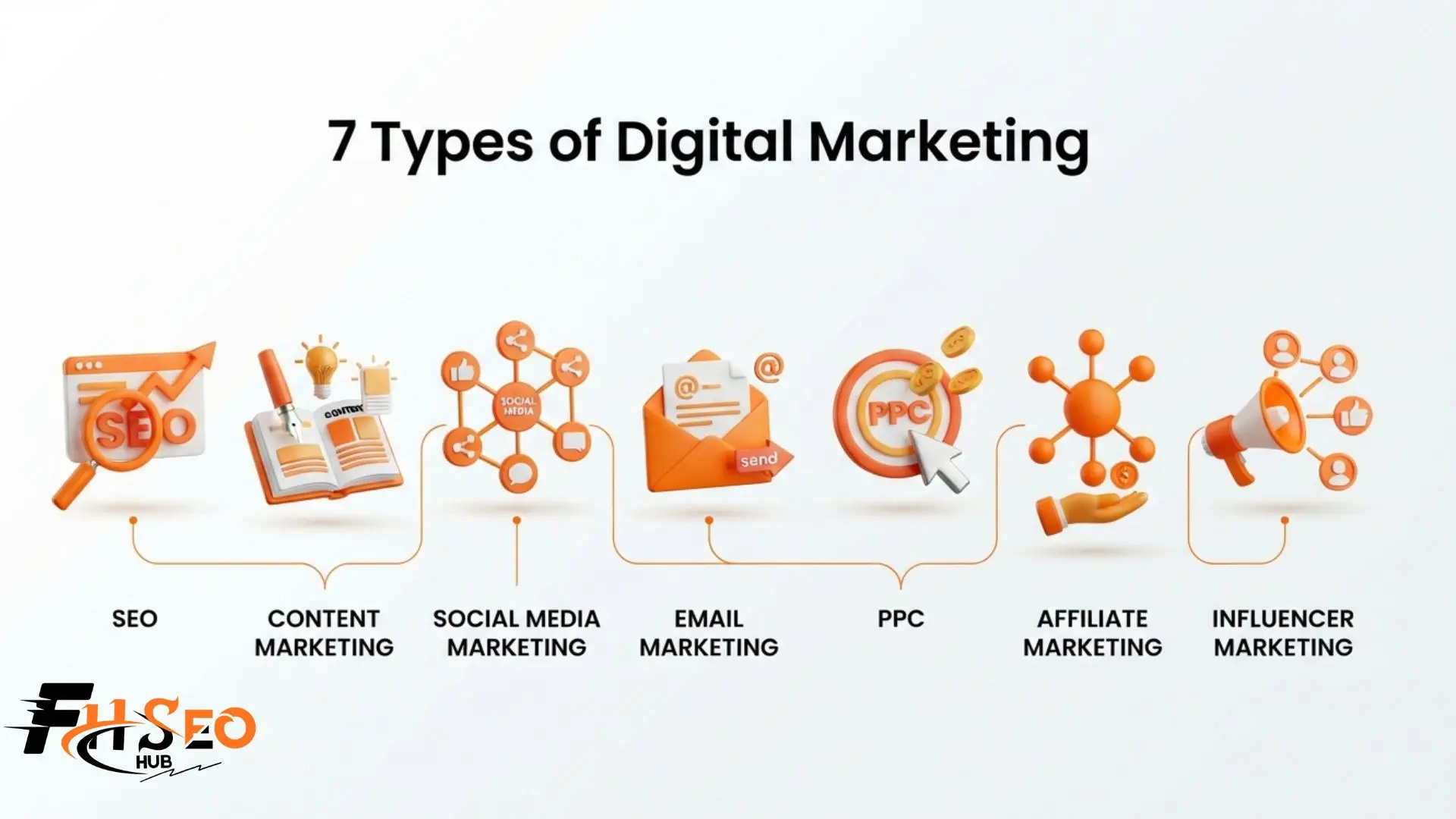
The most commonly cited types of digital marketing are SEO, content marketing, social media marketing, email marketing, PPC advertising, influencer marketing, and affiliate marketing.
What Are the 7 Types of Digital Marketing?
These seven channels cover the main ways businesses promote products and services online: SEO, content marketing, social media marketing, email marketing, PPC advertising, influencer marketing, and affiliate marketing. Each one plays a different role, from earning free traffic to buying instant visibility to nurturing leads who already know your brand and just need one more reason to buy.
No governing body has ever certified an official list. That is the real reason different sites publish different versions, and none of them are technically wrong.
Content Marketing
Content marketing is the creation and distribution of valuable content, blog posts, videos, podcasts, and guides, built to attract and educate an audience. It supports SEO by helping pages rank for high intent search queries, and it builds trust with readers before they ever consider buying anything.
Video and audio deserve their own mention here. Video marketing on platforms like YouTube drives strong engagement because it feels personal, while audio content like podcasts reaches people during commutes and workouts when text content simply cannot compete for attention.
SEO (Search Engine Optimization)
SEO earns free organic traffic by improving a site’s visibility through on page, technical, and off page work like backlinks. SEM traditionally means paid search advertising specifically, though some sources use it more loosely to include SEO too, which is a common source of confusion worth clearing up early.
Think of it this way: SEO is the free lane, SEM is the paid lane, and both lanes lead to the same search results page. Local SEO adds a geographic layer on top, helping businesses show up for searches tied to a specific city or region. A landscaping company competing only in one metro area often gets more value from local SEO alone than from a broad national campaign.
Social Media Marketing
Social media marketing builds brand awareness and engagement through platforms like Facebook, Instagram, LinkedIn, and TikTok, using both organic posts and paid promotion together. It also supports retargeting and content distribution, working as an amplifier for whatever else your strategy is already doing, since a strong blog post or product page gets far more reach once it circulates through a few well chosen channels.
Email Marketing
Email marketing sends targeted messages to nurture leads and retain existing customers through newsletters, promotions, and automated sequences. Reported return figures vary quite a bit across sources, generally landing somewhere between $36 and $40 back for every dollar spent, which still makes it one of the highest return channels available.
SEO professionals consistently find that email underperforms only when businesses skip segmentation. Sending the same message to your entire list instead of splitting it by behavior or interest is one of the fastest ways to waste a genuinely strong channel. A welcome sequence for new subscribers and a separate re-engagement sequence for inactive ones typically outperform a single generic newsletter sent to everyone at once.
PPC Advertising
PPC advertising places ads on search engines and social platforms, and you only pay when someone clicks. Google’s own economic data suggests businesses see roughly $2 in revenue for every $1 spent on ads, rising toward $8 when organic clicks from the same campaigns get included.
A common mistake beginners make is launching a PPC campaign without a dedicated landing page. Sending paid traffic to a generic homepage instead of a page built for that specific offer quietly wastes a large share of any ad budget, since visitors land somewhere that never answers why they clicked in the first place.
Influencer Marketing
Influencer marketing partners with creators who already have a trusted, established audience to promote products through content that feels authentic rather than like an ad. Nano and micro influencers often generate stronger engagement than celebrities, since their smaller, tighter audiences tend to trust their recommendations more.
This runs counter to what most beginners assume. Bigger follower counts do not automatically mean better results, and a creator with ten thousand highly engaged followers in your exact niche can outperform one with a million scattered ones spread across unrelated interests.
Affiliate Marketing?
Affiliate marketing pays partners a commission for sales generated through their unique tracking links. It expands your reach with limited upfront risk, since you only pay when a referral genuinely converts into a sale, which makes it one of the few channels where the cost stays proportional to actual results rather than effort spent.
How Do I Choose the Right Digital Marketing Channels?
Start with the specific business bottleneck you are trying to fix, traffic, lead quality, conversion, or retention, rather than picking channels first. SEO and content solve visibility problems over time. PPC solves speed when you need results now. Email solves retention. Social and influencer marketing solve trust and awareness.
Most businesses get the best return by combining two or three of these instead of running one channel in isolation, since each one tends to strengthen the others. A retailer running PPC alongside email marketing, for example, can capture the sale immediately through ads while nurturing the browsers who did not buy on their first visit.
What Are the 7 C’s of Digital Marketing?
Most versions include Customer, Content, Context, Community, Convenience, Consistency, and Conversion, though some sources swap in Cohesion or Communication instead of one of these. Every version centers on building customer focused campaigns rather than disconnected tactics.
| Framework | Focus | What It Helps You Do |
| 7 C’s | Customer experience | Build cohesive, customer centered campaigns |
| 7 P’s | Marketing mix | Adapt product, price, and promotion decisions to digital |
| 7 S’s | Team structure | Align strategy, systems, and people internally |
What Are the 7 P’s?
The 7 P’s adapt traditional marketing principles, Product, Price, Place, Promotion, People, Process, and Physical Evidence, to digital channels and customer journeys, giving marketers a structured way to plan beyond channel selection alone.
What Are the 7 S’s?
The 7 S’s refer to the McKinsey 7-S framework, Strategy, Structure, Systems, Style, Skills, Staff, and Shared Values, applied to how a marketing team operates internally. It is a framework for organizational alignment, not a list of marketing channels, which is why it gets confused with the 7 types so often.
What Is the Rule of 7?
The rule of 7 states that prospects typically need around seven interactions with a brand before converting. This is the practical reason multi channel campaigns consistently outperform single channel efforts, since no one platform alone usually delivers seven touchpoints on its own within a reasonable timeframe.
Does AI Search Change How These Channels Work?
Increasingly, yes. As AI Overviews answer queries directly and zero click searches rise, content marketing and SEO now need to account for being cited inside an AI generated answer, not just ranking on a traditional results page. A well written page can still earn value even if the searcher never clicks through, since the citation itself builds brand recognition over time.
Final Thoughts
Digital marketing works best as a system, not a checklist you rush to complete. Pick the channels that solve your real bottleneck, measure what each one contributes, and expand only once the first ones are proven. Treated this way, the 7 types become a flexible toolkit rather than a rigid list you feel pressured to copy exactly.
FAQs
Common examples include SEO to earn organic rankings, email marketing to nurture leads, and social media marketing to build community, often used together as part of one strategy rather than alone.
Beyond the core seven, businesses often add video marketing, marketing automation, and mobile marketing to a broader strategy as budgets and teams grow.
Common tools include Google Analytics for tracking performance, Semrush and Ahrefs for keyword and competitor research, and Mailchimp or HubSpot for managing email and automation.
SEO earns free traffic through organic rankings. SEM traditionally refers to paid search advertising specifically, though some sources use the term more loosely to include SEO as well.
No. Most businesses succeed by combining two or three channels that match their specific bottleneck, then adding more only once those channels are already working well.
PPC advertising typically shows results within days since visibility is immediate once a campaign launches. SEO and content marketing take longer, often several months, but tend to deliver more sustainable traffic once they start working.


