How to Index Backlinks? Helpful Methods That Force Google to Count Your Links

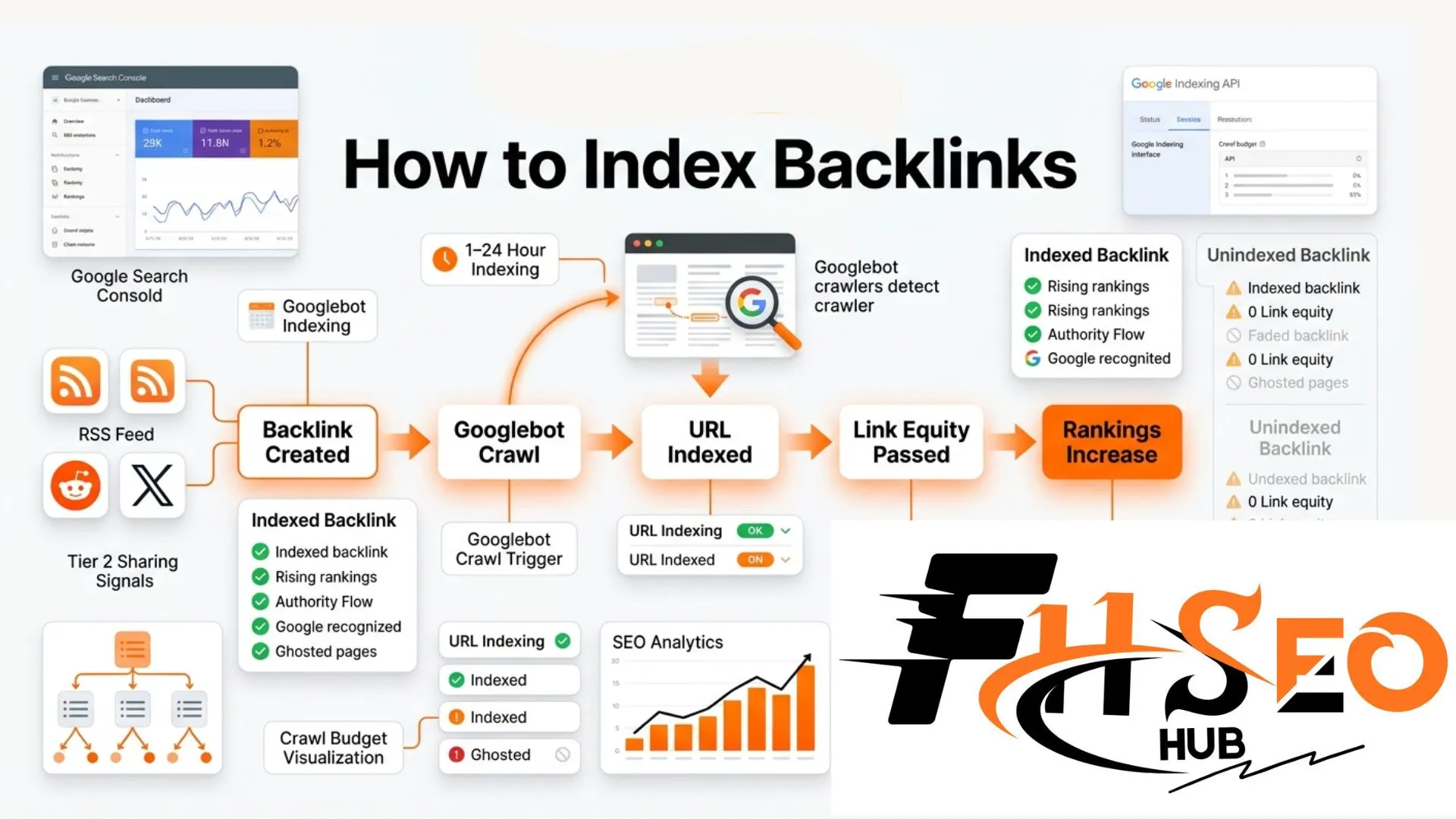
An unindexed backlink passes zero link equity to your site. Google does not treat it as pending. It treats it as irrelevant. To index backlinks effectively in 2026, build links on already-crawled pages, use Google Search Console, the Google Indexing API, IndexNow protocol, third-party indexers, RSS feeds, social sharing and Tier 2 linking.
Most SEOs never check whether their backlinks are even indexed. They build links, watch Ahrefs graphs, and wonder why rankings never move. That is the real problem this guide solves.
What does it mean when a backlink is indexed?
Indexing a backlink is not Google simply “adding a page.” Five specific actions must complete before your link counts for anything:
- Google discovers the URL where your link lives
- Googlebot crawls the page
- Google identifies your specific link
- The anchor text and placement get processed
- Ranking value connects to your domain’s trust graph
Until all five steps finish, your link is just text on a webpage. No link equity transfers. No authority flows and rankings move. A DR90 link on an uncrawled page delivers the exact same SEO value as a link on a DR5 page: zero.
Why does Google treat an unindexed backlink as irrelevant rather than pending?
Google does not hold a queue of pending backlinks. The index is binary: a page is either in it or not. If the referring page never gets crawled, no ranking value or trust flow gets assigned. There is no credit accrued in the meantime. An unindexed link is not a future asset. It is a present liability on your link-building budget.
Why are your backlinks not getting indexed?
Six core reasons explain why most backlinks fail to get indexed even on legitimate sites:
How do you build backlinks that get indexed without extra effort?
Prevention removes most indexing problems before they start. Before accepting any link placement, verify the referring page already exists in Google’s index using site:[URL] in Google Search. If the page appears, Googlebot visits that domain. If nothing shows, your link will likely face the same fate.
Sites that publish consistently, receive organic traffic, and maintain clean internal link structures get re-crawled automatically. Links on these pages often index within one to three days with no additional work required.
How do you force index a backlink using Google Search Console?
If you own or have verified access to the site where your backlink lives, this is the most direct method. Steps:
- Add the site to Google Search Console
- Open URL Inspection
- Paste the referring page URL
- Click Request Indexing
Googlebot typically visits within 24 to 72 hours. This works only for pages you control such as your own guest posts or Web 2.0 properties. The URL Inspection API allows up to 2,000 requests per day, making it significantly more scalable than the manual interface for high-volume campaigns.
How does the Google Indexing API index backlinks faster than GSC?
The Google Indexing API sends submitted URLs directly into a priority crawl queue that Googlebot processes within 1 to 24 hours. A URL_UPDATED notification goes out via HTTP request using a service account JSON key tied to a Google Cloud project. Most URLs appear in Google’s index the same day they are submitted.
This is faster than waiting for natural crawling, faster than the standard GSC URL Inspection, and far more scalable for link-building operations managing dozens of placements simultaneously.
Is using the Google Indexing API for backlink pages safe or against Google’s guidelines?
Officially, Google’s documentation restricts the Indexing API to pages with JobPosting or BroadcastEvent markup. In practice, the API processes all page types without penalties, GSC warnings, or footprints. Testing across thousands of domains in competitive verticals including ecommerce, SaaS, and affiliate sites confirms this. Google acknowledges this gray zone without actively penalizing it. The practical rule: submit quality pages only and avoid thin content or spam submissions.
What is the IndexNow protocol and how does it help with indexing?
IndexNow is a free, open protocol developed by Microsoft and Yandex that notifies search engines the moment a URL is published or updated. Unlike the Google Indexing API, IndexNow requires no Google Cloud setup, carries no submission limits and processes URLs instantly for Bing and Yandex.
The effective strategy combines both: Google Indexing API for Google and IndexNow for Bing and Yandex simultaneously. Plugins like CrawlWP and platforms like Sight AI automate IndexNow pings alongside sitemap updates, creating zero-effort multi-engine indexing coverage for every backlink page.
Which third-party backlink indexing services work in 2026?
Third-party indexers combine Google Indexing API access, social signals, tiered traffic and RSS pings to trigger Googlebot visits on pages you do not own.
| Tool | Best For | Methodology | Risk Level |
| Omega Indexer | Volume and safety balance | API + signals | Low |
| Indexceptional | Premium quality links | Multi-method | Low |
| Indexification | Natural-looking submissions | Drip-feed over days/weeks | Very Low |
| SpeedLinks VIP | Speed at affordable cost | API-focused | Low |
| Link Centaur | Tier 2 link indexing | Tiered signal building | Low |
| IndexInject / IndexMeNow | One-off submissions | API-based | Low |
Indexification’s drip-feed methodology spaces submissions over days and weeks to mimic organic discovery patterns rather than submitting hundreds of backlinks simultaneously. This looks far more natural to Google than a sudden submission burst.
How do RSS feeds and social sharing trigger Googlebot to crawl backlinks?
RSS feeds work because Google monitors active feeds for content changes. Submit your RSS feed to Feedburner, Feedage, or Ping-o-Matic and Google gets pinged that new content exists. If your backlink URL appears in that feed, Googlebot visits within 24 to 72 hours.
Social sharing works because Reddit and Twitter/X get crawled by Googlebot in near real-time. The indexing power order is: Reddit > Twitter/X > Facebook > Pinterest > LinkedIn.
What makes Reddit the most effective social platform for backlink indexing?
Reddit threads rank in Google Search themselves and get crawled constantly. When you share a referring page URL naturally inside a relevant Reddit thread rather than dropping a naked link, Googlebot discovers it through its regular Reddit crawl within hours. Google and Twitter/X have maintained a real-time indexing partnership since 2015, so Twitter/X threads referencing your backlink page also generate fast crawl responses.
How does Tier 2 linking fix stubborn backlinks Google keeps ignoring?
When Google ignores the page where your Tier 1 backlink lives, point links at that referring page rather than your own site. Three practical Tier 2 moves:
You are not building Tier 2s for link juice. You are building them to trigger crawl interest. Once Googlebot sees indexed pages pointing to your backlink’s home, it crawls it.
How do you check if a backlink is indexed and monitor at scale?
To check a single backlink, run site:[referring page URL] in Google Search. If the page appears, it is indexed. If nothing shows, the link is ghosted.
| Tool | Use Case | Scale | Cost |
| Google site: operator | Single URL check | One at a time | Free |
| Google Search Console | Crawl status and errors | Your own sites | Free |
| Ahrefs (Live Links filter) | Pull referring URLs | Hundreds/thousands | Paid |
| IndexCheckr | Bulk index status checking | Large scale | Low cost |
| Scrapebox | Automated bulk checks | Very large scale | One-time |
| URL Profiler | Combined SEO + index metrics | Agency level | Paid |
Track every backlink in Airtable or Google Sheets with columns for URL, date built, indexed status, tier level, indexing method used, and current status. Run a quarterly audit to catch ghosted links before they drain your link-building budget indefinitely.
How long does it take for different backlink types to get indexed?
| Link Type | Avg. Index Time | Best Method | Notes |
| Contextual guest post (DR40+) | 1-3 days | Natural crawl | Already crawled regularly |
| Niche edit on aged blog | 3-10 days | GSC + social share | Faster with social push |
| Web 2.0 blog (new) | 5-30 days | RSS + pinging | Needs content around the link |
| Forum profile link | Never | Skip entirely | Consistently ignored by Google |
| Tier 2 blogspot to guest post | 7-14 days | Pinging + RSS | Boosts Tier 1 indexing |
| Google Indexing API submission | 1-24 hours | API | Priority crawl queue |
Research shows 83% of pages get indexed within the first week. The remaining 17% may never index without active promotion. If your links fall in that 17%, waiting longer will not change anything. Switch methods.
What backlink indexing tactics are completely dead in 2026?
Stop using these immediately:
The core takeaway
When you index backlinks proactively, every link-building dollar works. Unindexed links are not a delay. They are a total loss until fixed. Start with a site: operator check on your ten most recent backlinks today. If any are ghosted, apply the Google Indexing API for pages you control and a tool like Omega Indexer for everything else.


