
What Is Keyword Difficulty? What is Difference between High KD and Low KD

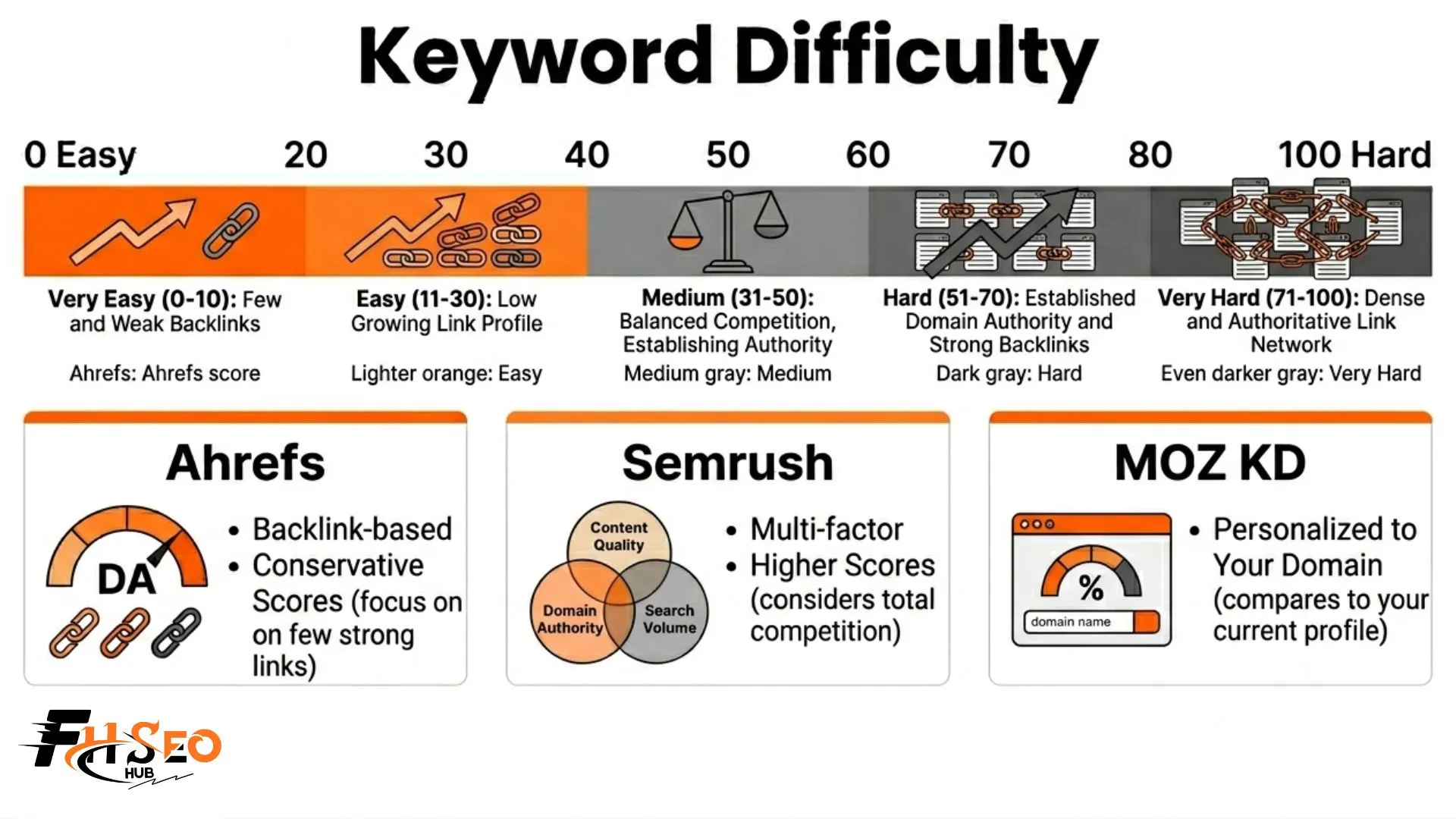
Keyword difficulty (KD) is an SEO metric that estimates how hard it is to rank on page one of Google for a specific keyword. Expressed on a 0-100 scale, it synthesizes signals like backlink profiles, domain authority and SERP features from pages currently ranking at the top. A score of 0 means almost no competition. A score of 100 means the toughest competition on the web.
Most SEOs pick keywords based on search volume alone. That is the mistake that keeps websites stuck on page three indefinitely. Knowing the difficulty before targeting a keyword is what separates strategic SEO from random content publishing.
What is keyword difficulty in SEO?
Keyword difficulty is a composite SEO metric that estimates how challenging it is to earn a page-one organic ranking for a specific search query. It does this by analyzing the strength of the pages currently sitting in the top 10 positions and asking: how hard would it be to displace them?
The score runs from 0 to 100. Turn it toward 0 and you are looking at topics with almost no authoritative competition. Turn it toward 100 and you are looking at some of the most contested search terms on the web, dominated by publishers who have spent years building authority in their spaces.
What makes KD a composite metric is that it does not rely on a single signal. It pulls together multiple factors about the current page-one landscape including backlink profiles, domain authority, SERP features and content quality signals, then synthesizes them into one number you can use to make prioritization decisions during keyword research.
Is keyword difficulty the same as keyword competition?
No. These two terms confuse many beginners. Keyword difficulty measures how hard it is to rank in organic search results. Keyword competition is a separate metric found in Google Keyword Planner that measures how competitive the paid search auction is for a keyword among advertisers bidding for placement. A keyword can have low difficulty (easy to rank organically) while simultaneously carrying high keyword competition (expensive to bid for in Google Ads). Never use these terms interchangeably when building your SEO or PPC strategy.
What do the different KD score ranges mean?
Knowing the score is only half the work. Knowing what that score means for your specific site is the other half.
| KD Score | Difficulty Level | Who Can Target | Typical Context | Recommended Strategy |
| 0–10 | Very Easy | Any site, any age | Niche topics, new categories | Target immediately for new sites |
| 11–30 | Easy | New and mid-authority sites | Low-competition niches | Low-hanging fruit targeting |
| 31–50 | Medium | Established sites with some authority | Competitive niches | Topic cluster building |
| 51–70 | Hard | Strong-authority sites | High-demand categories | Long-term content investment |
| 71–100 | Very Hard | High-authority, well-established sites | Dominant industry terms | Enterprise or multi-year strategy |
The right tier for your site depends entirely on your current domain authority. A site with strong authority and hundreds of referring domains can target medium and hard keywords effectively. A site that launched six months ago should live almost entirely in the 0-30 range until topical authority builds naturally through consistent publishing and link acquisition.
How do SEO tools calculate Keyword difficulty scores?
Every major tool calculates KD differently because no standardized formula exists across the industry. What they share is a common starting point: they all analyze the backlink profiles and domain authority of pages currently ranking in the top 10 for a keyword. The stronger those pages are in terms of referring domains and authority scores, the higher the KD score becomes.
But the similarity ends there. The calculation diverges significantly between platforms, which is exactly why the same keyword can produce wildly different scores depending on which tool you check.
Why does Ahrefs show a different KD score than Semrush for the same keyword?
Ahrefs KD is primarily based on the median number of referring domains linking to the top-10 ranking pages, making it a backlink-centric calculation that tends to produce more conservative scores. Semrush KD% factors in broader signals including domain authority scores, SERP features presence, dofollow and nofollow link ratios and estimated click patterns, which typically produces higher scores for the same keyword. Neither is more accurate. They measure the same competitive landscape through different lenses.
| Tool | Primary Calculation Method | Score Format | Score Tendency | Key Limitation |
| Ahrefs | Median referring domains to top-10 pages | 0–100 | More conservative | Heavily backlink-dependent |
| Semrush KD% | Referring domains + authority scores + SERP features + click patterns | 0–100% | Higher scores | Varies by regional data |
| Semrush PKD% | Your domain’s authority vs currently ranking pages | 0–100% (site-specific) | Personalized | Paid plan only |
| Moz | Page authority + domain authority of top-10 | 0–100 | Mid-range estimates | Based entirely on Moz metrics |
The most reliable approach is you need to check the same keyword in Ahrefs and Semrush and treat the range between their scores as your practical difficulty estimate rather than fixating on either number alone.
Why are backlink-only KD scores becoming less reliable?
The dominant criticism of most keyword difficulty tools is that they rely almost entirely on backlink profiles to calculate their scores. But backlinks no longer carry the weight they once did.
Google’s John Mueller has publicly stated that the weight of backlinks as a ranking factor is expected to decrease over time as search engines get better at understanding how content fits within the context of the wider web. Tools built exclusively on referring domain counts increasingly miss the full picture of what page-one ranking actually requires in 2026.
Content quality signals, SERP volatility, topical authority, and historical SERP behavior all influence whether a page can earn and hold a top position. A KD score built from backlink data tells you how many links the current top pages have. It does not tell you whether your content could earn that position through superior quality, better intent matching, or stronger topical relevance. Use KD scores as a starting estimate, not a final judgment on ranking potential.
What factors should you manually analyze to assess ranking difficulty?
When a KD score alone does not give you enough confidence to make a keyword decision, manual SERP analysis fills the gap. Six factors to review across the top 10 results:
Manual analysis takes longer but reveals opportunities that standardized KD scores miss, especially for SERP features you could win with the right content format.
How do you use KD scores to build a smarter content strategy?
Use keyword difficulty as a filter, not a final verdict. The goal is to find the intersection of manageable difficulty, sufficient search volume, and matching search intent for your content goals.
A practical prioritization approach:
This compound approach allows new sites to win easy keywords quickly, build credibility through topical depth, and eventually compete for the harder and higher-traffic terms that were unreachable at launch.
What keyword difficulty should a brand new website target?
A brand new website should target KD scores below 20 initially. These keywords typically carry lower search volume but face minimal organic competition, making page-one rankings achievable within weeks rather than months. Focus on long-tail keywords with informational search intent where the top-ranking pages show low domain authority and weak backlink profiles. Expand your target difficulty range upward as domain authority builds through consistent content and earned links.
How does keyword difficulty relate to search volume and CPC?
KD, search volume and CPC each measure a different dimension of keyword value and none of them alone tells the full story.
| Metric | What It Measures | Where to Find It | Use Case |
| Keyword Difficulty (KD) | How hard to rank organically | Ahrefs, Semrush, Moz | Keyword prioritization and effort estimation |
| Search Volume | Monthly search frequency for the keyword | All keyword tools | Traffic potential assessment |
| CPC | Cost per click in Google Ads | Google Keyword Planner, Semrush | Commercial intent and ROI indicator |
| Domain Authority (DA/DR) | Your site’s overall link authority | Moz, Ahrefs | Benchmark your chances against KD score |
| Keyword Competition | Advertiser competition in paid search | Google Keyword Planner | PPC planning only |
The most valuable keywords for SEO balance manageable difficulty with sufficient search volume and strong enough CPC to indicate real business value. A keyword with KD of 15 but search volume of 50 and CPC of $0.10 is easy to rank for but unlikely to drive meaningful traffic or revenue. Look for the intersection of all three metrics when prioritizing, not just the lowest difficulty score available.
The core takeaway
Keyword difficulty is one of the most useful filters in SEO when you know how to read it and one of the most misleading when you take it at face value. Use it as a starting point for prioritization, not a final verdict on ranking potential. Check scores across multiple tools, layer in search volume and search intent analysis and validate the SERP manually before committing content resources. The practical next step is opening your preferred keyword tool, filtering your keyword list to KD under 30 and identifying the three most relevant opportunities for your site this week.


