
What Is Topical Authority in SEO? Definition, Google Signals and Why It Matters

Picture two websites in the same niche. Site A publishes 40 blog posts covering marketing, travel, personal finance and fitness. It has decent backlinks and a respectable domain rating, but it ranks for almost nothing consistently. Site B publishes 35 carefully interconnected articles about one topic: home security for homeowners. Within eight months, Site B dominates the first page for nearly every home security keyword, outranking national brands with budgets ten times larger.
The difference between these two sites is topical authority.
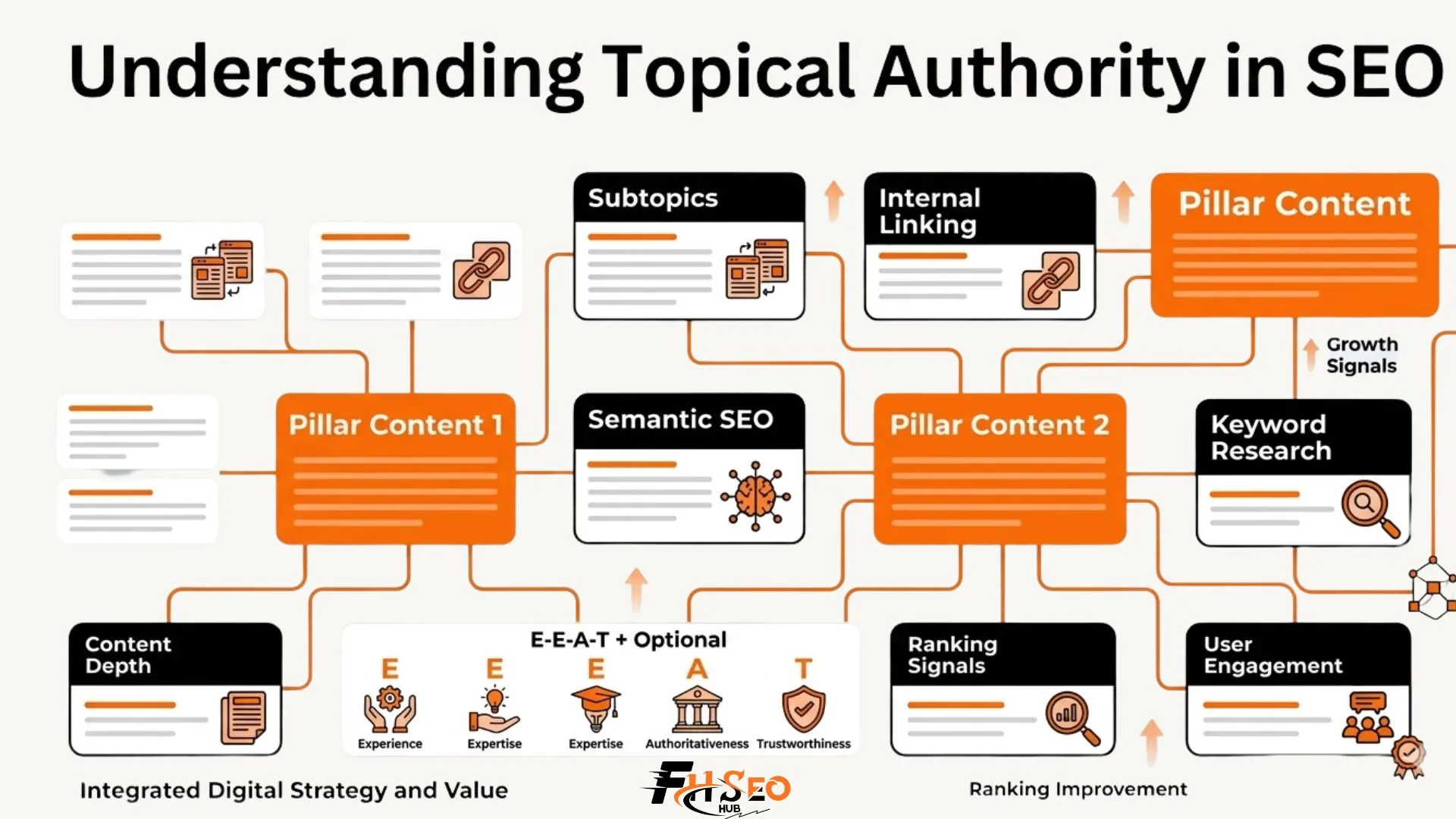
Topical authority is the state of being recognized by Google as the most comprehensive, trustworthy source on a specific subject. It is not a single number you can check in a dashboard. It is the accumulated signal Google receives when your entire website demonstrates depth, consistency and expertise across one clearly defined topic area.
In this guide, you will learn what topical authority actually means in plain language, why a site with a low domain rating can outrank major brands, how Google measures it through E-E-A-T signals, how it connects to keyword research without replacing it, and why it matters more in 2026 than at any previous point in SEO history.
What is topical authority in SEO?
Topical authority is an SEO concept where a website becomes the definitive source on a specific topic by covering that topic more comprehensively and consistently than any competitor. When your site addresses every meaningful subtopic, answers every common question, and connects all those pieces through strategic internal linking, Google begins to recognize your domain as a subject matter expert in that area.
The core principle is straightforward. You build topical authority by covering a subject comprehensively rather than targeting isolated keywords. That means addressing the full breadth of a topic, answering every subtopic your target audience searches for, and structuring all that content in a way that makes your expertise impossible for Google to miss.
Topical authority is about choosing a focused niche and then going deeper into that niche than anyone else has gone before.
Topical authority vs keyword targeting: what changed?
For most of SEO’s history, keyword targeting was the dominant strategy. You wanted to rank for “protein powder”? You wrote an article optimized for “protein powder.” You wanted to rank for “how to start a blog”? You wrote one article targeting that exact phrase. The relationship between a keyword and a piece of content was relatively direct, and Google matched search queries to pages primarily through keyword presence.
That approach no longer works in isolation. Google’s algorithm has evolved dramatically over the past decade.
In 2013, Google’s Hummingbird algorithm shifted rankings from pure keyword matching to query relevance. Google began understanding the intent behind a search, not just the words in it. In 2019, the BERT model allowed Google to understand contextual relationships between words and concepts in natural language. In 2021, MUM expanded this further, enabling Google to process and connect information across topics in ways that had previously been impossible.
Google no longer evaluates a single page against a single keyword. It evaluates the entire website’s expertise, depth and consistency across a topic area. A website that covers every angle of home security is more likely to rank for “best outdoor security cameras” than a website with one well-optimized article on the same query, even if that single article is technically excellent.
What is semantic SEO and how does it connect to topical authority?
Semantic SEO is the practice of structuring and creating content around the meaning and relationships between concepts rather than individual keyword strings. If traditional keyword SEO asks “what words are people typing?”, semantic SEO asks “what do those words actually mean and what related concepts and questions surround them?”
The connection to topical authority is direct. Semantic SEO is the mechanism. Topical authority is the outcome.
When you practice semantic SEO, you identify the semantic cluster surrounding your topic, create content that covers every meaningful concept within that cluster, and connect those pieces with intentional internal linking. This signals to Google, through its Knowledge Graph and entity recognition systems, that your website understands a subject at a conceptual level, not just a keyword level.
For example, if you run a personal finance website and want topical authority in budgeting, semantic SEO tells you to cover not just “how to create a budget” but also: envelope budgeting, zero-based budgeting, budget apps for beginners, budgeting for variable income, common budgeting mistakes, and how to stick to a budget long-term. Each piece covers a semantically related concept. Together they form a comprehensive picture of your expertise in budgeting that search engines can confidently assess.
Topical authority vs domain authority: what is the difference?
What is domain authority and who created it?
Domain authority (DA) is a metric created by Moz, a third-party SEO software company. It was designed as a predictive score, typically ranging from 1 to 100, that estimates how likely a website is to rank in search results based primarily on its backlink profile.
Domain Rating (DR) is Ahrefs’ equivalent metric. While Moz and Ahrefs use different calculations, both metrics are fundamentally built around the same concept: the more authoritative websites that link to your domain, the stronger your overall site authority score.
Key differences: how each is measured
The distinction between domain authority and topical authority is fundamental to modern SEO strategy.
| Factor | Domain Authority (DA) | Topical Authority |
| What it measures | Overall backlink strength and site age | Depth of expertise on a specific topic |
| Who measures it | Moz and Ahrefs (third-party tools) | Google’s internal algorithm |
| How it is built | Earning backlinks from authoritative websites | Publishing comprehensive, interconnected content on one topic |
| Influence on rankings | General across all topics | Specific to your niche and related queries |
| Can a lower-scoring site outrank a higher-scoring site? | Rarely | Yes, consistently with deep topic coverage |
| Time to build | Years of consistent link acquisition | 8-12 weeks for first measurable gains |
| 2026 importance | Declining as sole ranking signal | Rising, especially for AI-driven search |
The core difference: domain authority tells you how trusted your site is in general, based on who links to you. Topical authority tells you how expert your site is on a specific subject, based on how deeply and consistently you cover it.
Topical authority examples
Understanding topical authority becomes much clearer when you see how it plays out in real competitive SERPs.
The mountain bike gifts example: A website called twowheeledwanderer.com, with a Domain Rating of 23, ranked above Amazon (DR 96) for the keyword “mountain bike gifts.” The reason is not a technical SEO advantage or a superior backlink profile. It is topical authority. The entire site focuses on the topic of bikes. Amazon sells everything, which means its topical relevance to cycling is diluted across millions of product categories. The niche site wins because Google associates it specifically and deeply with the mountain biking topic.
The protein powder example: A dedicated health and fitness blog targeting the protein powder niche covers not just “protein powder” but every connected subtopic: what is protein powder, how much protein do you need, what is the best protein for weight loss, how long does protein powder last, can you bake with protein powder, best protein powder for beginners. Each of these articles individually earns traffic, and together they reinforce the site’s authority on the protein topic. A general health website that published one article on protein powder cannot compete with this level of coverage.
The property management example: A focused real estate blog publishing 50 systematically interconnected articles on property management can outrank national real estate portals for property management queries. The national portal has higher domain authority but spreads its content across every real estate topic. The focused blog covers only property management and covers it completely.
The AI citation case study: One eCommerce site focused on meal planning and nutrition guidance built a systematic topical authority content cluster and earned 169 AI citations across ChatGPT, Perplexity and Google AI Overviews within the content’s first year of publication. This demonstrates that topical authority in 2026 extends beyond Google’s traditional organic results into AI-generated answers, making it one of the most durable investments in digital visibility available.
These examples share a consistent pattern that is the winning site covers its niche more completely, connects its content more deliberately, and satisfies the specific search intent of its audience more thoroughly than any general competitor can.
How does topical authority affect Google rankings?
How Google rewards sites that cover a topic deeply
When Google evaluates search results for a query, it does not only examine the page you published for that keyword. It examines your entire site’s relationship with the surrounding topic.
This happens because of how Google processes information through its semantic search systems. With Knowledge Graph integration, the Hummingbird shift, BERT’s contextual understanding, and more recently AI-driven quality evaluation systems, Google has developed a sophisticated understanding of how topics, subtopics and concepts relate to each other.
When your site comprehensively covers a topic including subtopics, related questions, foundational concepts and practical applications, several things happen simultaneously:
Can topical authority help a niche website rank faster?
Yes. This is one of the most underutilized advantages in SEO for smaller publishers and independent sites.
Niche websites have a structural advantage that large general websites cannot easily replicate. By focusing deeply on a narrow subject, a niche site achieves comprehensive topical coverage faster and more efficiently than a large site producing content across dozens of unrelated categories.
A SaaS website publishing systematically about one category of software problems can outrank general technology publications. An eCommerce store publishing deeply researched buying guides in a single product category can outrank major retailers in that category. A blog focused entirely on personal finance for freelancers can outrank major financial publications for freelancer-specific queries.
The benchmark for a meaningful topical cluster is 25 to 30 well-interconnected articles covering all subtopics and questions within a focused subject area. Most sites start seeing measurable organic gains within 8 to 12 weeks of publishing a complete, well-linked content cluster.
How does Google measure topical authority? E-E-A-T explained
Google has published a framework that its human Quality Raters use to evaluate content quality: E-E-A-T, which stands for Experience, Expertise, Authoritativeness and Trustworthiness. While E-E-A-T is not a direct algorithmic ranking factor in the way a technical setting would be, it represents the qualities Google’s algorithms are designed to recognize and reward across a site’s content.
Experience refers to first-hand, lived engagement with the topic. A review of a hiking boot written by someone who has actually hiked in those boots demonstrates experience. A product comparison written by someone who has personally tested the items carries more weight than one assembled from secondary sources. Google looks for signals of genuine experience in content, not just research synthesis of what others have already written.
Expertise refers to demonstrated knowledge and skill in a subject. This matters especially for topics that affect people’s health, finances, safety, or major life decisions. These are what Google calls YMYL (Your Money or Your Life) topics, where getting the information wrong has real consequences. A finance article written by a certified financial planner demonstrates expertise differently than one written by a general content writer.
Authoritativeness refers to your recognized reputation in a field. It is measured not only by what you say about yourself, but by what others say about you: backlinks from authoritative sources in your niche, mentions in respected publications, and citations by credible organizations all contribute to authoritativeness signals.
Trustworthiness refers to the overall reliability and honesty of your website and its content. Clear authorship, accurate sourcing, updated information, transparent business practices, and a secure website all contribute to trustworthiness signals that Google’s Quality Rater Guidelines specifically call out.
How E-E-A-T connects to topical authority
E-E-A-T is the lens through which Google evaluates authority. Topical authority is what you build when you satisfy those E-E-A-T signals consistently across many pieces of content within a focused topic.
One great article demonstrates expertise. Twenty great, interconnected articles on the same topic, each demonstrating experience, expertise, authoritativeness and trustworthiness, builds topical authority.
This is why topical authority cannot be built with a single piece of content, no matter how well written or well optimized. It is an accumulation effect. Each content piece you publish within a topic contributes an E-E-A-T signal. As those signals accumulate across your domain within a specific subject area, Google’s assessment of your authority on that topic strengthens progressively.
This connection extends to AI-driven search. ChatGPT, Perplexity and Google AI Overviews increasingly cite sources that demonstrate consistent expertise and comprehensive coverage. A site with 35 well-structured articles on cybersecurity for small businesses is far more likely to be cited in AI-generated answers about cybersecurity than a site with one well-ranked article on the same topic. In 2026, E-E-A-T signals across a topic cluster directly influence AI citation probability, not just traditional organic rankings.
What on-page signals tell Google you are an authority?
Beyond the overall E-E-A-T framework, Google evaluates specific on-page and on-site signals that indicate topical authority:
- Named authors with demonstrable expertise: Author bios that link to credentials, published work, or professional profiles signal that real knowledge stands behind the content rather than anonymous publishing
- Original insights and first-hand information: Content that includes unique data, proprietary research, original case studies, or clearly documented personal experience carries more E-E-A-T weight than content that only repackages what competitors have already written
- Citations of credible external sources: Linking to and citing authoritative external sources such as academic research, government data, and recognized industry publications signals that your content participates in the broader knowledge conversation
- Content freshness and accuracy: Regularly updating content to reflect current information signals ongoing expertise and active engagement with the topic
- Structured internal linking: A clear, logical internal link structure between pillar content and cluster articles signals to Google that your content reflects genuine expertise rather than disconnected keyword targeting
- Comprehensive subtopic coverage: If your site covers every meaningful question, angle, and subtopic within a niche, Google builds a stronger confidence score around your topical relevance for that subject
Does topical authority replace keyword research?
Topical authority does not replace keyword research. It changes the order of operations and the purpose of keyword research fundamentally.
In the traditional approach, keyword research was the starting point. You identified which keywords had search volume, evaluated their competition and built content specifically to rank for those phrases. The keyword was the destination and the content was the vehicle.
That approach still produces some results. But it creates a ceiling. Sites built purely on keyword-by-keyword targeting tend to have disconnected content that Google cannot easily associate with genuine subject expertise. Each article performs as well as its individual optimization allows, with no compounding benefit from the surrounding content.
How topical research and keywcord research work together
Topical research and keyword research serve different purposes in a modern SEO content strategy, and they produce the best results when used in sequence.
Topical research asks: what is the full scope of this subject? What does someone need to understand it thoroughly? What questions arise at every stage of a person’s relationship with this topic?
Keyword research then answers: what specific phrases do people use when searching for answers to those questions, and how much search volume does each phrase carry?
When you lead with topical research, keyword research becomes more targeted and more effective. Instead of finding high-volume keywords and building content around them, you identify the topics your audience genuinely needs, map out the content structure required to cover them comprehensively, and then use keyword data to ensure each piece targets the way real people search for that specific subtopic.
Topical research also solves the problem of content gaps. Many keyword-first content strategies produce uneven coverage: strong content where high-volume keywords exist, and no content in adjacent areas that matter to the audience but carry lower search volume. Topical authority requires filling those gaps. Keyword research then helps you prioritize which gaps to fill first based on search demand.
The right workflow: topic-first, keyword-second
The practical workflow that integrates topical authority with keyword research looks like this:
- Choose a focused niche. Define a clear semantic boundary around the topic you want to own. Be specific: not “fitness” but “strength training for people over 50.”
- Map the topic completely. Identify every subtopic, every common question, every related concept, and every stage of your audience’s understanding of this subject.
- Do keyword research for each subtopic. Use tools like Ahrefs Keywords Explorer, Semrush, or Google Search Console to find the specific phrases people use when searching for each mapped subtopic.
- Assign search terms to content pieces. Each piece of content targets one primary keyword but is written to satisfy the full semantic scope of that subtopic, not just the exact phrase.
- Build the content cluster. Publish the pillar page first, then the supporting cluster articles, connecting all of them through intentional internal linking with descriptive anchor text.
- Measure and fill gaps. Use the Ahrefs traffic share by domains method (developed by Kevin Indig) to identify areas where competitors earn topical traffic your site does not yet address. Fill those gaps systematically.
The keyword-first approach limits you to what search tools confirm is already popular. The topic-first approach expands your coverage to what your audience actually needs, then uses keyword tools to ensure that coverage is discoverable. Topical authority is not a replacement for keyword research. It is the strategic framework that makes keyword research more purposeful and more powerful.
Conclusion
Topical authority means becoming Google’s most trusted source on a specific subject by covering that subject more completely and consistently than anyone else. It is why a DR 23 niche cycling website outranks Amazon for mountain bike gift queries. It is why a focused property management blog outranks national real estate portals. And in 2026, it is why sites with deep topical coverage earn citations from AI systems like ChatGPT and Google AI Overviews, while general content hubs get passed over.


