What Is Holistic SEO? Guide to Ranking Your Entire Website

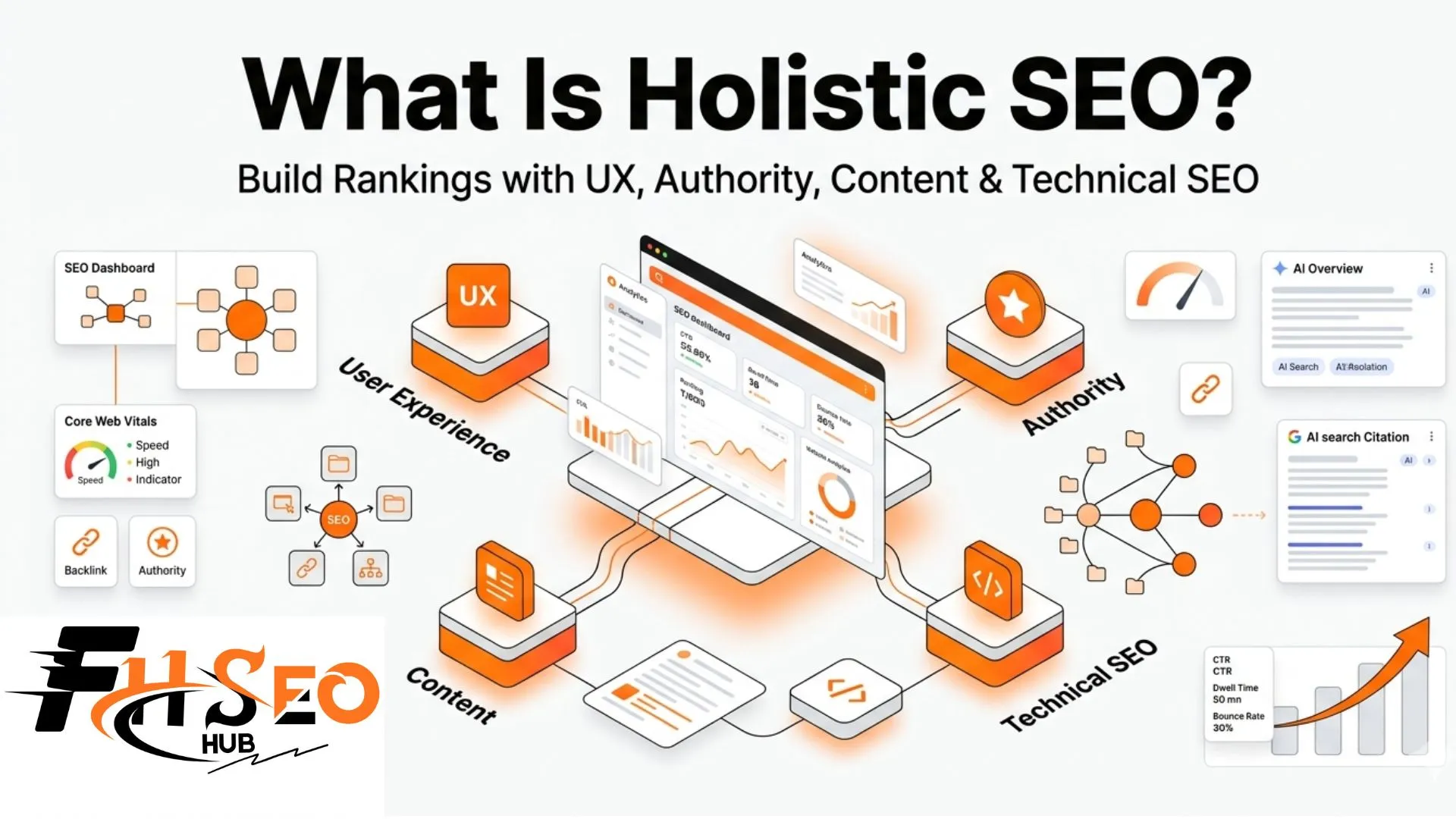
Holistic SEO is a complete approach to search optimization that treats your entire website as a connected system rather than a collection of isolated tactics. Instead of fixing individual keywords or pages, it strengthens four interconnected pillars: User Experience, Authority, Content and Technical SEO. Together, these pillars build stable, compounding rankings that survive every algorithm update.
What is holistic SEO?
Holistic SEO solves that compounding problem. It is an all-around search optimization strategy that improves your entire digital ecosystem rather than chasing single keyword rankings. Every improvement you make under this approach should strengthen at least two other areas of your strategy simultaneously.
Eric Ritter, President and Founder at Digital Neighbor, described this problem from real audit experience: “We often find their technical team fixed site speed issues, their content team published great blog posts, and their PR team earned backlinks, but nobody ensured these efforts were reinforcing each other. The blog posts aren’t linking to key service pages. The fastest pages aren’t the ones driving revenue. The backlinks point to outdated content.”
That siloed reality is the specific problem this approach was designed to fix.
What is the XACT SEO framework?
The XACT SEO framework, introduced by Search Atlas, is the clearest named structure for this approach. XACT stands for User Experience (X), Authority (A), Content (C) and Technicals (T). These four areas represent the core dimensions Google uses when evaluating and ranking websites. Each pillar supports the others, meaning a weakness in one area simultaneously reduces the effectiveness of all three remaining pillars.
How is holistic SEO different from traditional SEO?
Traditional SEO isolates tactics. A content team writes, a technical team optimizes, a PR team builds links, but these efforts never connect or compound. This approach connects every effort so each optimization makes the next one more effective.
| Factor | Traditional SEO | Holistic SEO |
| Focus | Individual keywords and pages | Entire website as a connected system |
| Team approach | Siloed, content, tech, PR separate | All efforts reinforcing each other |
| Algorithm vulnerability | High (single-tactic sites suffer) | Low (multiple strong trust signals) |
| Time to stable rankings | Short bursts then drops | 3-6 months building then compounds |
| AI search visibility | Limited | High (authority + structure = AI citations) |
| Long-term outcome | Volatile, unpredictable rankings | Compound, algorithm-resistant growth |
The compounding effect is the real argument for this model. SEO delivers 702% ROI over three years when executed as a connected, consistent system. That result only happens when all four pillars work together rather than in isolation.
What are the four pillars of Holistic approach?
| Pillar | What It Covers | Key Signals |
| User Experience (UX) | CTR, dwell time, bounce rate, Core Web Vitals | Time on page, pogo-sticking rate, CWV scores |
| Authority | Backlinks, E-E-A-T, brand mentions, author verification | Domain Authority, referring domains, branded searches |
| Content / Topical Coverage | Topic clusters, intent alignment, content freshness | Cluster rankings, content gap coverage, content decay |
| Technical SEO | Crawlability, schema, page speed, LLM access | Crawl errors, LCP, CLS, indexed pages, schema coverage |
Each pillar feeds the others. Better UX lowers bounce rate, which strengthens engagement signals that confirm your authority. Stronger authority earns better backlinks to your topic clusters. Clean technical health ensures search engines and AI systems can access all of that effort and credit it to your site.
How does the User Experience pillar affect rankings?
User experience is how Google verifies that your content satisfied the searcher. Google’s Navboost system and Real-Time Engagement (RTE) system track measurable user behaviors to adjust rankings in real time.
The key UX signals Google monitors:
Research from SEO Labs found that 90% of users will not return to a website after a bad experience. Google reads every departure as a ranking signal. Core Web Vitals formalize this measurement: Largest Contentful Paint (LCP) for load speed, Cumulative Layout Shift (CLS) for visual stability, and Interaction to Next Paint (INP) for responsiveness.
How does the Authority pillar work?
Authority is not a single number in a dashboard. It is the overall credibility and trustworthiness your site demonstrates across multiple signals simultaneously.
Google evaluates authority through the E-E-A-T framework: Experience, Expertise, Authoritativeness and Trustworthiness. Building authority requires consistent work across several areas:
How does topical coverage build long-term authority?
Topical authority builds when your site comprehensively covers a subject through topic clusters and pillar pages rather than publishing isolated articles around random keywords. The hub and spoke model structures this: a central pillar page covers a broad topic in depth, and supporting cluster articles expand on every specific subtopic.
Google reads this connected structure as evidence of genuine expertise. AI search engines use it to identify authoritative sources for a topic area. Content freshness matters here too. When cluster content decays without updates, both traditional rankings and AI citation probability decline over time.
How do topic clusters replace traditional keyword strategies?
Rather than isolated keyword-focused blog posts, topic clusters build semantic authority. A pillar page on a broad subject links to cluster articles on every related subtopic, each page reinforcing the others. Google’s NLP systems and LLM crawlers recognize this as comprehensive coverage of a subject. In 2026, this is also the primary mechanism through which content earns citations in Google AI Overviews and other generative search results.
What does the Technical SEO pillar cover?
Technical SEO ensures search engines and AI agents can fully access, crawl, render and understand your site. Without a clean technical foundation, the work you do across UX, authority and content pillars never reaches full ranking potential.
The core technical areas to keep healthy:
How does this approach connect to Google AI Overviews?
In 2026, with 16.4 billion daily searches happening on Google and AI-generated summaries appearing above organic results for a growing share of queries, being cited in those summaries requires exactly the signals that a connected four-pillar strategy develops.
Google AI Overviews, ChatGPT, Gemini and Perplexity all evaluate:
What is Generative Engine Optimization and how does it connect?
Generative Engine Optimization (GEO) is the practice of structuring content so AI search engines select it when generating answers. The same four pillars that earn traditional rankings also signal to AI systems that your brand is a trustworthy, comprehensive source. Entity recognition, structured data and topical authority are the most direct bridges between a well-executed connected SEO strategy and AI citation visibility.
What mistakes prevent this strategy from working?
The most common failure is continuing to optimize in silos even after committing to a connected approach.
| Mistake | What Happens | Fix |
| Optimizing in silos | Tech, content, and PR efforts never reinforce each other | Run connected audits that align all SEO efforts |
| Blog posts not linking to service pages | Authority stays siloed away from revenue pages | Add contextual internal links from blog to money pages |
| Backlinks pointing to outdated content | Wasted link equity going to irrelevant pages | Update content or redirect to current authoritative page |
| Fastest pages not driving revenue | Core Web Vitals wins benefit the wrong pages | Prioritize CWV improvements on commercial pages first |
| Chasing keywords over search intent | Rankings without clicks or conversions | Map every page to one clear search intent before publishing |
How do you measure success across all four pillars?
Use Google Analytics 4 (GA4) for user behavior and conversion data. Monitor technical health and indexation issues in Google Search Console. Track domain authority and referring domain growth in Ahrefs or SEMrush. Measure content performance through topic cluster rankings and content gap coverage over time.
The takeaway
Holistic SEO is not a trend. It is the only approach that produces compound, stable rankings because both search engines and AI systems evaluate your entire digital ecosystem, not isolated pages. The practical step is a connected audit that reveals where your four pillars are weakest and which single fix would simultaneously strengthen the most other areas of your strategy. Start there and let compounding do the rest.
Whenever we build backlinks at FHSEOHub we follow this approach according to the off-page point of view.


