
How to Maximize and Distribute Link Juice: Complete Strategy Guide

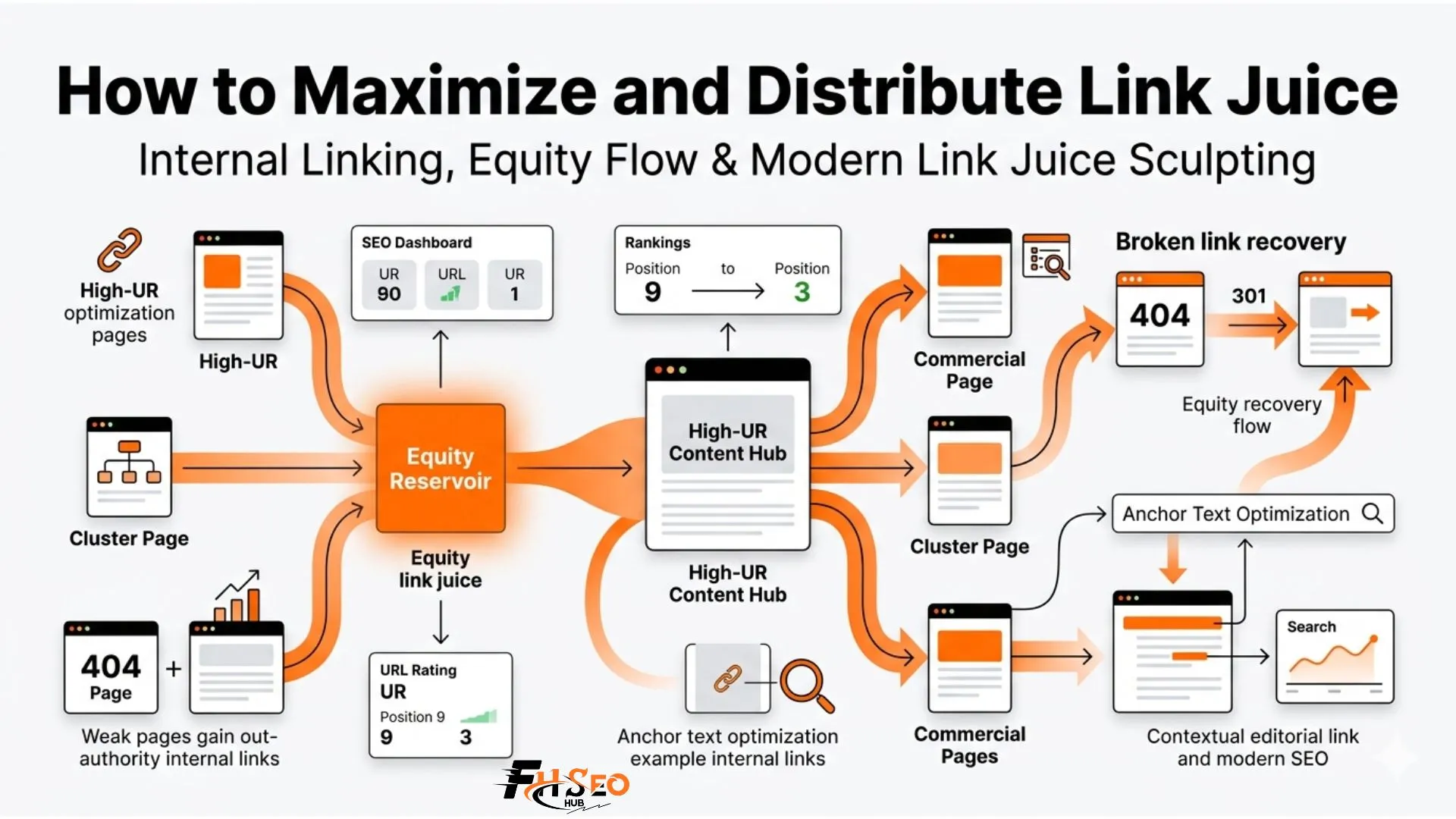
To distribute link juice effectively, identify your highest-authority pages as equity reservoirs, then add targeted internal links from those pages to the pages you want to rank higher. Most sites earn backlinks but never strategically direct where that equity flows, leaving high-value pages weak while low-value pages accumulate authority by accident.
Most sites have a link juice problem that has nothing to do with link building. They earn backlinks, those backlinks pass equity to various pages, and then nothing deliberate happens. The equity sits on whichever pages happened to attract links naturally, which is almost never a commercial page. High-value product pages, service pages and conversion-focused landing pages stay weak while blog posts and resource pages accumulate equity they barely need.
How to pass link juice to your most important pages
Passing link juice to priority pages requires three sequential steps: identify which pages need equity most urgently, find your highest-authority source pages and add internal links between them with deliberate anchor text.
Step 1: Identify which pages need more link juice most urgently
Open Google Search Console and filter your pages by average position. Pages currently ranking between positions 5 and 15 are your highest-priority targets. These pages already satisfy Google’s relevance criteria for their target queries. They need only a modest link juice boost to cross from page two to page one. A page in position 9 will respond to internal linking changes faster than a page in position 40 because Google already considers it relevant.
Step 2: Find your highest-authority pages to link from
Open Ahrefs Site Explorer and sort your site’s pages by URL Rating (UR). The pages with the highest UR are your equity reservoirs: pages that have accumulated strong link equity from external backlinks. These pages are your most powerful internal linking sources.
The commercial page problem is a real structural challenge that most guides ignore as a concept. High-authority external sites almost never link to product pages or pricing pages. They link to informational content. This means your equity reservoirs are almost always blog posts, guides, or research pages, not the commercial pages you most want to rank. Naming this problem is the first step to solving it through deliberate internal linking.
Equity reservoir mapping means systematically cataloging these high-UR pages alongside their current outbound internal links. When you audit your top twenty UR pages in Ahrefs and find that none of them link to your target commercial pages, that gap is your primary opportunity.
Step 3: Add targeted internal links with descriptive anchor text
Add two to three contextual internal links from your highest-UR pages to your target ranking pages. Use descriptive anchor text that reflects the target page’s primary keyword rather than generic phrases. The link should appear naturally within body content, not in a sidebar or footer.
One insight practitioners discover only after doing multiple audits: the anchor text on existing internal links ages invisibly. An internal link pointing to your commercial page with anchor text “our pricing” may have been added years ago before you refined your keyword strategy. Re-auditing anchor text on existing internal links from equity reservoir pages every quarter produces measurable improvements without adding any new links.
This three-step process produces ranking movement faster than any other tactic that requires zero new backlink acquisition. The next section ensures that every backlink you do earn delivers maximum juice to begin with.
How to maximize link juice from backlinks
Maximizing link juice from backlinks requires evaluating five factors beyond domain authority before pursuing any placement.
Why link placement on the linking page determines juice received
A link in the editorial body of a high-traffic article on a page with UR 50 and five outbound links passes more juice than a footer link on a low-traffic page from the same domain with UR 65 and eighty outbound links. Link placement, page-level authority, and outbound link dilution interact simultaneously. Evaluating only domain-level metrics misses the factors that determine what you actually receive.
How to prioritise backlinks that pass the most equity
When evaluating link opportunities, check five factors in this order:
- URL Rating (UR) of the specific linking page, not just the site’s Domain Rating (DR)
- Number of outbound links on that specific page (fewer is better)
- Whether the link will appear in editorial body content versus sidebar or footer
- Topical relevance between the linking page’s content and your target page’s topic
- Whether the anchor text is descriptive and reflects your target page’s subject
The role of topical relevance in maximizing juice transfer
Topical relevance between the linking page and your page amplifies how the transferred equity is interpreted by Google. A link from a specialist SEO publication to an SEO article passes stronger ranking signals for SEO-related queries than a link from an unrelated domain with a higher overall domain rating. In 2026, Google’s NLP systems measure the semantic relationship between linking and destination content. Building links from topically aligned sources multiplies the practical ranking value of each unit of equity you earn.
What is link juice sculpting and how to do it?
Link juice sculpting is the practice of deliberately controlling where link equity flows across your site. The original method (using nofollow tags on internal links) is obsolete. Modern sculpting uses structural architecture changes.
The original concept and why nofollow sculpting no longer works
The original link juice sculpting tactic involved adding rel=”nofollow” to internal links pointing to low-value pages (login pages, contact pages, tag archives) to concentrate PageRank on priority pages. This approach worked in the early 2010s when nofollow was a hard directive. Google’s 2019 update reclassified nofollow as a hint, meaning Google may still crawl and evaluate nofollowed internal links. Using nofollow on your own internal links to sculpt equity produces no reliable benefit in 2026.
What modern link juice sculpting looks like in 2026
Modern link juice sculpting works through three structural changes:
How to distribute link juice across a website
To distribute link juice effectively across a website, implement a hub-and-spoke internal linking architecture where pillar pages accumulate external backlink equity and cluster pages receive that equity through internal links.
The hub-and-spoke model for link juice distribution
Pillar pages are your equity hubs. They receive the most external backlinks and accumulate the highest URL Ratings on your site. Cluster pages are the spokes: topic-specific articles covering subtopics related to the pillar’s subject. The pillar links to each cluster. Each cluster links back to the pillar. This closed equity loop strengthens both the pillar and the cluster pages simultaneously.
How to audit where link juice is flowing right now
Open Ahrefs Site Explorer and export your pages sorted by URL Rating. Cross-reference that list with your pages sorted by referring domain count. If your highest-UR pages are not the pages you most want to rank commercially, your equity is pooling in the wrong places. Every high-UR page that lacks internal links to your target pages represents wasted distribution opportunity.
How to recover and reclaim lost link juice
Link juice recovery reclaims equity that already belongs to your site but is currently wasting through broken links, redirect chains, or unlinked brand mentions.
Finding and fixing broken internal and external links
Run a site crawl in Screaming Frog and filter for 4xx error pages. Every 404 page that has external backlinks pointing to it is a broken equity source. Implement 301 redirects from each broken URL to the most relevant live page on your site. According to Incremys (March 2026), Googlebot processes approximately 20 billion pages daily, meaning pages with broken incoming links compete at a structural disadvantage for re-crawl priority.
Using 301 redirects to recover equity from deleted pages
When you find 404 pages with referring domains in Ahrefs, prioritize the ones with the most external links pointing to them. A single 301 redirect from a broken page with ten referring domains can recover significant accumulated equity within four to six weeks of implementation, typically visible as a URL Rating increase on the redirect destination.
Link reclamation: recovering juice from unlinked brand mentions
Search for your brand name in Ahrefs Content Explorer filtered to pages that mention your brand but do not link to it. A simple outreach email requesting that the existing mention be converted to a live link succeeds frequently because the site has already referenced you as a source. This is the fastest link juice acquisition tactic because no new content creation is required.
Conclusion
To distribute link juice effectively, start with your equity reservoirs: identify your highest-UR pages and add targeted internal links from them to the ranking-target pages that need a boost most. Maximize what each new backlink delivers by evaluating placement, outbound link count and topical relevance on the specific linking page rather than only the domain’s overall authority.
Fix your distribution architecture by consolidating thin pages, removing low-value outbound internal links from hub pages, and building a hub-and-spoke internal structure that routes equity toward commercial pages naturally. Recover lost equity by fixing broken link pages with 301 redirects and reclaiming unlinked brand mentions before investing in new link acquisition.
These are the highest-ROI link juice activities available because they work on authority you have already earned.


