
How Link Juice Works: Technical Flow, Redirects, Nofollow & Anchor Text

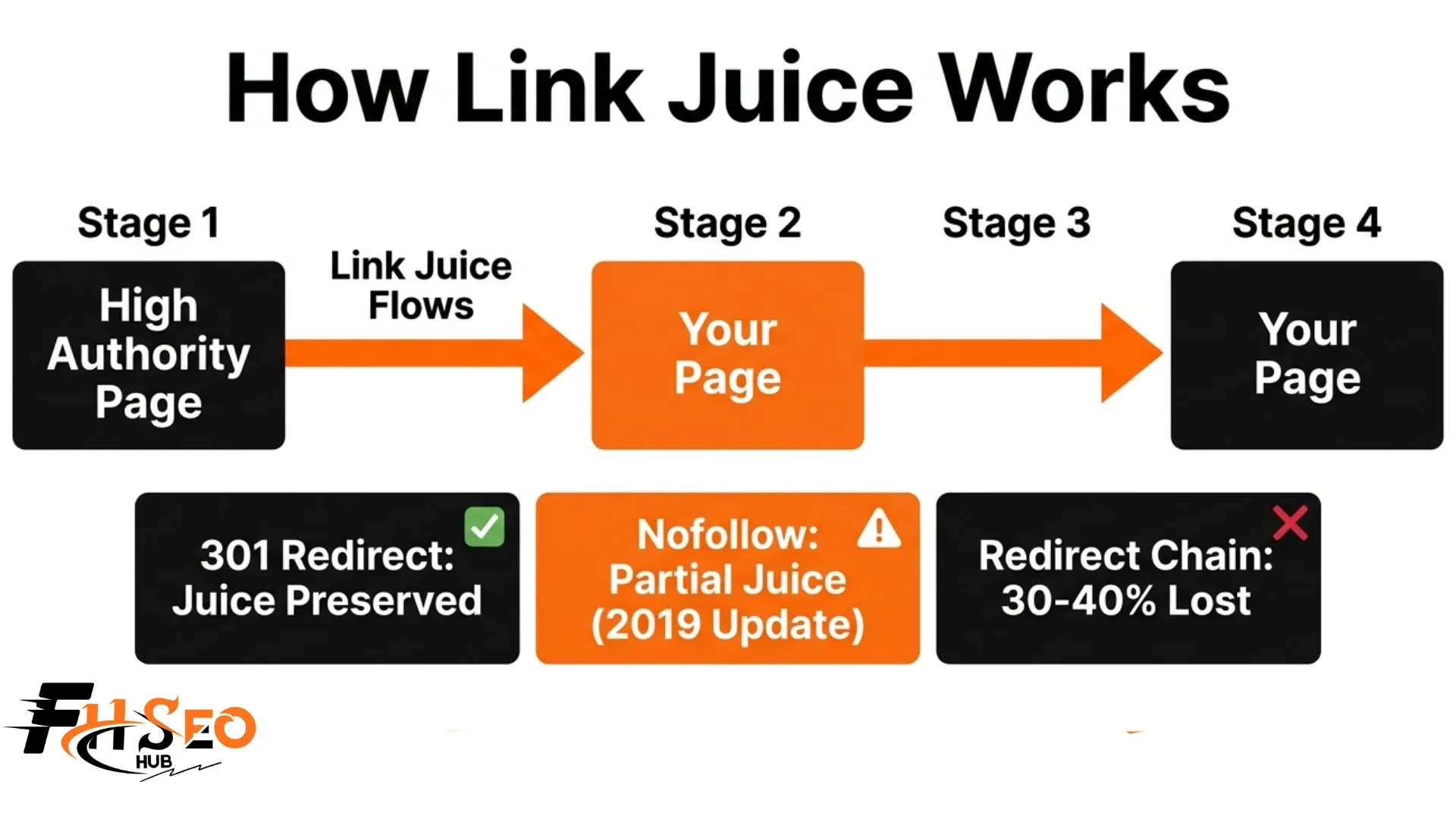
When a page links to yours, it transfers a fraction of its own accumulated authority through that hyperlink. How much transfers depends on the authority of the linking page, how many other outbound links share that same authority and whether the link carries any technical restrictions. Manage those three variables correctly and you control your ranking potential directly.
Most SEOs know that backlinks matter. Far fewer understand the technical mechanics behind how link juice actually moves, where it leaks and what reduces or amplifies the amount that reaches your pages. The result is a lot of link building effort that produces disappointing ranking returns.
How does link juice technically flow from one page to another?
Link juice flows through hyperlinks by transferring a proportional share of the linking page’s accumulated authority to every page it links to. The total available equity is divided across all outbound links on the linking page, which means more outbound links produce less juice per link.
The proportional distribution model
Think of link juice as a fixed budget on every page. If a highly authoritative page links to three other pages, each receives roughly one-third of that page’s available equity. If that same page links to thirty pages, each receives approximately one-thirtieth. This is why outbound link count on a linking page matters as much as the domain’s overall authority when evaluating a specific link opportunity.
When you check a potential link partner in Ahrefs, look at the URL Rating of the specific page doing the linking, then open that page and count its outbound links. A page with URL Rating 45 linking to only four other pages passes substantially more juice than a page with URL Rating 65 linking to eighty destinations.
The topical amplification effect
Topical relevance between the linking page and your page amplifies how much of the transferred juice is actually useful for your target keyword. Two pages can pass identical raw equity, but the one that is semantically aligned with your content produces a stronger ranking signal for relevant queries.
Semantic similarity is a gap concept most competitors miss entirely here. In 2026, Google’s NLP systems measure the cosine similarity between the linking page’s content and your target page’s content. When the semantic distance between them is small (meaning they cover closely related subjects), Google interprets the link as a highly relevant endorsement. When semantic distance is large (a cooking blog linking to a cybersecurity product page), the raw equity still transfers but carries diminished topical signal. Building links from semantically similar pages amplifies the ranking impact of every unit of link juice you earn.
Crawl frequency as a secondary benefit
According to Incremys (March 2026), Googlebot processes approximately 20 billion pages daily. Pages that accumulate strong incoming link equity get crawled and re-indexed more frequently because Google’s systems prioritize pages that other trusted sources are actively referencing. Building strong inbound link juice therefore accelerates both your rankings and the speed at which Google discovers and indexes new content on those pages.
How do redirects affect link juice?
A 301 redirect (permanent redirect) passes most of the link juice from the old URL to the new destination. A 302 redirect (temporary redirect) historically passed little to no juice, but Google has clarified that it now treats 302 redirects similarly to 301s in many cases, particularly when the redirect has been in place for extended periods.
301 vs 302 redirects and link equity transfer
The 302 vs 301 distinction matters more than most SEO experts acknowledge. A 302 redirect signals to Google that the move is temporary, which historically caused Google to continue associating authority with the original URL rather than the destination. Google has softened this stance for long-standing 302 redirects, but for permanent URL changes where preserving link juice is the goal, always use a 301.
A 302 redirect is the right choice only when the redirect genuinely is temporary: A/B test variations, seasonal campaign pages or maintenance redirects. Using a 302 for a permanent URL change risks stranding link juice at the origin URL where it becomes inaccessible to the destination.
The redirect chain problem
Redirect chains reduce link juice with each additional hop. A direct link delivers close to full equity to the destination. A single-hop 301 redirect passes most of that equity (Google estimates this at the high end of the range). A chain of three or more redirects can reduce the juice reaching the final destination by 30 to 40 percent compared to a direct link, even when every hop is a 301.
This is the counterintuitive insight practitioners discover when auditing redirect infrastructure. When you run a redirect audit in Screaming Frog and find chains longer than two hops, consolidating them to a single direct redirect often produces measurable URL Rating improvements within 4 to 8 weeks. Most sites accumulate redirect chains invisibly through website migrations, CMS changes and URL restructures over years. Auditing and flattening these chains is one of the highest-ROI technical SEO tasks available.
Canonical tags as a redirect alternative
Canonical tags serve a related but distinct function: they concentrate link equity from duplicate or variant URLs onto a single preferred URL without redirecting visitors. When your site has product variant pages, paginated content, or regional URL versions that share similar content, implementing canonical tags ensures all link juice pointing to those variants flows to the canonical (primary) version. Without canonical tags, link equity fragments across URL variations, diluting the authority of your intended ranking page.
How does nofollow affect link juice flow?
A nofollow link was designed to block link juice transfer by instructing Google not to pass authority through that hyperlink. The practical reality in 2026 is more nuanced than this simple rule suggests.
rel=”sponsored” and rel=”ugc” in the equity picture
Google introduced rel=”sponsored” for paid links and rel=”ugc” for user-generated content as part of the same 2019 update. Both signal to Google that the link should not pass link juice, and Google treats these as hints rather than directives in the same way as nofollow. This matters if your site hosts comments or forum content: marking user-generated links as rel=”ugc” communicates their nature accurately, which can protect your site’s link profile credibility even if it does not directly affect your rankings.
When to use nofollow strategically
Nofollow internal links represent a misguided attempt to sculpt link juice that Google largely ignores. Adding rel=”nofollow” to internal links to concentrate PageRank on specific pages (a tactic called PageRank sculpting) was effective in the early 2010s but stopped working as Google’s systems grew more sophisticated. In 2026, using nofollow on internal links to control how link juice works within your site produces no measurable benefit and risks creating confusing internal link signals.
How does anchor text affect how link juice passes?
Anchor text does not change the quantity of link juice that transfers through a hyperlink, but it directly determines how that juice is interpreted. Descriptive, topically relevant anchor text tells Google what your destination page covers, amplifying the topical signal of the transferred authority for specific keyword rankings.
The four anchor text types and their functions
| Anchor Type | Example | Topical Signal | SEO Use |
| Exact match | “link juice in SEO” | Very strong | Use sparingly (5-10%) |
| Partial match | “how link juice flows technically” | Strong | Preferred for most links |
| Branded | “your site name” | Brand authority | 40-50% of profile |
| Generic | “click here” or “read more” | None | Acceptable for diversity |
Exact match anchor text passes the same equity as any other anchor but carries the strongest topical signal for the precise keyword it uses. Over-relying on exact match anchors creates an unnatural pattern that Google’s spam detection systems flag, which can reduce how the authority is weighted.
How do you use internal linking to direct link juice across your site?
Internal linking gives you direct, cost-free control over how link juice flows once external backlinks bring it into your domain. Every external backlink lands equity on a specific page. Internal links then move that equity toward pages that need it, including commercial pages that struggle to earn direct external links.
The informational-to-commercial link juice funnel
High-authority external sites rarely link to product pages, service pages, or pricing pages. They link to informational content: research, guides and data-driven articles. This creates a structural problem for any site that needs its commercial pages to rank. The solution is the informational-to-commercial link juice funnel: earn links to your informational content, then use internal links from those pages to pass earned juice to your commercial targets.
This funneling approach works immediately because internal links pass juice with the next Google crawl of the source page. When you earn a strong external backlink to a blog article and add an internal link from that article to your product page using descriptive anchor text, the product page begins receiving equity from that external backlink within weeks without ever having earned an external link directly.
Link juice cascade through topic clusters
A link juice cascade through a topic cluster is another mechanism most competitors overlook. When you build a cluster of interconnected articles around a central pillar page, each external backlink that lands anywhere in the cluster distributes equity through the internal link network to every connected page. The cascade effect multiplies the value of every external link you earn.
Orphan pages and link juice starvation
Orphan pages (pages with no internal links pointing to them) receive zero link juice from your domain’s external backlinks regardless of domain authority. If you publish a new page and leave it unlinked from your existing content, it ranks solely on its own thin external link profile with no equity contribution from the rest of your site. Add two to three contextual internal links from your highest URL Rating pages before running any outreach for any new page you publish.
Conclusion
How link juice works comes down to three controllable variables: how much equity a linking page carries, how that equity distributes across the page’s outbound links and whether the technical conditions (redirects, nofollow, anchor text) amplify or restrict the transfer. Each variable is measurable in tools like Ahrefs and Screaming Frog and each one responds to deliberate optimization.
Technical redirect chains are the most underdiagnosed link juice leak on most sites. Fix chains longer than two hops and the equity you have already earned starts reaching its intended destinations at higher strength.
Start by auditing your top twenty referring URLs in Ahrefs, checking the redirect chain length to your destination pages, and mapping your three highest-authority blog pages to the commercial pages that need authority most. Read the complete walkthrough in our link juice strategy guide for a step-by-step audit process.


