Performance Marketing SEO: The Integration Playbook That Cuts CAC and Compounds Growth

Performance marketing SEO combines paid channels like Google Ads, Meta Ads, and LinkedIn Ads with search engine optimization to generate results that are both immediate and compounding. In 2026 the highest-performing teams treat both as one unified strategy because neither channel alone delivers sustainable lead generation at a manageable customer acquisition cost.
If pausing your ads makes your pipeline go quiet, you already understand one side of the problem. If your SEO has been running for months with no measurable revenue impact, you understand the other. Most teams run paid and organic in separate silos and each channel hits its ceiling faster than it should. The fix is not more budget. It is integration.
What Is Performance Marketing SEO and Why Does It Matter in 2026?
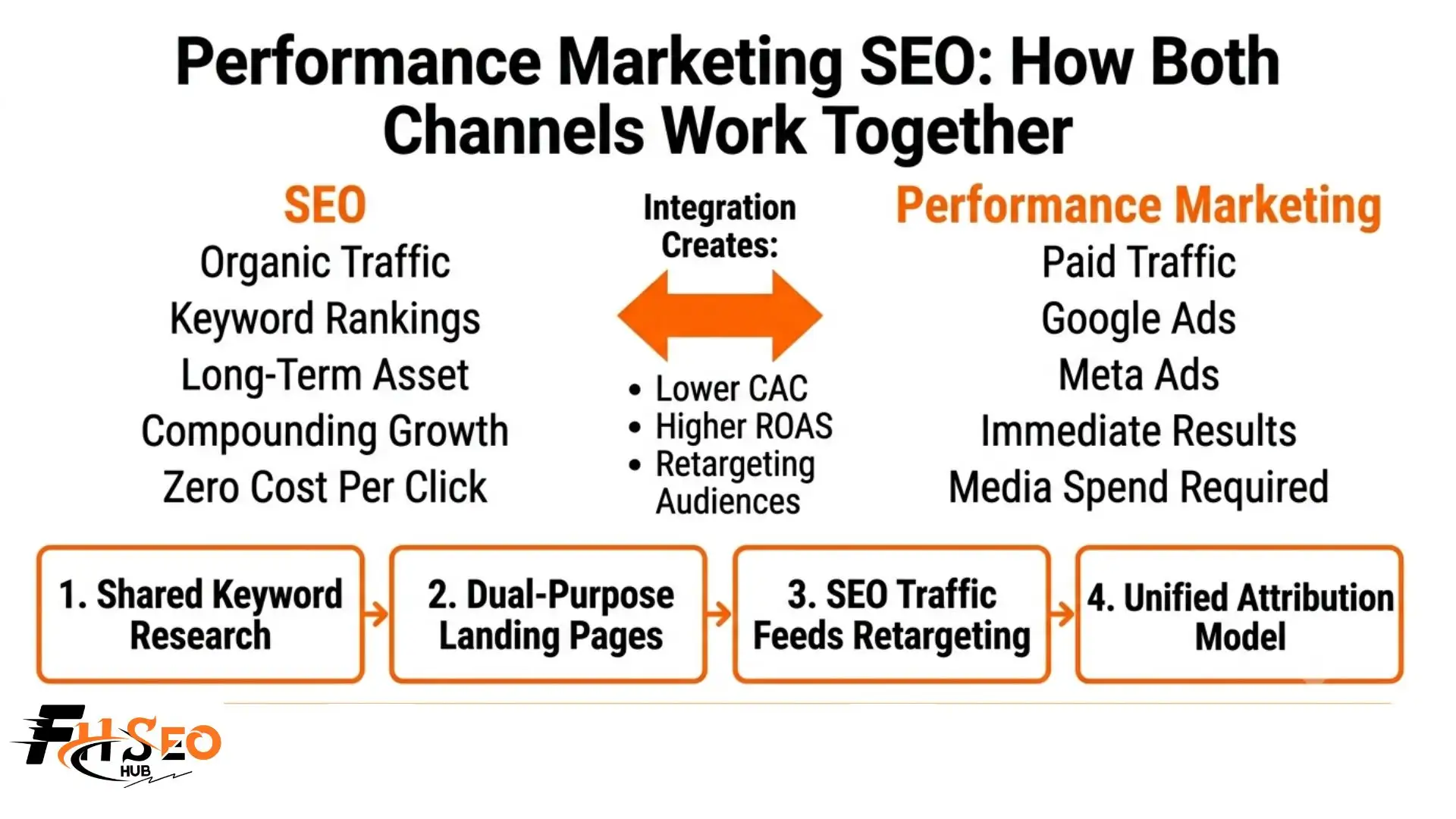
Performance marketing SEO is the integrated approach of combining results-driven paid advertising with long-term organic search optimization into a single growth engine. Paid channels deliver immediate traffic and measurable return on ad spend. SEO builds compounding organic traffic that reduces media spend dependency as keyword rankings improve month over month.
In 2026 this integration matters more than ever. Google AI Overviews now answer many queries directly on search engine results pages, cutting click-through rates for standard organic search results. At the same time rising cost per click across paid search campaigns is squeezing return on ad spend for teams relying on paid traffic alone. Brands treating both channels as one unified strategy capture demand faster, spend less per acquisition, and build pipelines that don’t collapse when budgets get cut.
What Is the Real Difference Between SEO and Performance Marketing?
SEO earns organic traffic through keyword research, on-page optimization, technical SEO, and backlinks. Every piece of optimized content builds domain authority that compounds over time at zero cost per click. Performance marketing pays for results through paid search campaigns, display advertising, and social media advertising on platforms like Meta Ads and LinkedIn Ads.
SEO is a long-term asset. Performance marketing rents short-term attention. Both have a defined role and neither works at its best in isolation. Paid search campaign data tells you which topics convert. That data sharpens your SEO content strategy directly. Meanwhile SEO-optimized landing pages improve Quality Score on Google Ads campaigns, reducing cost per click without increasing media spend. This connection is where performance marketing SEO creates financial leverage that most marketers completely miss.
How Does SEO Directly Improve Your Performance Marketing Results?
Most teams treat SEO and paid campaigns as separate budget lines with nothing shared between them. That separation costs money on both sides. Here is what changes when you integrate them properly.
SEO lowers your cost per click on paid campaigns: Google assigns every paid search campaign a Quality Score based on ad relevance, expected click-through rate, and landing page experience. A landing page built with strong on-page optimization, fast site speed, and clear user intent alignment raises Quality Score and improves Ad Rank. Higher Ad Rank means Google charges less per click even when your bid stays exactly the same.
Organic traffic builds your retargeting audiences: Every visitor who lands on your website through SEO can be added to custom audience lists inside Google Ads or Meta Ads. Organic traffic earned at zero cost per click fills retargeting campaign pools with people who already showed buying intent. Larger organic audiences mean lower cost per acquisition and higher conversion rates.
First-party data from SEO content powers paid targeting: Blog posts, gated guides, and webinar landing pages driven by organic search collect first-party data through email sign-ups and lead forms. Paid teams who feed this data into audience targeting see higher return on ad spend because they reach users who already engaged with your brand organically.
Keyword research alignment eliminates budget waste: Paid search campaign data identifies which keywords convert at the lowest cost per acquisition. That same data tells your SEO team which content topics to prioritize next based on proven commercial value.
How Do You Measure Performance Marketing SEO Results Correctly?
Measuring both channels together requires one unified view instead of separate reports for organic and paid.
Track these metrics together without siloing them by department:
Teams that keep metrics separate make budget decisions in the dark. Teams that unify them make decisions based on what actually drives revenue from both sides.
What Is the Right Attribution Model for Combined SEO and Performance Marketing?
Last-click attribution gives all conversion credit to the final paid ad and erases every organic touchpoint that built intent before it. This is the measurement problem that causes teams to consistently underinvest in SEO because its revenue contribution never appears in the paid dashboard.
A multi-touch attribution model distributes credit across SEO blog visits, organic search clicks, and retargeting campaigns proportionally. A lead that read two articles, clicked one retargeting ad, and then converted on a branded paid search query should credit all three touchpoints. This gives your team the accurate customer acquisition cost and true return on investment from both channels. It also makes the internal case for integrated performance marketing SEO budget without relying on gut instinct.
How Are Google AI Overviews Changing the Game for SEO and Paid in 2026?
Google AI Overviews now answer queries directly on search engine results pages. Click-through rates for standard organic results dropped as a result. The search intent is still there but the click goes to the AI answer instead of to your website.
This creates two outcomes depending on your strategy.
The problem: organic traffic drops for informational queries as AI Overviews absorb the click. Brands compensate by increasing Google Ads spend to maintain the same paid traffic volume. This drives up cost per click and compresses return on ad spend across performance marketing campaigns.
The opportunity: brands that earn AI Overview citations become the sourced answer inside the AI response. No click required. Their brand appears at the moment of maximum intent. Earning citations requires well-structured SEO content, strong E-E-A-T signals, clear structured data markup, and authoritative specific answers that AI systems cite from trusted sources.
Teams that integrate performance marketing data with SEO content structure are best positioned to target citation opportunities systematically in 2026 while competitors pay more and more per click for the same traffic.
How Does Content Velocity Accelerate Both SEO and Paid Performance?
Content velocity, meaning how consistently you publish optimized content, directly affects both channels at the same time and most teams never track it this way.
Low content creation output creates two problems simultaneously. SEO has fewer ranking opportunities across target keyword clusters. Performance marketing campaigns have fewer quality landing pages to work with. Both channels slow down from the same bottleneck.
High content velocity compounds in both directions. More optimized content means more keyword rankings and more organic traffic flowing into retargeting audiences. It also means more landing pages that improve Quality Score on paid campaigns and lower cost per click. Every optimized piece of content serves both channels at once.
In 2026 the brands growing fastest publish consistently across core topic clusters and use paid search data to decide what to produce next. That alignment is where the compounding loop actually starts.
When Should You Prioritize SEO Over Performance Marketing and Vice Versa?
The decision depends on your current business data rather than marketing ideology.
Invest more in SEO when:
Scale performance marketing when:
The most effective digital marketing strategy shifts budget proportionally as organic search optimization matures, with both teams sharing keyword research and attribution data.
Final Thoughts
Performance marketing SEO is not a philosophy you debate in planning meetings. It is a specific operational decision to make your paid and organic channels share data, audiences, and landing pages instead of running blind to each other.
In 2026 the brands reducing customer acquisition cost while growing pipeline contribution are the ones that integrated both strategies into one approach. Start with shared keyword research and dual-purpose landing pages. Build retargeting audiences from organic traffic. Track pipeline contribution from both channels inside one attribution model. The compounding effect builds from those three moves and accelerates from there.
FAQs
SEO is not a traditional performance marketing channel because it does not follow the pay-for-results model. But it functions as one when measured with performance marketing KPIs like cost per lead, conversion rate, and organic revenue share. Performance-driven SEO produces the same business outcomes as paid search campaigns through organic search results instead of media spend.
Landing page Quality Score improvements can lower cost per click within 30 days. Retargeting campaign audiences built from organic traffic grow meaningfully over 60 to 90 days. Organic revenue share reaching 10 to 25% of total revenue and reducing media spend dependency meaningfully takes 6 to 12 months of consistent SEO work.
Yes and they should. Running both together improves Quality Score on Google Ads, builds larger retargeting audiences from organic traffic, and gives paid teams better landing page and conversion data. Running them separately leaves performance gains on the table from both channels.
SEO reduces cost per acquisition through three compounding mechanisms. It grows organic traffic that converts without media spend. It builds retargeting audiences from organic visitors at zero cost per click. It improves Google Ads Quality Score on landing pages, lowering cost per click across active paid search campaigns at the same time.
Track organic traffic growth, keyword rankings, cost per lead by channel, customer acquisition cost split across paid and organic, return on ad spend improvement from better Quality Score, organic revenue share, and pipeline contribution from SEO-sourced leads. Google Analytics, Google Search Console, SEMrush, and Ahrefs together give you the complete picture.
Google Ads paid search campaigns pair most directly with SEO because both target search intent on the same platform. SEO-optimized landing pages improve Ad Rank and lower cost per click on Google Ads simultaneously. Meta Ads and LinkedIn Ads work best for retargeting campaigns built from organic traffic audiences collected through SEO-driven content.
Google AI Overviews reduce click-through rates for standard organic results by answering queries directly on search engine results pages. Brands compensate by increasing Google Ads spend, which raises cost per click. Brands that earn AI Overview citations through structured SEO content gain brand presence at the moment of peak intent without paying for the click at all.
No. Small businesses benefit significantly from integrating both channels. Even a modest organic traffic base builds retargeting audiences that reduce cost per acquisition. Early-stage SEO content lowers Google Ads cost per click by improving landing page Quality Score, making paid budgets go further when media spend is limited.


