
Authority vs. Relevance: Which Matters More for Link Weighting?

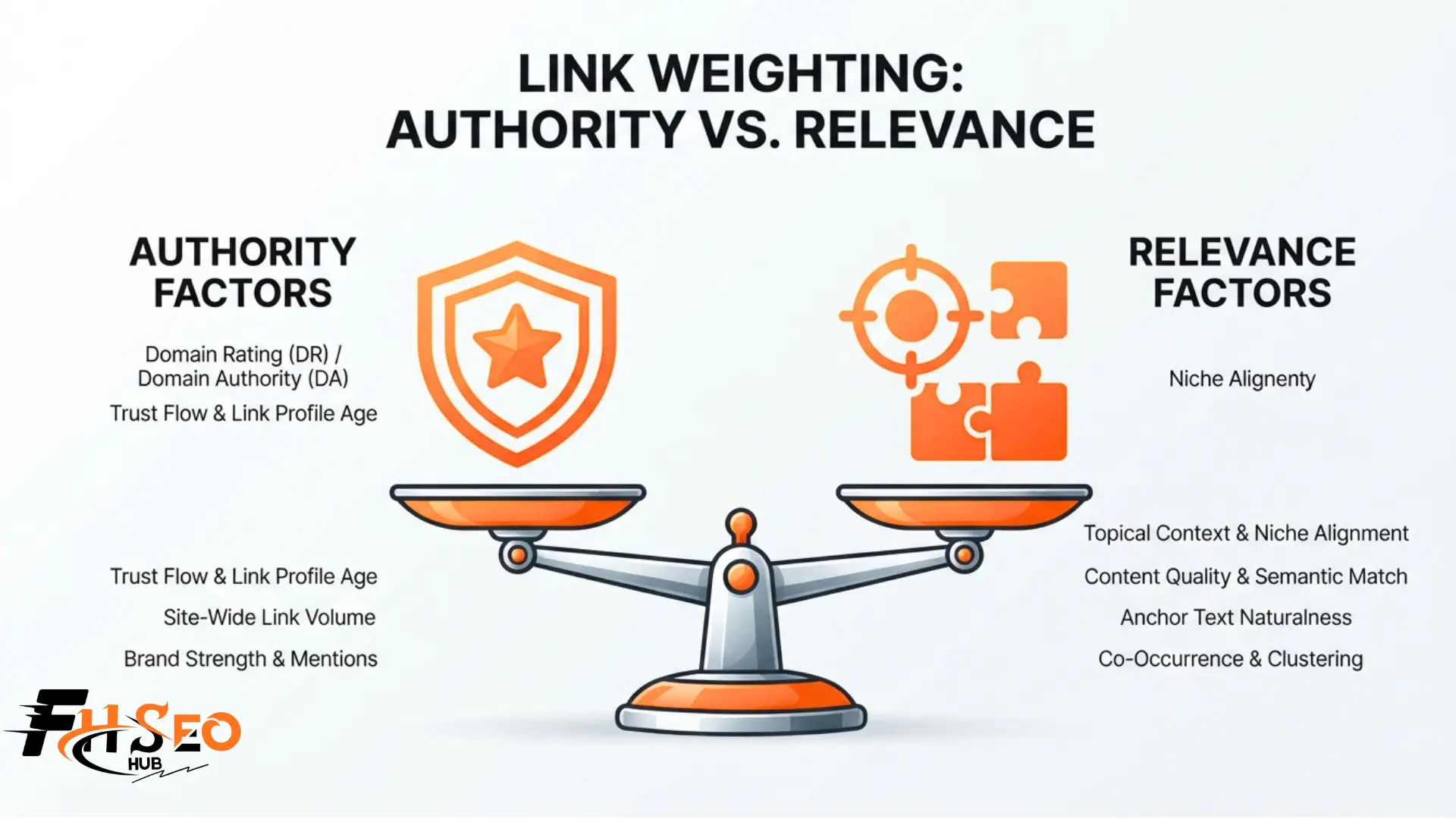
Neither wins outright. Link relevance determines whether Google trusts a link as a genuine topical signal in the first place, while link authority determines how much weight that signal carries once it counts. The practical problem shows up on every prospect list you build: a DR 70 site in an unrelated niche sits next to a DR 25 site that matches your topic exactly, and someone has to decide which one is worth the outreach.
What Is Link Authority?
Link authority reflects how much trust and ranking power a linking domain or page carries. Practitioners approximate it through third-party metrics like Domain Rating, Domain Authority, or Trust Flow, none of which Google uses directly, but all of which correlate reasonably well with how much weight a link tends to pass.
A high-authority backlink from an established, trusted domain still functions as a strong vote of confidence, even when a search engine’s own systems evaluate trust through far more granular signals than any single score can capture.
What Is Link Relevance?
Link relevance measures how closely a linking page’s topic aligns with your own content. This gets judged through topical relevance, contextual relevance, and increasingly through entity relationships, whether the linking page discusses the same concepts, terminology, and related subjects a genuine expert in your space would cover. Niche relevance narrows this further, looking at whether the linking site operates within your specific industry rather than just a broadly adjacent category.
A relevant backlink from a smaller, niche-focused site can carry more topical weight than a high-authority link from a large, unrelated publication, precisely because it reinforces what your site is genuinely about rather than just adding generic trust.
How Does Google Evaluate Relevance in 2026?
Google increasingly evaluates expertise and relevance at the content cluster level rather than the domain overall. A recent Google Discover update made this explicit: a topically focused section of an otherwise broad or unrelated site can now pass relevance signals that a domain-wide authority score misses entirely.
This matters directly for link weighting. A backlink from a general news site’s dedicated health section can carry real relevance for a health-related page, even though the domain as a whole covers dozens of unrelated topics. Entity SEO reinforces this shift, since Google increasingly maps content through entity relationships and topical clusters rather than treating a domain as a single undifferentiated block of authority.
A common mistake beginners make is evaluating every prospect purely by domain-wide Domain Rating without checking whether the specific section or page they’d be linked from genuinely belongs to a relevant topical cluster.
When Does Authority Matter More Than Relevance?
Authority tends to dominate in three situations: a new site still building its first backlink profile with almost nothing to compare relevance against yet, a highly competitive niche where genuinely relevant, link-worthy sources are scarce, and campaigns aiming for broad brand credibility rather than ranking one specific topic cluster.
New sites in particular benefit from authority early on, since a thin backlink profile has little topical signal to reinforce regardless of source. SEO professionals consistently find that a new domain gains more from a handful of trusted, high-authority links establishing baseline domain trust than from chasing perfect topical matches it hasn’t yet earned the content depth to support. This shifts as the site matures. Once a domain has published enough depth to form a real topical cluster, relevant links start contributing more than additional high-authority ones from unrelated sources, since the site now has genuine topical authority to reinforce rather than a blank slate.
When Does Relevance Matter More Than Authority?
Relevance tends to dominate for YMYL topics, for established sites deepening an existing topical cluster, and for any page competing on a narrow, specific keyword rather than a broad brand term. Google’s current guidance treats expertise and subject-matter alignment as effectively non-negotiable for YMYL content, which extends naturally to how those sites should evaluate incoming links.
A finance site earning a link from a well-regarded but general business publication gets some value from that authority. The same finance site earning a link from a specialized personal finance resource, even one with a noticeably lower Domain Rating, reinforces topic alignment and subject expertise in a way the higher-authority, less relevant link cannot replicate. This distinction matters more the deeper a site sits in competitive or sensitive verticals, since search engine trust in these areas leans heavily on demonstrated, consistent industry relevance rather than raw domain-wide trust signals.
How Do I Decide Between a High-Authority and a Relevant Link?
Weigh both against your specific goal rather than defaulting to whichever metric looks better on a report. Use authority as the deciding factor for broad trust building and new-site foundation work, and use relevance as the deciding factor for topical ranking, YMYL credibility, and page-level relevance on competitive, narrow keywords.
| Scenario | Prioritize | Why |
| New site, thin backlink profile | Authority | Establishes baseline domain trust quickly |
| YMYL content (health, finance, legal) | Relevance | Expertise signals are close to mandatory |
| Competing on a narrow, specific keyword | Relevance | Topical alignment reinforces the exact ranking target |
| Broad brand awareness campaign | Authority | Reach and credibility matter more than topic match |
| Established site, deepening a topic cluster | Relevance | Reinforces existing content cluster authority |
When a prospect scores similarly on both, anchor text and surrounding context become the practical tiebreaker. A natural anchor text footprint around a relevant, well-placed link tends to reinforce topical signals more reliably than the same anchor text sitting inside an unrelated, high-authority page. Link profile diversification also matters here: a backlink profile built entirely from one type, all high authority or all narrowly relevant, reads less naturally than one that blends both in proportions that make sense for the site’s stage and niche.
Cost and timeline differ between the two approaches too. Highly relevant, niche-specific placements often cost less than premium, high-authority sites in broad or competitive categories, simply because fewer link builders compete for them, though truly relevant sites in a saturated niche can price just as high. High-authority links from broadly known publications typically take longer to secure, often several weeks of relationship building or a genuinely newsworthy pitch, while relevant niche links can sometimes move faster if you already have an existing connection or a clearly matched resource to offer. Neither route reliably beats the other on speed alone, so budget and timeline expectations should follow the specific prospect, not a blanket assumption about either category.
What Techniques Earn Relevant, Authoritative Links Together?
Guest posts on topically aligned publications, broken link replacement targeting genuinely relevant resource pages, and digital PR pitched specifically to industry outlets tend to produce links that score well on both dimensions at once, rather than forcing a trade-off between them.
Editorial placements secured through real digital PR outreach carry a particular advantage here. A well-pitched piece of research or data study picked up by an industry publication earns an editorial link that’s both relevant by definition, since the outlet covers your space, and often reasonably authoritative, since industry publications tend to carry established trust within their niche. This combination takes longer to secure than a generic guest post, often several weeks of pitching before placement, but it avoids the authority-versus-relevance trade-off entirely rather than forcing a choice.
Broken link replacement deserves the same framing. Finding a dead link on a genuinely relevant resource page and offering your content as the replacement produces a link that was already judged relevant enough to include once, which tends to make the pitch itself far more persuasive than cold outreach with no existing context. The authority of the resulting link depends entirely on the page’s own standing, so this tactic works best when you can filter prospects for both relevance and a reasonable authority floor before reaching out.
What Link Types Should I Avoid Regardless of Authority or Relevance?
Paid links without proper disclosure, directory links from low-value aggregators, and link schemes built purely to inflate authority all carry manual penalty risk no matter how authoritative or relevant the source appears on the surface. Google’s guidelines treat undisclosed paid links as a violation regardless of how well the surrounding content happens to align with your topic.
Dofollow links from genuinely relevant, authoritative sources remain valuable. The risk sits specifically in manufactured patterns, not in the dofollow attribute itself.
Do Brand Signals Change the Authority vs. Relevance Equation?
Increasingly, yes. Brand signals and AI search visibility introduce a factor that sits outside the strict authority-or-relevance binary. Consistent brand mentions across both relevant and authoritative sources reinforce trust signals that AI systems appear to weigh somewhat independently of traditional link equity, since a mention doesn’t need a link at all to contribute to how consistently a brand shows up as a recognized entity.
This doesn’t replace the authority-relevance calculation. It adds a parallel track worth tracking alongside it, since a brand that shows up consistently and credibly across a topic cluster, linked or not, builds a form of search engine trust that compounds over time regardless of any single link’s Domain Rating.
What Tools Help Evaluate Authority and Relevance Together?
Ahrefs and Semrush both surface Domain Rating or Authority Score alongside referring domain and organic traffic data that helps gauge topical relevance, not just raw authority. Moz’s Domain Authority pairs with its own linking root domain context to round out the same picture from a third angle.
| Tool | Authority Signal | Relevance Signal |
| Ahrefs | Domain Rating | Organic keyword overlap, referring domain topic |
| Semrush | Authority Score | Referring domain traffic and topical relevance data |
| Moz | Domain Authority | Linking root domain context |
None of these tools directly measure relevance the way Google’s own systems evaluate entity relationships and topical clusters. Treat their relevance-adjacent metrics as a useful proxy for manual review, not a final verdict, and always check the actual linking page’s content and context before committing outreach time to a prospect. A quick manual read of the linking page, checking whether it genuinely discusses your subject matter or just happens to share a broad category, catches mismatches these tools miss entirely.
Final Thoughts
Authority and relevance answer two different questions, not one. Authority asks whether a source is generally trustworthy. Relevance asks whether that trust genuinely applies to what you’re trying to rank. Evaluate every prospect against your site’s actual stage and goal rather than defaulting to whichever metric is easier to screenshot for a client report, and treat the two as complementary inputs into one link weighting decision, not a competition with a single winner.
FAQs
Domain authority is a third-party metric predicting how well a domain might rank, based partly on its backlink profile. Backlinks are the individual links themselves, the raw material domain authority scores are calculated from, not the same thing as the score.
Yes, and practitioners report this happening regularly, particularly for narrow, specific keywords where topical alignment matters more than broad domain-wide trust. This effect tends to be strongest on competitive keywords within an established topical cluster.
Neither wins in every situation. New sites and broad brand campaigns lean toward authority, while YMYL content and narrow, topic-specific rankings lean toward relevance. The honest answer depends on your site’s stage and the specific page you’re trying to rank.
Generally yes. Google’s current guidance treats subject-matter expertise as close to mandatory for YMYL content, which extends to link acquisition, making topical relevance and industry relevance a higher priority than domain-wide authority alone for these sites.
Not automatically. An unrelated high-authority link rarely hurts on its own, and disavowing removes link equity along with any perceived risk. Reserve disavowing for links that look manipulative or spammy, not simply ones that happen to be off-topic.


