What Is Resource Page Link Building? Guide to Earning High-Quality Backlinks

Resource page link building is the practice of earning editorial backlinks from webpages that curate lists of valuable external resources for a specific niche. You find relevant resource pages, pitch your linkable asset as a useful addition and earn a dofollow backlink when the page owner agrees. It is one of the few white-hat link building strategies where the site owner actually wants you to reach out.
Most people get it wrong from the start. They send generic emails to the wrong person, pitch weak content and wonder why they hear nothing back. This guide fixes all of that.
What Is Resource Page Link Building and How Does It Work?
A resource page is a webpage that exists primarily to link out to useful content, tools, or guides on a specific topic. Think of a university’s “Student Mental Health Resources” page or an SEO blog’s “Best Tools for Beginners” list. These pages serve their audience by curating the best external resources in one place.
Resource page link building works because the page owner already wants useful additions. When your linkable asset genuinely improves their curated link list, you are not begging for a link. You are doing them a favor.
That is why outreach conversion rates for this strategy run higher than most other link building tactics. The page was literally built to link out.
How Is This Different from Guest Posting?
Guest posting requires you to write a brand-new article for another site. Resource page link building pitches content you already have. You suggest your existing guide, tool, or research as a natural addition to their curated page. No new article required. No editorial gatekeeping around topics. Faster placements with less upfront work.
The tradeoff is that resource page links require a strong linkable asset. If your content is thin or mediocre, no amount of outreach skill will earn consistent placements.
Have Resource Pages Changed in 2026?
Traditional static resource pages have lost significant SEO value since Google’s link spam algorithm updates. Many old-school resource pages sit unmaintained, full of broken links and do not rank in search results themselves. Getting listed on a page nobody visits produces little to no benefit.
What replaced them matters more now.
Listicle link building from ranking roundup posts and “best X” articles now delivers far more value than traditional resource pages. Here is why a single placement on a ranking listicle does three things at once:
Answer engines constantly pull recommendations from listicles that already perform well in search results. If your brand appears on those pages, you increase your chances of showing up in AI-generated answers. That is a benefit traditional resource pages can rarely offer in 2026.
How to Create Your Own Resource Page to Attract Inbound Links
Before you start outreaching other sites, consider building a resource page on your own site. This is a reverse flywheel strategy most people miss entirely.
When other site owners run their own resource page link building campaigns, they use the same search operators you use. If your resource page shows up in their prospecting, they pitch you for inclusion and often offer a link in return.
A strong resource page on your own site should:
The audience trust your resource page builds also strengthens your E-E-A-T signals with Google, which helps your entire domain.
How to Find Resource Pages worth Targeting
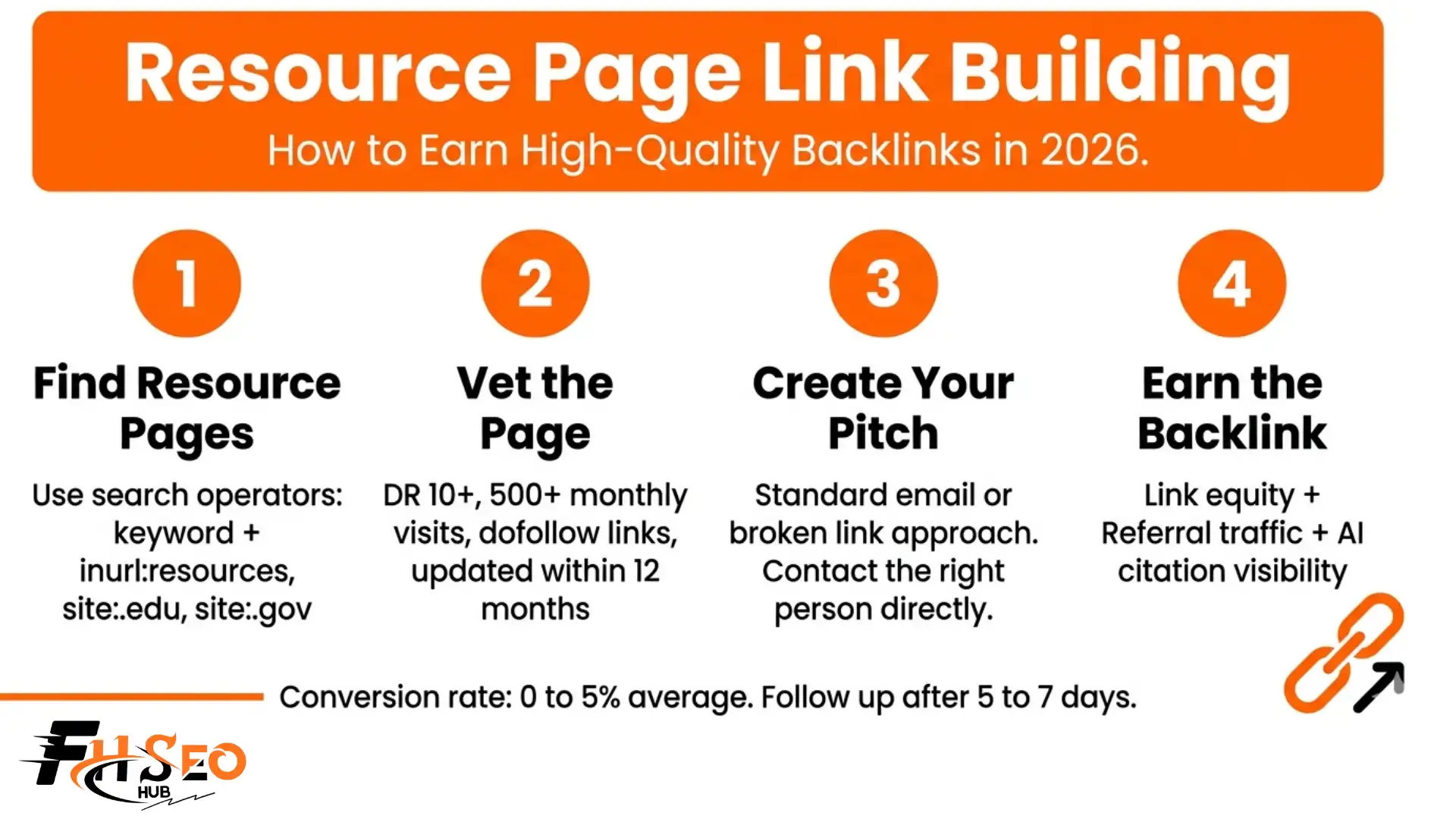
The fastest way to find resource pages is through Google search strings that target the footprint terms page owners consistently use in their titles and URLs.
Start with these search strings and swap in your niche keyword:
The .edu and .gov variations often yield the highest domain authority targets with almost no competing outreach. University department pages and government agency resource sections are rarely flooded with pitches.
Also run competitor backlink reverse engineering. Open a competing website in Ahrefs Site Explorer or SEMrush, go to their backlink report, and filter for referring page URLs containing “resources” or “links.” Every result is a resource page that already links to content like yours.
How to Vet a Resource Page before Reaching Out
Filtering by domain rating alone misses half the picture. Many high-DR pages carry broken links, lack topical clustering or have not been updated in years.
A proper vetting framework checks five things:
Pages that pass all five criteria deserve a manual review. Open the URL, scan for content relevance, check whether your linkable asset would genuinely fit and identify which specific section your content belongs in. That last detail becomes critical in your outreach email.
Use Screaming Frog or the Ahrefs SEO Toolbar to check for broken links before emailing. This one extra step can double or triple your outreach conversion rate.
How to Write a Resource Page Outreach Email That Gets Replies
Most outreach emails fail for three reasons: they go to the wrong person, they use an obvious template and they give the page owner no reason to act. Fix all three and your response rate improves immediately.
Find the specific person responsible for maintaining the page. Avoid generic contact forms. Use Hunter.io to find the right email address and dig into the site’s About or Contact pages for department information. For university sites, check the department staff directory.
Template 1: Standard Pitch
Subject: Quick suggestion for [Page Name]
Hi [First Name], I came across your [page title] while researching [topic]. I noticed you link to resources on [subtopic]. I recently published [brief description and URL] that might be a useful addition under the [section name] section. Thanks for maintaining such a helpful page.
Template 2: Broken Link Pitch (Higher Conversion Rate)
Subject: Found a broken link on your resources page
Hi [First Name], I found a few dead links on your [page title]: [URL 1] and [URL 2]. Thought you would want to know. I also recently published [brief description and URL] which covers [related topic] and might work as a replacement for one of those broken links. Either way, I hope this helps.
The broken link variation consistently hits the higher end of the 0 to 5 percent average conversion rate for this strategy. You lead with genuine helpfulness before making any request. The page owner is already opening their editor to fix links, and adding yours takes seconds.
Send a follow-up after 5 to 7 days if you hear nothing. Keep it short, reference your original email and ask if they had a chance to review. Most conversions from resource page outreach happen on the second email.
Does Resource Page Link Building Work for Local SEO?
Yes, and local businesses face far less competition for these placements than national brands do.
The best local SEO resource page targets include:
These pages carry strong domain authority for geographic searches, produce referral traffic from locally relevant visitors and almost never receive competing pitches. A local plumber or accountant pitching a city government resource page faces almost no competition.
Which Tools Speed Up Resource Page Link Building?
You do not need every tool. A focused stack covers the full workflow without bloat.
For prospecting: Ahrefs Content Explorer, ScrapeBox, or Citation Labs Link Prospector find resource pages faster than manual Google searching.
For vetting: Screaming Frog checks for broken links on target pages. Ahrefs SEO Toolbar pulls domain rating and traffic data directly in search results without switching tabs.
For contact finding: Hunter.io finds accurate email addresses for the specific people who manage resource pages.
For outreach: BuzzStream, Pitchbox and Respona manage personalized email sequences and follow-ups at scale without losing the personal touch that drives replies.
For tracking: Google Analytics shows referral traffic from earned backlinks. Google Search Console tracks ranking improvements over time.
The Right Way to Run Resource Page Link Building in 2026
The tactic still works. What changed is where the best opportunities live. In 2026, target both traditional resource pages and ranking listicles that combine link equity, referral traffic and AI citation visibility in a single placement. Vet every prospect on a multi-criteria framework beyond just domain rating. Use the broken link outreach approach as your primary template. And build your own resource page to create a passive inbound channel alongside your active outreach.
That combination is what separates campaigns that earn consistent high-quality backlinks from campaigns that generate zero replies.