
How Building Citations Can Improve Your Link Building

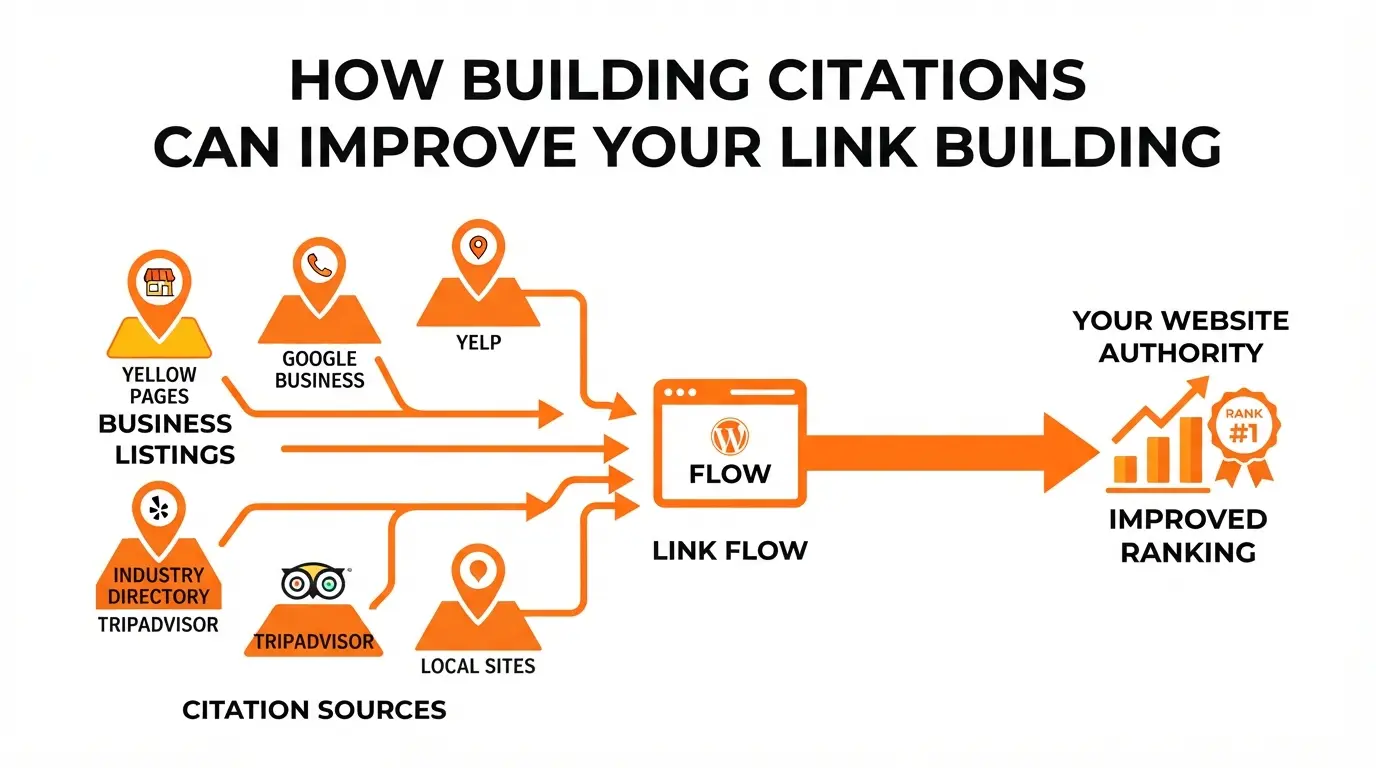
Citations are online mentions of your business name, address, and phone number, and building them systematically strengthens your link building campaign by adding trust signals and referring domains that a pure backlink strategy often misses. They won’t replace editorial links, but treating them as a separate, disconnected task wastes real synergy between two efforts that reinforce each other.
What Are Citations?
A citation is any online mention of your business’s name, address, and phone number, whether or not it includes a clickable link back to your site. Citations live on data aggregators, directory listings, review sites, and industry-specific platforms, forming a web of consistent business information that search engines cross-reference to verify your business actually exists where you say it does.
This verification function is what separates citations from generic backlinks. A citation doesn’t need to pass link equity to do its job, since its primary value comes from confirming the same business details appear consistently across many independent sources, a trust signal search engines weigh differently than a single high-authority editorial link.
Structured vs. Unstructured Citations

Structured citations follow a fixed format on directory sites and data aggregators, name, address, phone number entered into specific fields the platform controls, appearing on sites like Yelp, the Better Business Bureau, and industry-specific directories built around this exact format. Unstructured citations show up organically within regular content, a local news article mentioning your business name and city in a sentence, a blog post referencing your address in passing, with no fixed field structure at all.
Both carry real value, but they serve different purposes. Structured citations are easier to build systematically and audit for consistency, since the format is predictable. Unstructured citations tend to carry more weight individually since they’re harder to fake or automate at scale, appearing as organic mentions rather than a directory submission.
What Is NAP (and NAP+W)?
NAP stands for Name, Address, and Phone number, the three core pieces of business information that need to stay identical across every citation source for the consistency signal to work. NAP+W adds Website to that core set, reflecting how modern citation sources increasingly expect a linked or listed website URL alongside the traditional three fields.
Consistency here means exact-format consistency, not just factually-correct information. “St.” versus “Street,” a suite number formatted differently, an old phone number still live on one directory while a new one shows everywhere else, all create discrepancies search engines have to reconcile, and unreconciled discrepancies undermine the trust signal citations are supposed to build in the first place.
Citations vs. Backlinks: What’s the Difference?

A backlink is a hyperlink from one site to another, valued primarily for the link equity and referring domain authority it passes. A citation is a mention of your business’s NAP data, which may or may not include a link, valued primarily for consistency and verification rather than direct authority transfer. Many citations sit in the gray area of dofollow and nofollow links entirely, carrying no link attribute at all, yet still contribute meaningfully to local trust signals in a way a purely SEO-focused link building campaign wouldn’t otherwise capture.
The overlap matters more than the distinction here. A citation source that does include a dofollow link functions as both at once, a referring domain contributing to domain authority and a NAP data point contributing to local consistency, which is exactly the synergy a combined citation-and-link-building strategy is built to capture.
Why Citations Matter for SEO and Local Rankings
Citations contribute directly to local pack visibility and prominence, one of the three core local ranking pillars alongside relevance and proximity, by confirming to Google that a business’s information is consistent and verifiable across the web. Businesses with consistent NAP data across major citation sources are meaningfully more likely to appear in the local pack than those with scattered, inconsistent listings, a real, measurable gap rather than a theoretical concern.
The honest 2026 context worth stating directly: citation consistency alone now accounts for a smaller share of local pack ranking weight than it did several years ago, with Google Business Profile signals and review signals both carrying substantially more influence in current industry survey data. This doesn’t make citations irrelevant, it makes them a foundational requirement rather than a primary lever, the equivalent of clean technical SEO underneath a page that still needs genuinely strong content to actually rank.
How Building Citations Improves Your Link Building Campaign
Citation building and link building solve overlapping but distinct problems, and running them together produces results neither achieves as efficiently alone. A citation campaign naturally surfaces referring domains you wouldn’t find through standard backlink prospecting, since citation sources and directory listings live in a different part of the web than the editorial sites a typical outreach campaign targets.
This matters practically for backlink profile diversity. A link profile built entirely from guest posts and digital PR placements can look narrow to an algorithm evaluating natural link acquisition patterns, while a profile that includes genuine citation sources alongside editorial links reads as more organic, the kind of varied, multi-source profile a real, established local business would naturally accumulate over time. Running citation audits alongside link building outreach also surfaces unlinked mentions, existing brand references with no link attached, that convert into genuine new backlinks with a simple, low-effort outreach request asking the site to add one.
Citations and Domain Authority: How They Build Referring Domains
Every citation source that includes a dofollow link functions as a real referring domain contributing to overall domain authority, even when the individual link’s authority is modest compared to a strong editorial placement. Volume matters differently here than in traditional link building: dozens of citation sources each contributing a small amount of trust and referring domain diversity compound into a meaningfully stronger overall backlink profile, even though no single citation would shift rankings much alone.
The honest trade-off worth naming directly: chasing citation volume for its own sake, submitting to every directory regardless of relevance or quality, produces diminishing returns fast and can actually introduce NAP inconsistency risk if you’re managing dozens of low-quality listings without a real system for keeping them accurate. Prioritize citation sources with genuine relevance to your industry or location over raw directory count every time.
How Popular Is Citation Building Among SEOs?
Whitespark’s Local Search Ranking Factors survey, running in some form since 2008 and now conducted every two to three years, surveyed 47 local SEO experts scoring 187 individual ranking factors for the 2026 edition, giving the clearest available picture of how practitioners actually weight citations today. The data shows citation signals accounting for roughly 6 to 7 percent of local pack ranking weight, a real but modest share compared to Google Business Profile signals at around 32 percent and review signals at approximately 20 percent, up from 16 percent just a few years earlier.
This is a real shift in practitioner consensus: citation building was widely treated as a foundational, high-priority tactic in earlier years of local SEO, and current survey data shows that relative importance has declined as GBP optimization and review velocity have taken on more of the controllable ranking weight. The 2026 survey marked the first time AI search visibility was measured as its own formal category, and citations showed a notably different pattern there, discussed in more detail further down, worth knowing before assuming citation building has simply become obsolete rather than repositioned.
Where to Build Citations: Top Directories and Sources
Prioritize data aggregators and major structured directories first, since these often feed information downstream to dozens of smaller, niche directories automatically, making a handful of high-quality submissions more efficient than manually chasing every possible listing individually. Industry-specific and niche directories relevant to your actual business category carry more genuine relevance signal than broad, generic directories with no real topical connection to what you do.
Local news mentions and unstructured citations from genuinely local publications carry real weight precisely because they’re harder to build systematically, worth actively pursuing through the same kind of local digital PR and HARO-style outreach a broader link building campaign already uses. Review sites deserve specific attention as citation sources too, since they typically display NAP data prominently alongside the review content itself, making review platform consistency part of the same NAP discipline as directory listings.
How to Build Citations: A Step-by-Step Process
- Audit your existing citations first before building anything new, since fixing inconsistent NAP data across sources you’re already listed on typically produces faster, more reliable improvement than adding volume on top of an already-inconsistent foundation.
- Establish your canonical NAP format in writing, the exact way your business name, address, and phone number should appear everywhere, including how you’ll handle suite numbers, abbreviations, and any secondary phone lines.
- Submit to major data aggregators and structured directories first, since these often propagate information to smaller directories automatically over the following weeks.
- Target industry-specific and niche directories relevant to your actual business category, prioritizing genuine relevance over raw volume.
- Pursue unstructured citations through digital PR and HARO-style outreach, positioning local news mentions and organic brand references as a genuine extension of your broader link building effort rather than a separate task.
- Reclaim unlinked mentions you find during the audit process, reaching out to sites already mentioning your business without a link to request one be added.
- Re-audit on a recurring schedule, since citations drift out of consistency over time as directories update independently, phone numbers change, or a business relocates.
NAP Consistency and Citation Accuracy
NAP consistency requires exact-format agreement, not just factual correctness, across every citation source, which means a citation audit needs to check formatting details most manual reviews skip past. Common, easy-to-miss inconsistencies include abbreviation mismatches, “St.” on one directory and “Street” on another, suite number formatting differences, and outdated phone numbers still live on directories nobody’s checked in years.
Real research on this specific issue found meaningful local pack improvement, in the range of a meaningful double-digit percentage, within about 90 days of correcting major NAP inconsistencies across a business’s core citation sources, though results vary by how inconsistent the starting point was and how competitive the local market is. Treat a citation audit as a genuine prerequisite before investing in new citation volume, since building new, correctly-formatted citations on top of an inconsistent existing foundation just adds more discrepancies for search engines to reconcile.
Getting Your Citations Indexed
New citations don’t provide value instantly, since a directory listing needs to be crawled and indexed before it contributes to the consistency signal citations are meant to build. Most businesses see initial ranking movement within six to ten weeks of completing a citation campaign, with more meaningful, compounding change showing up around the three to four month mark as data aggregators propagate information downstream and search engines re-crawl the affected sources.
Indexing speed varies by source authority and crawl frequency, a well-established, frequently-crawled data aggregator tends to get reflected faster than a smaller, less-active niche directory. There’s no reliable way to force faster indexing here beyond building on sources search engines already crawl regularly, making source selection itself part of the timeline consideration, not just an afterthought once submissions are already live.
Tools for Citation Management and Tracking
Whitespark, founded by Darren Shaw, focuses specifically on citation building and local rank tracking, operating more as a hybrid service than a pure self-serve platform. Its Local Citation Finder tool runs roughly $25 to $35 a month for ongoing gap analysis against competitors, while its manual citation building service, actual human-built, permanently-owned citations rather than an automated sync, typically runs anywhere from around $200 for a small package up to $800 or more depending on scope.
Moz Local sits at the budget end of the ongoing subscription tier, running roughly $14 to $33 a month per location depending on plan, automating distribution across a wide network of directories and data aggregators with review monitoring included. BrightLocal runs around $39 a month for a single location and positions itself well for agencies specifically, combining citation auditing, white-label reporting, and broader local SEO tracking in one platform. Yext targets enterprise clients with real-time syncing across a much larger network of platforms, though its pricing is notoriously difficult to pin down, advertised around $500 but frequently discounted, and cited elsewhere as roughly $199 a month or per year depending on the source, worth confirming directly rather than trusting any single quoted figure.
The genuinely important distinction across all of these: one-time, manually-built citations from a service like Whitespark or a similar provider remain live permanently once submitted, regardless of whether you keep paying for the service afterward. Subscription-based sync tools like Moz Local, Yext, and similar platforms maintain your listings only as long as you keep the subscription active, and canceling typically means those listings revert to unmanaged over time. Neither model is universally better, a growing multi-location business often needs the real-time sync a subscription provides, while a single-location business building citations for the first time often gets more lasting value from a one-time, owned citation package.
| Tool | Pricing | Best For |
| Whitespark | ~$25-35/mo (Citation Finder), ~$200-800+ for manual building | Owned, permanent citations and competitor gap analysis |
| Moz Local | ~$14-33/mo per location | Budget-friendly ongoing directory sync |
| BrightLocal | ~$39/mo per location | Agencies needing white-label reporting and auditing |
| Yext | ~$199-500+/mo, highly variable | Enterprise, multi-location real-time sync |
Measuring Citation Impact on Your Link Building Results
Track local pack visibility and ranking position for your core service and location terms before and after a citation campaign, using a local rank tracker checking from within your actual service area rather than a generic national average position. Referring domain growth specifically attributable to citation sources, tracked separately from editorial links earned through broader outreach, shows whether the citation layer of your strategy is genuinely contributing new domains or simply adding NAP consistency without much additional link value.
Watch branded search volume too, since consistent, accurate business information across the web makes it easier for someone who’s encountered your business anywhere, a citation, a review, a mention, to find and search for you directly afterward. Give a citation campaign the same realistic runway as the indexing timeline above suggests, six to ten weeks for initial movement, three to four months for more meaningful change, rather than judging impact after only a few weeks.
Common Citation Building Mistakes to Avoid
Chasing raw citation volume without checking relevance floods a backlink profile with low-quality, unrelated directory listings that add NAP consistency risk without meaningful trust or authority benefit. Skipping the audit step and building new citations directly on top of an already-inconsistent NAP foundation compounds the exact problem citation building is meant to solve, since search engines now have even more conflicting data points to reconcile.
Treating citation building as a one-time project rather than an ongoing discipline misses how often source data drifts, a directory updates its own database, a business relocates or changes phone providers, and yesterday’s consistent citation becomes tomorrow’s discrepancy without anyone noticing until a citation audit catches it. Ignoring unstructured citations and unlinked mentions in favor of only pursuing structured directory listings leaves real, easy link building opportunities unclaimed, since converting an existing unlinked mention into a link is meaningfully lower effort than earning a brand-new placement from scratch.
Citations and AI Visibility: The New Frontier
This is where the honest 2026 picture gets interesting. While citation signals account for a modest share of traditional local pack ranking weight, current industry survey data shows citations carrying roughly double that relative importance for AI search visibility specifically, the first time this category has been measured formally at all. AI tools like ChatGPT reportedly draw on a meaningfully different set of sources than Google’s own local pack does, including Bing-indexed results, Foursquare data, Yelp listings, Better Business Bureau records, and industry directories, largely bypassing Google’s own walled-off review data entirely.
This creates a genuinely important, current risk worth naming directly: a business can dominate Google’s local pack through strong GBP optimization and review velocity while remaining largely invisible to the growing share of consumers using AI tools for local recommendations, since those tools are reading a different data layer altogether. AI citations don’t work like anchor text in a traditional backlink, there’s no keyword phrase being optimized, just consistent, structured facts an AI system can extract and trust. Usage of AI tools specifically for local business recommendations has grown substantially and quickly, and AI Overviews now surface local business information directly within Google’s own results too, meaning citation consistency across the sources AI systems actually reference, not just the sources Google’s local pack weighs most heavily, is becoming a genuinely distinct optimization target rather than a redundant extension of standard local SEO.
Conclusion
Citation building earns its place in a modern link building strategy specifically because it surfaces referring domains and unlinked mentions a pure editorial outreach campaign misses, not because citation volume alone still drives local pack rankings the way it once did. Audit before you build, prioritize genuine relevance over raw directory count, and treat citation consistency as a foundational requirement sitting underneath your broader link building work rather than the primary lever it used to be. With AI search visibility now weighing citations more heavily than traditional local pack rankings do, the discipline is shifting rather than disappearing, and getting the foundation right positions a site well for both what search rewards today and whatever comes next.
FAQs
Yes, though their relative weight in traditional local pack rankings has declined compared to Google Business Profile signals and reviews. Citations now carry proportionally more importance for AI search visibility specifically, making them a shifted priority rather than an obsolete one.
A backlink is valued primarily for the link equity and domain authority it passes. A citation is a mention of your business’s name, address, and phone number, valued primarily for consistency and verification, and may or may not include a link at all.
Most businesses see initial ranking movement within six to ten weeks of completing a citation campaign, with more meaningful change typically showing up around the three to four month mark as sources get indexed and NAP consistency compounds.
Yes, always. Building new citations on top of an already-inconsistent NAP foundation adds more conflicting data points for search engines to reconcile rather than fixing the underlying trust signal problem.
It depends on your model preference. Whitespark’s manual service produces permanently-owned citations that remain live after the service ends, while Moz Local offers lower-cost ongoing directory sync that requires an active subscription to keep listings current.
Yes, and current data suggests they matter more there proportionally than they do for traditional local pack rankings, since AI tools often draw on a different mix of sources, Bing-indexed data, Foursquare, Yelp, and directories, than Google’s own local ranking system does.


