Link Authority Measurement: Technical Signals, Internal Linking & Measurement Tools

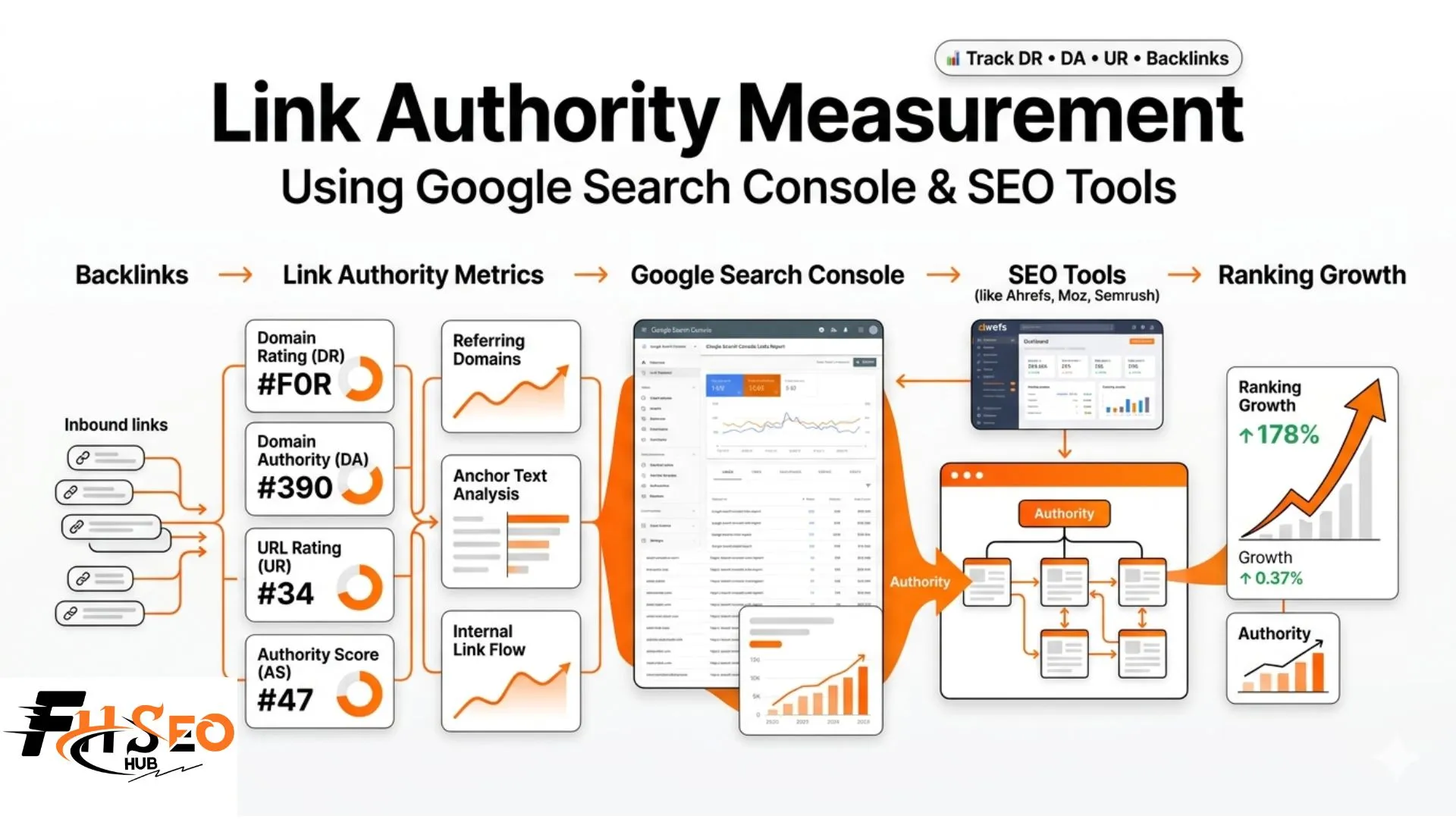
Link authority measurement uses proxy metrics because Google does not publish a public authority score. The primary tools are Ahrefs (URL Rating and Domain Rating), Semrush (Authority Score), Moz Link Explorer (Domain Authority and spam score) and Google Search Console (Links report). Track these metrics monthly to detect growth patterns rather than chasing specific numerical targets.
Building link authority without measuring it produces a strategy that cannot be refined. You end up repeating tactics that are not working and abandoning ones that are, because the feedback loop is missing.
This article covers three specific things: the tools and metrics that make accurate link authority measurement possible, how link authority technically flows through a website including where it leaks and how to optimize anchor text and internal linking to extract maximum ranking value from the external links you earn.
How is link authority measured? Key metrics explained
Google does not publish a link authority score, so every measurement system uses proxy metrics that approximate what Google’s internal systems calculate. Understanding what each metric measures and where it falls short is as important as knowing how to read the numbers.
Why there is no single ‘link authority’ score from Google
Google confirmed in 2016 that Toolbar PageRank was retired as a public metric. The underlying PageRank calculation still runs internally across multiple variants, as confirmed by the 2024 Google API leak. But Google has never made those scores accessible to third-party tools. Every domain authority or link strength metric you see in any SEO tool is that company’s estimate of what Google’s systems might calculate, built from the portion of the web that tool’s own crawler has indexed.
This matters practically: two tools will give you different scores for the same page because they have different index sizes, different crawl frequencies and different weighting formulas. Neither is wrong. They are measuring the same concept through different lenses with different data coverage.
The proxy metrics SEOs use: DR, DA, PA, URL Rating
Five metrics cover most practical link authority measurement needs in 2026:
How to read these scores accurately without over-relying on them
Use these metrics for relative comparison between competing pages, not as fixed numerical targets. A site with DR 50 is not twice as authoritative as one with DR 25. The logarithmic scale creates unequal intervals across the range.
One measurement insight most practitioners only learn through experience: when your DR or DA plateaus for two to three months despite consistent link acquisition, it rarely means your strategy has stopped working. The logarithmic scale creates natural resistance zones where underlying authority continues growing but the displayed metric barely moves. Checking your URL Rating (UR) on individual target pages gives a more sensitive signal of incremental page-level gains that the domain-level score masks.
Authority signal response lag is a related concept worth tracking. There is typically a 2 to 8 week delay between when Google discovers a new backlink and when that authority signal fully registers in rankings or third-party tool scores. If you acquired strong links in the past four weeks and your scores have not shifted, wait before concluding those links are underperforming.
Best tools to check and track link authority in 2026
Effective link authority measurement requires four core tools working together: Ahrefs for page and domain-level backlink data, Semrush for holistic authority scoring and competitor gap analysis, Google Search Console for real link data directly from Google and Moz Link Explorer for spam scoring and DA tracking.
Ahrefs – best for DR, URL Rating, and backlink depth
Open Ahrefs Site Explorer and enter any URL to see its Domain Rating, URL Rating, total referring domains, and full backlink profile. For page-level link authority measurement, sort the Backlinks report by the URL Rating of the referring page rather than the Domain Rating of the referring domain. This shows which specific pages are passing the most authority to your site, not just which domains have the strongest overall profiles.
Semrush – best for Authority Score and competitor gap analysis
Semrush Authority Score integrates backlink signals, organic traffic data and spam detection into a single domain-level metric. This makes it more resistant to artificial manipulation than pure backlink metrics. Use the Semrush Backlink Gap tool to compare referring domains across your site and up to four competitors simultaneously. Domains linking to competitors but not to you represent your highest-priority outreach targets.
Google Search Console – best free tool for real link data
Google Search Console provides the only link data sourced directly from Google. The Links report (under the Search Results section in the left navigation menu) shows top linking sites, top linked pages and top anchor text. This data reflects what Google has discovered and attributed, not what a third-party crawler estimated.
Export the top linking sites report monthly and track new domains appearing in the list. A consistently growing unique referring domain count in Google Search Console is the most reliable ground-truth signal that your link authority strategy is producing verified results.
Moz Link Explorer – DA and spam score tracking
Moz Link Explorer provides Domain Authority, Page Authority and a Spam Score for any domain or URL. Any domain with a Spam Score above 30 percent warrants manual review before you pursue or retain a link from it. For links already in your profile that exceed this threshold and show signs of manipulation, the Google Disavow Tool allows you to request that Google ignore those links when calculating your authority.
Majestic- For link trust flow and citation flow
Majestic is an additional tool worth knowing for Trust Flow and Citation Flow. Trust Flow measures link quality based on proximity to manually verified trusted seed sites. Citation Flow measures raw link volume regardless of quality. A significant gap between Trust Flow and Citation Flow (high Citation Flow but low Trust Flow) signals a backlink profile that may carry link equity without topical trust signals. With your measurement toolkit established, the next section explains why authority flows unevenly through your site even when external links look strong.
How does link authority pass through a website?
Link authority passes from external linking pages to the pages they link to, then distributes through internal links to the rest of your site. Pages that receive no internal links receive essentially no authority from the domain’s external backlinks, regardless of how strong those backlinks are.
The link equity flow model: from linking page to target page
When a high-authority external page links to your homepage, the homepage gains link equity from that link. Internal links on that homepage then distribute portions of that equity to the pages they point to. Pages reachable in two clicks from the homepage receive strong authority flow. Pages sitting three or more clicks deep receive considerably less.
A practitioner estimate supported by consistent internal link audit findings: pages more than three clicks deep from the homepage receive 40 to 60 percent less link equity flow than pages reachable in two clicks. This is not a confirmed Google figure but reflects patterns SEOs observe repeatedly when comparing URL Ratings against site architecture depth. Shortening the click path to your most important pages produces measurable UR improvements without acquiring a single new external backlink.
How PageRank distribution works across internal and external links
PageRank distributes proportionally across all outbound links on a page. If your homepage links to eight internal pages, each receives one-eighth of the available equity. Reducing that to four links doubles the equity each linked page receives. This is why high-authority pages should link selectively to the pages that matter most, not to every page equally.
Canonical tags are a related technical mechanism for authority consolidation. When multiple URLs contain similar or duplicate content, a canonical tag tells Google which version to treat as the primary page and attribute link equity to. Without correct canonical tags, link equity fragments across duplicate URL variants and dilutes the authority of your intended ranking page. Auditing canonical implementations during any site migration or URL restructure protects the link authority you have already earned.
What causes link authority to leak and how to prevent it
Link authority leaks through five common technical issues:
Run a site audit in WebSite Auditor or Screaming Frog quarterly to identify all five issues. Fixing broken internal links and reconnecting orphan pages produces authority flow improvements within weeks of the next Google crawl cycle, at zero acquisition cost. With technical flow issues resolved, the next area to optimise is the anchor text attached to every link pointing at your site.
How does anchor text affect link authority?
Anchor text amplifies the topical signal of a link by telling Google what the destination page covers. The right distribution strengthens rankings for target keywords. An over-optimised distribution triggers spam detection signals that reduce how Google weights the authority the links transfer.
Exact match vs partial match vs branded anchor text
Exact match anchor text uses the precise keyword you want the destination page to rank for. Partial match uses a variation or related phrase. Branded anchor text uses your company or site name. Generic anchor text uses phrases like “read more” or “source” that carry no topical signal.
Each type passes link equity, but only exact match and partial match anchors amplify the topical relevance signal for specific keywords. A link with descriptive anchor text “link authority tools” tells Google that your destination page is relevant to that topic, strengthening its rankings for related queries. A link using “click here” passes the same equity from the same page but adds no topical signal at all.
How anchor text diversity signals natural link building to Google
An unnaturally concentrated anchor text profile is one of the clearest spam signals in Google’s link quality systems. Google’s link spam policy updates in 2024 and 2025 specifically targeted manipulative anchor patterns where exact match anchors were negotiated or purchased at scale. Natural editorial links use page titles, brand names, independently chosen descriptions, or generic references because writers reference pages naturally rather than following anchor text instructions.
When you audit your anchor text distribution in Ahrefs Anchors report and find more than 15 percent of your backlinks using identical exact match anchors, that concentration flag is visible to Google’s quality systems regardless of the quality of the linking pages themselves. Topical authority signals also connect here: a strong topical relevance between the anchor text and the destination page’s content cluster amplifies how Google interprets the topical trust transferred through the link.
Conclusion
Link authority measurement is accurate only when you use the right combination of tools: Ahrefs URL Rating for page-level monitoring, Semrush Authority Score for holistic domain evaluation, and the Google Search Console Links report for verified ground-truth data. No single tool captures the complete picture, which is why using two or three together eliminates the blind spots each one carries individually.
Technical authority flow determines how much value your external links actually deliver to the pages that need it. Fixing broken internal links, eliminating orphan pages, correcting canonical issues, and managing outbound link counts on hub pages all improve authority distribution without acquiring a single new backlink.


