
What Is Link Authority in SEO? Definition, Types & Key Differences

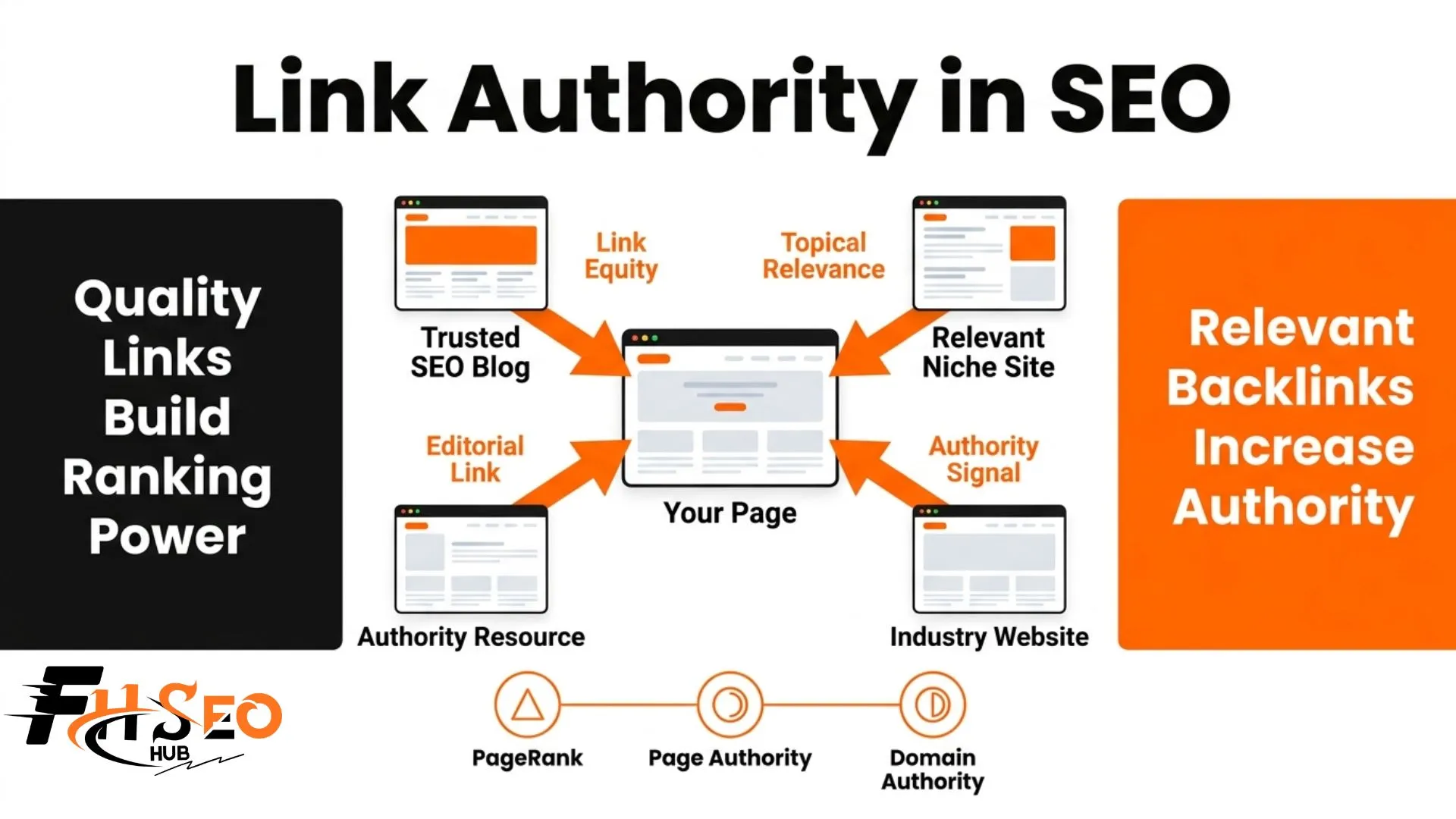
Link authority in SEO is the ranking power that a specific backlink transfers to the page it points to. That power comes from the quality, topical relevance and trustworthiness of the linking page, not just the domain it belongs to. Understanding this definition helps you stop chasing link volume and start targeting the links that shift rankings on individual pages.
Most SEOs encounter the terms link authority, domain authority, page authority and PageRank and assume they describe the same signal. They do not. Each one measures a different dimension of how search engines assess trust in a link. Treating them as interchangeable leads to distorted link building priorities and strategies that target the wrong numbers with the wrong resources.
This article explains each concept precisely, compares them directly, and tells you which signals matter most when building authority for a specific page. You will also learn how link authority connects to topical authority and when each one should take priority for a site at different stages.
What is link authority in SEO?
Link authority is the page-level SEO value that one page transfers to another through a hyperlink. It represents how much credibility and ranking power a specific link passes, based on the qualities of the page it originates from and how naturally the link is placed within that page’s content.
How link authority differs from general site authority
General site authority is a broader concept describing the overall trust a domain has accumulated. Link authority is more granular. Every page on your site carries its own link authority, built from the specific links pointing directly to it plus a share of authority flowing through internal links from other strong pages on the same domain.
Why link authority matters for every page on your site
Google relies on external signals because it cannot directly verify your expertise. When a credible site links to your page, it functions as a third-party endorsement that Google uses as a trust proxy. According to Semrush research in 2026, the median top-ranking page in Google has just 13 referring domains. Not hundreds. This reframes link building entirely: you need quality and topical alignment, not volume.
Understanding what link authority in SEO at the page level is changes how you evaluate every outreach decision. You stop treating backlinks as interchangeable and start assessing each one by the actual authority it will transfer. The next section compares this page-level signal to domain authority, the number most SEOs see in their dashboards but often misread.
Link authority vs domain authority: what is the difference?
Link authority is page-level and measures the ranking power of links pointing to a specific URL. Domain authority is a site-wide estimate from third-party tools that reflects the overall strength of an entire domain’s backlink history. They measure different things and neither is a direct Google metric.
How link authority and domain authority are calculated differently
Domain authority aggregates the backlink profiles of every page on a domain into one number. A high DA score tells you the domain as a whole has a strong link history, but it says nothing about any single page’s individual authority. A high-DA domain with a weak internal linking structure can have pages with very low page-level authority sitting on top of it.
Link authority operates at the page level. A page on a medium-DA domain that has earned twelve strong, contextual, topically relevant backlinks can outrank pages on much larger domains. This happens consistently in competitive SERPs, and it is why building page-level authority through targeted outreach beats broadcasting for general domain links.
Which one should you focus on for SEO?
Focus on page-level link authority as your primary target. When you run a link audit in Ahrefs, sort your key pages by URL Rating (UR) rather than Domain Rating. UR reflects the actual page-level authority flowing into that specific URL, which is the number that matters for the keywords you are trying to rank.
Domain authority improves as a byproduct of building strong page-level authority across your most important pages. Targeting a DA score directly is working backwards. Build the foundation at the page level and the domain metrics follow. From here, two additional metrics need clear explanation: page authority and the original PageRank algorithm.
Link authority vs page authority vs PageRank: A clear comparison
Page authority (PA) is Moz’s page-level equivalent of its domain authority score. PageRank is Google’s original internal algorithm for measuring page importance through link signals. Understanding what link authority in SEO is requires seeing how these metrics all describe the same underlying mechanism through different lenses.
What is page authority (PA) and how is it scored?
Moz’s Page Authority scores individual pages from 1 to 100 using a logarithmic scale. Moving from PA 20 to PA 30 requires less effort than moving from PA 70 to PA 80. Ahrefs’ page-level equivalent is URL Rating (UR). SEO PowerSuite uses InLink Rank, a 0-to-100 score that reflects page importance based on the quality and quantity of inbound links, including both external backlinks and internal links flowing through the site’s architecture.
All of these are third-party estimates of the same principle: pages that earn more and better links accumulate higher scores. They differ in methodology, index size, and weighting, which is why scores vary across tools for the same page.
What is PageRank and is it still used by Google?
PageRank was created by Larry Page and Sergey Brin as Google’s original ranking algorithm. Every page on the web received a numerical score based on the quality and quantity of links pointing to it, drawing on the logic of academic citations. Google removed the publicly visible Toolbar PageRank score in 2016, but the internal system never stopped running.
The 2024 Google API leak confirmed that Google still operates multiple PageRank variants internally. These include RawPageRank (the baseline link-based calculation), PageRank2 (an updated version), and PageRank_NS, the Nearest Seed variant. PageRank_NS appears to measure how topically close a page is to trusted seed domains, which influences how much authority a link from that page can pass forward. Every link building decision you make still feeds into a system whose foundational logic has been active since 1998.
How all three metrics relate to the same underlying concept?
| Metric | Created by | Measures | Scale | Still active? |
| Domain Authority (DA) | Moz | Site-wide backlink strength | 0-100 | Yes (Moz tool) |
| Domain Rating (DR) | Ahrefs | Site-wide backlink strength | 0-100 | Yes (Ahrefs tool) |
| Page Authority (PA) | Moz | Page-level link strength | 0-100 | Yes (Moz tool) |
| URL Rating (UR) | Ahrefs | Page-level link strength | 0-100 | Yes (Ahrefs tool) |
| InLink Rank | SEO PowerSuite | Page importance via links | 0-100 | Yes (SEO SpyGlass) |
| PageRank | Page importance via links | Internal | Yes (internal system) |
All five third-party metrics approximate the same mechanism PageRank introduced: links transfer value, and pages that accumulate more value rank higher. The tools differ in methodology and index coverage. What matters is not which tool scores highest. It is which types of links actually transfer the authority your pages need to compete. That leads directly into what makes a specific backlink genuinely high authority.
What makes a backlink high authority?
A high authority backlink comes from a page that is trustworthy, topically relevant to your content and editorially genuine in how it links. Five factors determine whether a specific link will transfer meaningful authority or contribute almost nothing to your rankings.
The 5 factors that determine a backlink’s authority level
- Page-level authority of the source: The linking page’s own accumulated link equity drives the transfer. A page with twenty quality backlinks pointing to it passes substantially more authority than a page with none, regardless of the domain name above it.
- Topical relevance of the linking page: A link from a specialist SEO publication to an SEO article carries stronger authority than a link from a general news aggregator with a higher domain rating. Topical alignment amplifies the raw authority signal Google reads from the link.
- Link placement within the content: Links placed in the editorial body copy of an article pass more authority than links in footers, sidebars, or site-wide navigation. Google understands placement context and weights accordingly.
- Anchor text descriptiveness: Natural, topic-relevant anchor text helps Google understand what your linked page covers and reinforces the topical signal. Over-optimized keyword anchors or generic phrases like “click here” provide less useful context.
- Dofollow vs nofollow status: A dofollow link actively passes link equity. A nofollow link (rel=”nofollow”) does not pass equity in the same way. Prioritize dofollow placements when building link authority for ranking purposes.
Outbound link selectivity on the linking page also matters. Sites that link to hundreds of external pages spread their authority thin across all of them. A site that links selectively, with clear editorial standards, concentrates more authority through each link it does place.
How to identify a high authority link opportunity
Ask three questions before investing in any link. Does this site publish consistently in my niche, and does its audience actually care about my topic? Does the specific page you want a link from have its own referring domains and organic traffic? Would this link still be valuable if search engines did not exist?
If all three answers are yes, you are looking at a genuine high authority opportunity. Two out of three is borderline. One out of three means the effort is unlikely to produce meaningful ranking improvement.
Link authority vs topical authority: two different things
Link authority and topical authority are distinct signals that Google evaluates separately. Link authority measures the strength of external links pointing to your specific pages. Topical authority measures how comprehensively your site covers a subject area. Optimizing for one while ignoring the other produces strategies that plateau predictably.
How link authority and topical authority work together
A page can accumulate strong link authority from high-quality backlinks but still plateau in rankings if the surrounding site lacks topical depth on the subject. Google does not evaluate your page in isolation. It considers whether the site the page sits on demonstrates genuine expertise through breadth and consistency of content on the same topic.
Topical authority is built through interconnected content covering every meaningful subtopic in a niche. When those pages also earn relevant backlinks, the two signals reinforce each other. The site becomes the most trusted source from both a content depth and external endorsement perspective and new pages published within that cluster earn rankings faster because the domain already carries topical credibility.
Conclusion
Link authority, domain authority, page authority, PageRank, and topical authority are all related but distinct signals. Link authority specifically measures the ranking power that individual backlinks transfer to a specific page, built through link equity flowing in from relevant, trusted sources over time. Domain authority is a third-party site-wide estimate, not a Google metric. PageRank is still active internally, confirmed by the 2024 Google API leak and still sits at the core of how Google evaluates the value of links.
The most direct lever you have for improving rankings on any specific URL is building what is link authority in SEO at the page level: earning quality, topically relevant, editorially placed backlinks that transfer genuine authority to the pages that need it.


