What Is a Conservative Search Engine? Top 10 Conservative Search Engines

A conservative search engine is a broad label covering two distinct types of Google alternative. The first is privacy-focused search engines that don’t track users, build profiles, or serve targeted ads. The second is ideologically conservative search engines that deliberately surface right-leaning content and news sources mainstream engines are perceived to downrank.
The privacy-focused group, DuckDuckGo, Brave Search, Startpage, and Mojeek among them, isn’t politically anything. These tools appeal to conservatives mainly through independence from Big Tech and a refusal to track users, not through any partisan slant in results. The ideologically conservative group, mainly FreeSpoke and Tusk Search, specifically markets viewpoint diversity and right-of-center content framing. Conflating the two is the most common mistake people make when choosing one.
Why Are People Switching to Conservative Search Engines?
People switch to conservative and privacy-focused search engines mainly over concerns about tracking, user profiling, targeted ads, and perceived search result bias. A broader distrust of how much personal data Big Tech search platforms collect, and how their algorithms rank politically sensitive topics, adds to the pull.
The privacy motivation and the ideological motivation often overlap in the same user, but they aren’t the same thing. Someone worried about their digital footprint, third-party trackers, and search history being tied to their IP address wants a private search engine. Someone who believes mainstream results filter or downrank certain viewpoints, a concern often framed around censorship and free speech, wants an ideologically conservative one that promises more unbiased search results. Both concerns are real drivers of the switch, and the best tool depends entirely on which one matters more to you.
Key Benefits of Using Conservative Search Engines
The main benefits of conservative and privacy-focused search engines are no user tracking, no personal data collection, reduced targeted advertising, stronger encryption of search activity, and independence from Big Tech ranking systems. The specific mix of benefits varies significantly from one engine to the next.
Not every engine on this list delivers every benefit. Some run their own independent search index, giving genuine ranking independence. Others are privacy layers over Google or Bing, delivering familiar result quality without the tracking but no true algorithmic independence. Some are ad-free search entirely, while others still show ads based only on your current query without building a long-term profile. Knowing which benefit you genuinely want prevents choosing an engine that markets privacy but doesn’t deliver the specific protection you assumed it did.
Features to Look for in a Conservative Search Engine
Key features to evaluate include whether the engine uses its own independent search index or relies on Google or Bing, plus its tracking and data collection policy. Also weigh encryption and HTTPS support, whether it serves ads or is fully ad-free, and its jurisdiction, since privacy law differs sharply between the US, EU, and Switzerland.
Independent indexing matters most for anyone specifically wanting results not shaped by Google or Bing’s search algorithm, since a privacy layer over Google still returns Google’s rankings. Jurisdiction matters more than most people realize. An engine based in Switzerland or the EU operates under stricter privacy law like GDPR than a US-based one. Ad model matters too: free engines fund themselves through non-personalized ads, affiliate links, or donations rather than selling your data, so “free” doesn’t mean there’s no business model behind it.
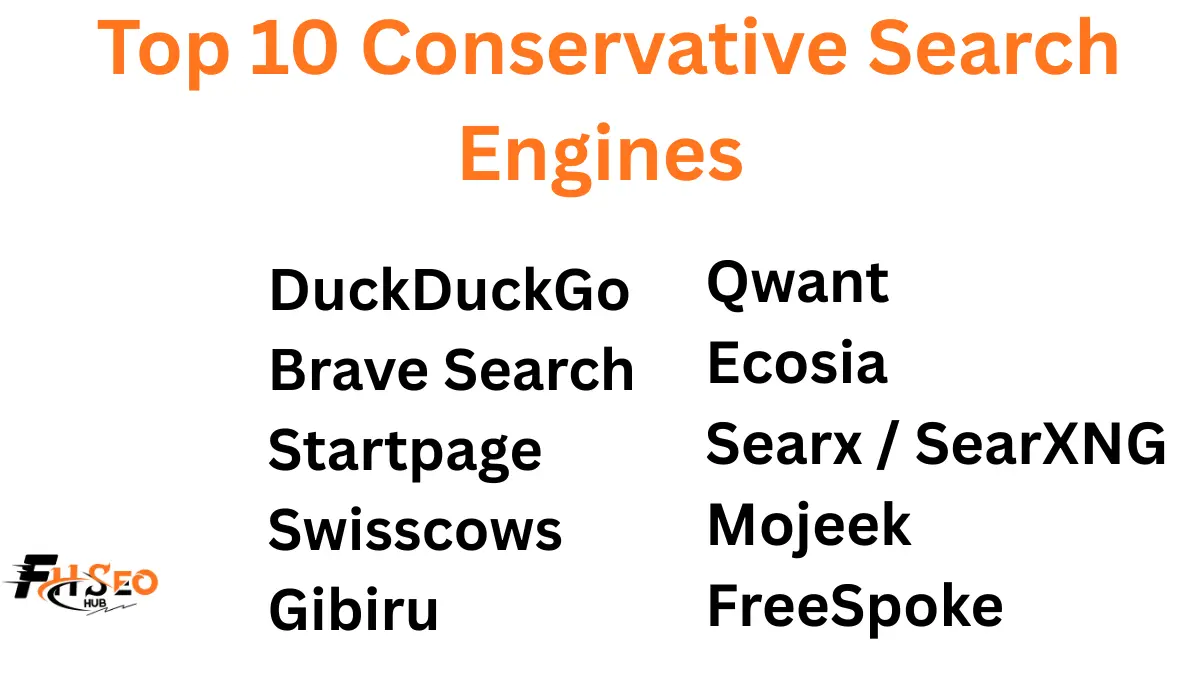
Top 10 Conservative Search Engines
These ten span both categories, privacy-focused and ideologically conservative. They’re ranked here by a mix of independence, privacy strength, and how well each fits the conservative-search use case rather than a single universal metric.
1. DuckDuckGo
DuckDuckGo is the most popular privacy-focused search engine, built around a single promise since 2008: no tracking, ever. It doesn’t profile users or tie searches to an identity, and it adds privacy grading, instant answers, HTTPS by default, and its “bangs” shortcut system for searching other sites directly.
DuckDuckGo pulls a meaningful share of its results from Bing rather than a fully independent index, so it isn’t algorithmically independent the way some alternatives are. It also still shows ads based on your current query, though without building a long-term profile. For most people wanting easy, cross-platform private search without changing their workflow, it remains the pragmatic default.
2. Brave Search
Brave Search, launched by Brave Software in 2021, runs on its own genuinely independent search index rather than relying on Google or Bing. This makes it one of the few options offering real ranking independence from Big Tech. It doesn’t track users, store personal data, or profile behavior, and trackers are off by default.
Brave Search integrates tightly with the Brave browser and its broader crypto ecosystem, and it added AI features through Brave Leo. The trade-off with independent indexing is occasional misses on obscure or niche queries, where a Google-backed engine would return more comprehensive results. For anyone prioritizing genuine independence from Big Tech ranking, Brave Search is the strongest pick on this list.
3. Startpage
Startpage delivers Google-quality search results without the tracking, acting as a privacy layer between you and Google. You get familiar Google result quality with no profiling, plus an Anonymous View proxy that lets you open result pages without the destination site seeing your real IP address.
Startpage is based in the EU and operates under GDPR, appealing to users who want a European privacy legal framework specifically. The honest caveat: because it draws results from Google’s index, it delivers no algorithmic independence, you’re getting Google’s rankings, just privately. For users who want Google’s result quality without Google’s tracking, nothing else matches it.
4. Swisscows
Swisscows is a family-friendly, privacy-focused search engine based in Switzerland, using AI semantic search to cluster related concepts while filtering explicit content by default. It stores no cookies, doesn’t track users, and operates under Swiss privacy law, which is among the strictest in the world.
Swisscows suits families and anyone wanting a family-friendly search environment built in rather than added on, and it’s fully ad-free. The semantic clustering approach works well for conceptual research but can feel less comprehensive than a mainstream engine on straightforward queries. Its Swiss jurisdiction is a genuine privacy advantage worth weighing against raw result breadth.
5. Gibiru
Gibiru markets itself around uncensored, unfiltered search results, built on a modified Google index with what it presents as an enhanced privacy mode and no long-term data collection. It positions itself specifically for users who believe mainstream engines filter or downrank certain content and news sources.
Since Gibiru is based on a modified Google index rather than a fully independent one, its “uncensored” positioning is more about surfacing results Google might rank lower than about a genuinely separate ranking system. It’s a reasonable pick for anyone specifically seeking less-filtered results. Treat the independence claims with the same scrutiny you’d apply to any engine built on top of Google.
6. Qwant
Qwant is a European, privacy-focused search engine that doesn’t track users or build profiles, delivering neutral results under European privacy standards with no personalized ads. It includes a Qwant Junior mode for children and separates results into web, news, and social sections.
Qwant appeals most to European users and families wanting an alternative to large US search platforms specifically, with its EU jurisdiction as a core selling point. Like several options here, it delivers privacy strongly but partial algorithmic independence, since it has historically relied on Bing for some results. Its family mode and European framing are its genuine differentiators.
7. Ecosia
Ecosia is a privacy-conscious search engine that uses ad revenue from searches to fund tree planting, anonymizes queries, runs on renewable energy, and publishes transparent financial reporting on where its money goes. It appeals to eco-conscious users who also want reduced tracking.
Ecosia isn’t a maximum-privacy or ideologically conservative option specifically, its differentiator is the environmental mission, funding tree planting through search ad revenue. It draws results partly from Bing, so it isn’t independently indexed. For users whose priority blends reduced tracking with an eco-friendly mission, it’s a genuine standout, though privacy purists will find stronger options elsewhere on this list.
8. Searx / SearXNG
Searx, and its actively maintained fork SearXNG, is a free, open-source metasearch engine that aggregates results from multiple sources without tracking users or storing data. It can be self-hosted for complete control over your own private search instance.
This is the most technically involved option here, and also the most private for anyone willing to self-host. Running your own SearXNG instance means no third party sees your queries at all, a level of control no hosted service can match. The trade-off is genuine setup effort, this suits technically capable users specifically, not people wanting a simple hosted search box. Public instances exist but vary in reliability and trustworthiness.
9. Mojeek
Mojeek runs its own genuinely independent search index, one of very few engines that crawls and ranks the web entirely on its own rather than pulling from Google or Bing. It doesn’t track users, is fully ad-free, and markets itself around ethical, transparent, independent search.
Mojeek offers the strongest algorithmic independence on this list alongside Brave Search, since it relies on no Big Tech index whatsoever. The honest trade-off is index size: an independent crawler covers less of the web than Google’s, so results can feel thinner on obscure queries. For anyone whose top priority is genuine independence from Big Tech ranking, Mojeek and Brave Search are the two standouts.
10. FreeSpoke
FreeSpoke is one of the clearest examples of an ideologically conservative search engine. It’s built specifically around uncensored search, news transparency, and surfacing right-of-center content and news framing that it presents as downranked on mainstream engines. This is a genuinely different product from the privacy-focused options above.
FreeSpoke belongs in the ideological category, not the privacy-maximizing one. Its differentiator is viewpoint diversity and conservative-friendly news framing, not zero-tracking privacy engineering. For users specifically wanting right-leaning results and alternative news framing rather than raw privacy, FreeSpoke and Tusk Search are the two most relevant options in 2026, distinct from everything else on this list.
Conservative Search Engine Comparison Table
Each engine below is categorized by whether it’s primarily privacy-focused or ideologically conservative, since that distinction matters more than any single feature.
| Search Engine | Independent Index | Category | Best For |
| DuckDuckGo | No (Bing-based) | Privacy | Easy everyday private search |
| Brave Search | Yes | Privacy | Genuine independence from Big Tech |
| Startpage | No (Google proxy) | Privacy | Google quality without tracking |
| Swisscows | Partial | Privacy | Family-safe, Swiss privacy law |
| Gibiru | No (Google-modified) | Privacy-leaning | Less-filtered results |
| Qwant | Partial (Bing-based) | Privacy | European users and families |
| Ecosia | No (Bing-based) | Eco-conscious | Tree planting mission |
| Searx / SearXNG | Metasearch | Privacy | Self-hosted maximum privacy |
| Mojeek | Yes | Privacy | Maximum algorithmic independence |
| FreeSpoke | No | Ideological | Right-leaning content and news |
Other Notable Private/Conservative Search Engines
Beyond the top 10, several additional engines fit one category or the other and are worth knowing depending on your specific priority.
Tusk Search sits alongside FreeSpoke in the ideologically conservative category, offering right-of-center results connected to a browser ecosystem. MetaGer is a German, non-profit metasearch aggregator with strong EU privacy protections. YaCy is a fully decentralized, peer-to-peer open-source search engine with no central server at all. Disconnect Search and Ghostery both come from privacy-tool companies focused on blocking third-party trackers. Yippy, once known for clustering results into topic folders, has largely faded from active use. Yandex, while a major independent index, is Russia-based and carries its own distinct jurisdiction and data considerations most privacy-focused users weigh carefully.
Which Search Engine Is the Most Private?
For maximum privacy, self-hosted SearXNG offers the strongest protection since no third party ever sees your queries. Independent-index engines like Mojeek and Brave Search follow, since they neither track you nor depend on Big Tech. Among hosted mainstream options, DuckDuckGo, Startpage, and Brave Search are the standard privacy picks.
The honest caveat every credible source repeats: none of these is a perfect anonymizer. Business models, technical limits, and back-end result providers mean privacy gains are meaningful but partial. Pairing any private search engine with a VPN, an ad blocker, and incognito mode strengthens overall anonymity far more than the search engine choice alone does. For genuine anonymity rather than just reduced tracking, the search engine is one layer, not the whole solution.
Can Alternative Search Engines Replace Google?
Alternative search engines can replace Google for most everyday searches, particularly Startpage and Brave Search, which deliver comparable result quality. Independent-index engines like Mojeek cover less of the web, so power users running obscure or highly specific queries may still occasionally need Google or Bing as a fallback.
The realistic answer is “mostly, with caveats.” Privacy-layer engines like Startpage return Google’s own results, so quality is identical. Independent-index engines trade some result breadth for genuine independence, a fair trade for most searches but occasionally limiting on niche queries. Setting a private engine as your default search engine and keeping Google available for the rare query that needs it is the practical setup most people land on rather than a hard, all-or-nothing switch. Diversifying which engines you rely on also mirrors a broader shift in types of traffic sources that marketers track as search fragments across more platforms.
The Future of Conservative Search Engines
The future of conservative and privacy-focused search engines points toward continued growth driven by privacy regulation, AI-powered search features, and ongoing distrust of Big Tech. Independent-index engines and paid ad-free models like Kagi are gaining ground as users grow more willing to pay for search that doesn’t monetize their data.
Two trends stand out for 2026. First, AI search features are arriving across privacy engines, Brave Leo being one example, closing the capability gap with mainstream engines. Second, the paid model is gaining legitimacy. A subscription like Kagi’s roughly $10 a month funds search without ads or data harvesting at all, an approach a growing segment of privacy-conscious users increasingly prefers over free-but-ad-supported alternatives. The ideological category remains smaller and more niche, but the privacy category is genuinely maturing.
Conclusion
Choosing a conservative search engine starts with one honest question: do you want privacy and no tracking, or ideologically right-leaning results? They’re different goals served by different tools, and conflating them is the mistake most people make. For private everyday search, DuckDuckGo, Startpage, or Brave Search cover most needs. For genuine independence from Big Tech ranking, Mojeek or Brave Search stand out. For specifically right-leaning content and news framing, FreeSpoke and Tusk Search are the relevant picks. And remember that no search engine is a complete privacy solution on its own. Pairing your choice with a VPN and an ad blocker does more for real anonymity than the engine alone ever will.
FAQs
There’s no single best option, since it depends on whether you want privacy or ideologically right-leaning results. For privacy, Brave Search, DuckDuckGo, and Startpage lead. For specifically conservative-leaning content and news framing, FreeSpoke and Tusk Search are the most relevant picks in 2026.
No search engine is completely unbiased. Every engine makes decisions about crawling, indexing, ranking, content policies, and legal compliance that shape results. A conservative or privacy-focused engine may reduce certain forms of perceived bias, but it can introduce other preferences based on its mission, audience, or source selection.
Most are free, including Brave Search, DuckDuckGo, Startpage, Mojeek, Qwant, Ecosia, and Swisscows. They’re funded through non-personalized ads, affiliate links, or donations rather than selling user data. Kagi is the main paid exception at roughly $10 a month for a fully ad-free experience.
A private search engine focuses on not tracking you, DuckDuckGo, Startpage, Brave Search. An ideologically conservative search engine focuses on surfacing right-leaning content and news, FreeSpoke, Tusk Search. The terms get used interchangeably, but they describe genuinely different goals and tools.
Yes. Every major browser lets you set a custom default search engine, and most private engines like DuckDuckGo, Brave Search, and Startpage offer easy setup or browser extensions. Many users set a private engine as default while keeping Google available for the occasional query that needs it.
Yes, and pairing them is genuinely recommended. A VPN hides your IP address and location while the private search engine avoids tracking your queries. Adding an ad blocker and incognito mode on top strengthens overall anonymity far more than any single tool does alone.


