What Is Predictive SEO? Complete Guide to Ranking before Trends Peak

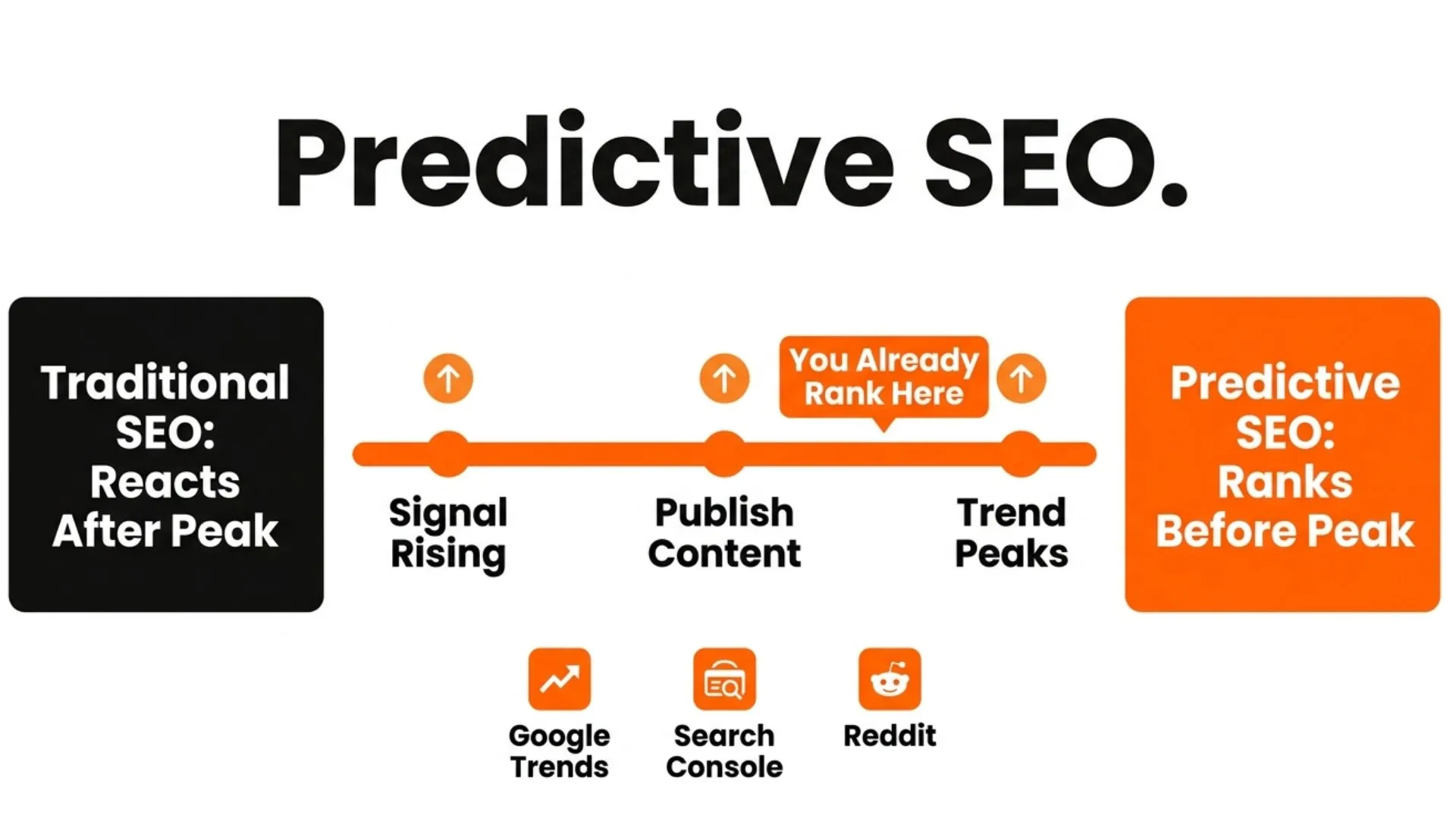
Predictive SEO is a proactive, data-driven approach to search optimization that uses historical data patterns, AI-driven forecasting and machine learning models to anticipate what users will search for before those searches peak in volume. Instead of reacting to trends that are already competitive, you position your content to rank during the early window before competition arrives.
By the time most SEOs notice a trending keyword, the opportunity is already shrinking. This approach solves that problem by letting you claim the ranking territory before the race even starts.
What is predictive SEO?
Predictive SEO is a forward-looking strategy that helps you create and optimize content before search trends reach their peak. It uses pattern recognition at scale, historical data analysis and AI-driven forecasting to identify what your audience will search for next month, next quarter or next year.
The simplest way to understand it is through contrast. Traditional SEO is like driving while looking in the rearview mirror. You react to what you already passed. Predictive SEO is like having a GPS that shows what lies ahead on the road before you reach it. You plan your route before the journey starts rather than correcting your path after taking the wrong turn.
For example you run a sustainable products store. Analyzing Google Search Console data over three months, you notice “compostable packaging” gaining impressions month over month even though volume is still small. You create comprehensive content on that topic now. By the time “compostable packaging” becomes a high-volume search term, you have already established topical authority. You rank faster, capture more traffic and beat competitors who waited until the keyword was saturated.
What makes predictive SEO different from traditional keyword research?
Traditional keyword research targets keywords that already show significant search volume. You find what is popular now and compete for it. Predictive keyword demand forecasting identifies keywords while they are still rising, before competition shows up. The difference is purely timing. Early ranking acquisition during low-competition windows produces compounding advantages that post-peak optimization rarely matches.
How does it differ from traditional SEO?
| Factor | Traditional SEO | Predictive SEO |
| Core approach | Reactive (responds to current data) | Proactive (forecasts future trends) |
| Keyword timing | Targets keywords at or after peak | Targets keywords before they peak |
| Content creation | Based on current search volume | Based on trend trajectory and signals |
| Algorithm response | Scrambles after updates hit | Anticipates shifts before they arrive |
| Competitive advantage | Fights for existing rankings | Claims territory before competition arrives |
| Data used | Rankings and current volume | Trend forecasting and behavioral signals |
| Best tools | Standard SEO tools | Google Trends, Exploding Topics, Glimpse |
The practical outcome is simple: reactive SEO keeps you busy without keeping you ahead. Predictive SEO trades some guesswork for systematic trend monitoring and rewards you with earlier rankings, lower competition levels and stronger topical authority when demand eventually peaks.
Why does predictive SEO matter more in 2026?
Google’s algorithm no longer updates just a few times a year. Between core updates, helpful content updates, spam updates, and the rollout of AI-powered search experiences like Search Generative Experience (SGE) and Google Gemini, the search landscape shifts constantly. By the time most sites react to a change, that change has already affected their rankings.
Three factors make this approach especially critical:
- Google AI Overviews and LLM-powered answers have changed how visibility works. Being cited in AI-generated summaries requires topical authority built before AI systems start covering a topic at scale. Early coverage creates that authority window before competitors arrive.
- Search Everywhere Optimization has expanded the battlefield. Users now discover content through TikTok, YouTube, Reddit and ChatGPT Search, not just Google. Predicting which topics will matter across these platforms before they trend gives you compounding multi-channel advantage.
- Micro-intent targeting has replaced broad keyword coverage as the primary winning strategy. Narrow, specific intents that emerge before broad keyword demand develops are the biggest opportunities available in 2026. Forward-looking SEO strategy finds these before competitors do.
How do AI Overviews change the urgency of acting early?
Google AI Overviews cite sources with established topical authority and comprehensive entity coverage. The brands that publish content on an emerging topic early and structure it for AI parsing build citation-worthy authority before competing pages even exist. By the time AI Overviews begin covering a topic at scale, your content carries the entity trust and depth needed to be selected.
How does it work in practice?
Predictive SEO works by monitoring multiple early demand signals simultaneously rather than waiting for search volume to validate a topic.
The core signals to track:
How do customer support and live chat signals predict future search trends?
Mining your own customer support tickets and live chat conversations is one of the most underused and most powerful predictive signals available for free. Users ask questions in live chat before those questions appear in Google Search. One SaaS startup noticed patterns in their customer support queries for features not yet searched on Google. They created content addressing those queries. Three months later, those exact topics started gaining global search traction. Because the content already existed and had started building topical authority, they ranked easily for newly competitive terms without the usual fight.
What are the best strategies to use today?
| Strategy | Difficulty | Impact | Best Tool |
| Track rising queries in Search Console | Low | High | Google Search Console |
| Monitor content engagement patterns | Low | Medium-High | GA4, MonsterInsights |
| Identify early content gaps | Medium | High | Semrush Topic Graph, Ahrefs |
| Detect search intent shifts | Medium | High | Google Trends, SERP analysis |
| Mine Reddit and forum signals | Low | Very High | Reddit, community boards |
| Seasonal pattern forecasting | Low | High | Google Trends year-over-year |
| Structure content for AI Overviews | High | Very High | Structured data, GEO optimization |
Two strategies from the table deserve special attention because competitors consistently underestimate them.
Reddit and forum signal mining is free, requires no tools, and typically gives you a two to six week head start on formal search volume appearing in keyword tools. When a subreddit discussion around a topic starts generating upvotes and comments consistently, that topic becomes a formalized Google search within the following month.
How does Predictive SEO connect to semantic SEO and GEO?
Predictive SEO and semantic SEO work together as a compound strategy. One identifies which topics will matter next. The other structures your content around entity relationships, topic clusters and internal linking to build the topical authority those future topics need to rank when they arrive.
Both feed Generative Engine Optimization (GEO) in 2026. AI systems like Google AI Overviews, ChatGPT and Perplexity don’t just rank pages. They evaluate entity authority across complete topic clusters. When your site covers an emerging topic comprehensively and early through predictive research and structures that coverage through semantic topic clusters, AI systems recognize the entity trust and topical depth needed to cite your content in generated answers.
What common mistakes destroy your results in this SEO strategy?
The most damaging mistakes share a common thread: prioritizing comfort over early action.
The core takeaway
Predictive SEO is not a separate discipline from SEO. It is the mindset shift that separates sites that react to rankings from sites that shape them. Start with what you already have: your Search Console rising queries, your GA4 engagement patterns, and a weekly habit of checking Reddit and Google Trends in your niche. Those three free signals, acted on consistently, will place your content ahead of competitors who are still waiting for the keyword to become popular before they write about it.


