
How to Build Topical Authority for a Website: Step-by-Step Strategy Guide at FHSEOHub

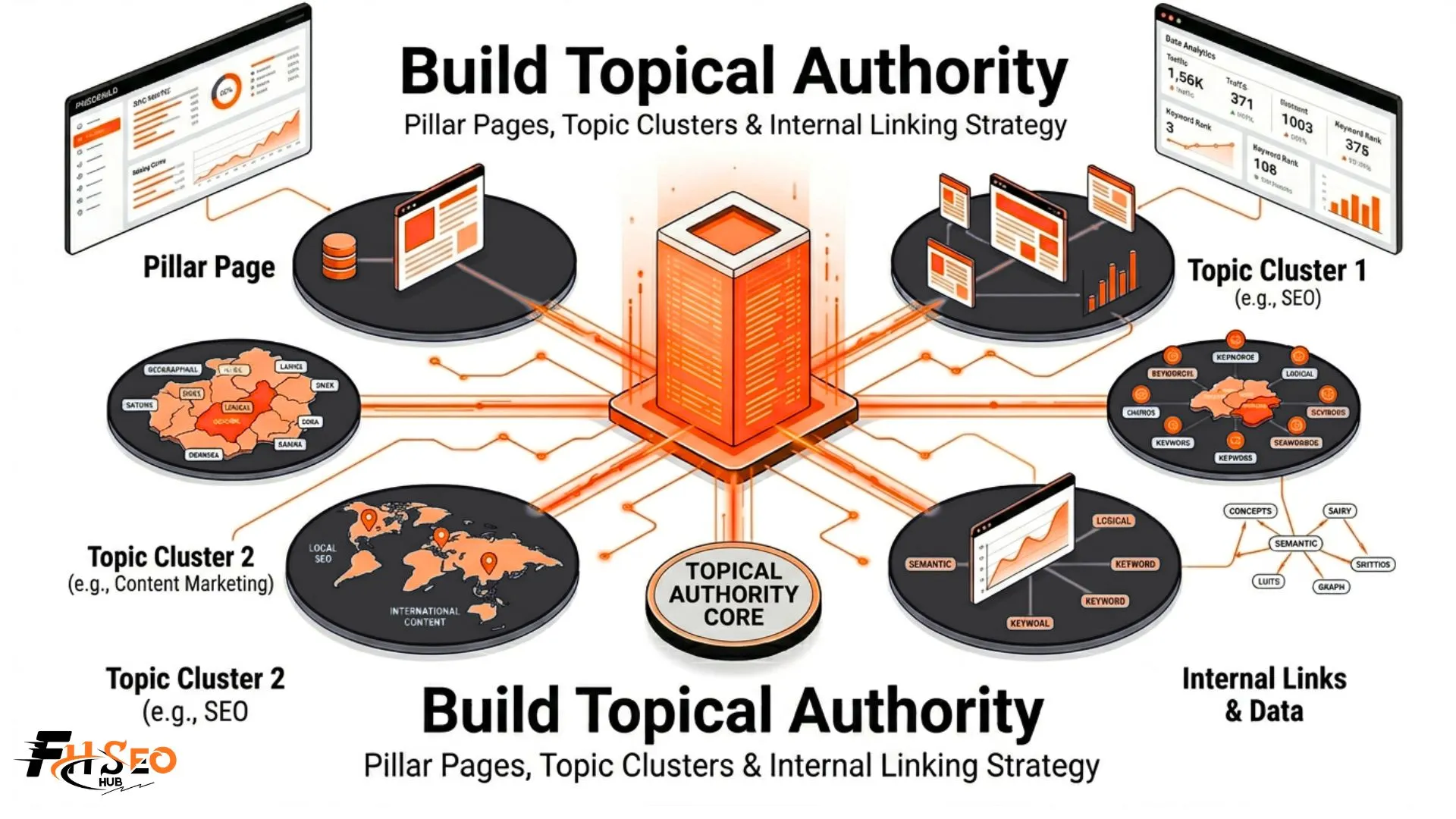
To build topical authority for a website, you need to cover one topic more comprehensively than anyone else through interconnected pillar pages, topic cluster articles and strategic internal linking. Most sites skip the structure and publish randomly. This guide gives you the exact system: topical map, content clusters, internal links and measurement.
If you are not sure what topical authority means yet, read our guide on what is topical authority before diving into the build process.
How to build topical authority for a website (step by step)
Most content teams know they need topical authority but have no system for building it. Here is the process that works.
Step 1: Choose your core topic and define your niche
Before writing a single word, define the semantic boundary of your topic. “Fitness” is too broad. “Strength training for women over 40” is a semantic boundary. The tighter your niche, the faster you reach comprehensive coverage and the sooner Google associates your domain with that specific subject.
Step 2: Research all subtopics your audience cares about
List every question, concern, use case and subtopic your target reader would search for within your defined niche. Do not start with keywords. Start with topics. Questions your audience asks at every stage from beginner to advanced. This list becomes the skeleton of your topical map.
Step 3: Plan your content before you write a single word
Map every piece of content you need before publishing anything. Group your subtopics into clusters. Assign each cluster a pillar page and supporting articles. This planning step saves months of disorganized publishing and ensures every article reinforces the others.
How to start if your website is brand new
For new websites, publish your pillar page first. It establishes the topical center of gravity for everything else. Then expand outward with cluster articles, one subtopic at a time. Do not scatter content across multiple topics in the early months. Pick one topic cluster and saturate it completely before touching a second.
How long does topical authority take to build?
Realistic timeline for new sites starting from zero:
What is a topical authority content strategy?
A topical authority content strategy is a system for achieving comprehensive coverage of one subject area before expanding to others. It is not a content calendar and it is not a keyword list. It is a structured plan that starts with topics, maps all subtopics, and then assigns keywords to each piece.
What is a topical map and why you need one before writing
A topical map is a hierarchical document that organizes your entire content plan around a core topic before any keyword research begins. It shows which subtopics you need to cover, how they relate to each other and which articles will form the pillar versus the cluster.
Without a topical map, you publish reactively. With one, you publish with purpose.
How to build a topical map step by step
- Write your core topic at the top of a document
- List every major subtopic under it (these become cluster groups)
- Under each subtopic, list every specific question or angle (these become individual articles)
- Prioritize clusters by audience need and business relevance
- Then run keyword research to find the search terms for each item on your list
This sequence matters. Topic first. Keywords second.
How many articles do you need?
Article count by site size:
The 2026 benchmark from SearchAtlas analysis of 400 campaigns: 25 to 30 interlinked articles within a single cluster is the minimum to produce measurable topical authority gains.
Pillar pages and content clusters: how to structure your content
This is where most sites get the structure wrong. They publish articles but they do not connect them. The pillar-cluster model solves this.
What is a pillar page and what goes in it?
A pillar page is a comprehensive overview of your core topic. It covers every major aspect of the subject at a high level and links out to every cluster article for deeper coverage. Target length: 3,000 to 5,000 words. The pillar does not go deep on any single subtopic. It goes broad, then points readers (and Google) to the articles that go deep.
What is a topic cluster and how does it support the pillar?
Topic cluster articles are the spoke content in your hub-and-spoke model. Each cluster page covers one specific subtopic in depth, targeting 1,200 to 2,500 words. Every cluster article links back to the pillar page. The pillar links out to every cluster article. Together they form a content web that signals comprehensive topical coverage to search engines.
How to create a content cluster
- Identify one subtopic from your topical map
- Write one dedicated cluster article targeting that subtopic
- Include a contextual internal link back to your pillar page
- Update your pillar page to include a link down to the new cluster article
- Repeat for each subtopic until the cluster is complete
The difference between a topic cluster and a content silo
Content silos isolate topics from each other. They prevent internal link flow between subject areas to maintain strict separation. Topic clusters connect everything. Cluster articles link to the pillar, to each other where relevant and receive links from popular pages. Clusters distribute authority. Silos contain it. In 2026, connected clusters consistently outperform isolated silos for topical authority building.
How to use internal linking for topical authority
Internal linking is not optional when building topical authority. It is the connective tissue that holds the entire topic cluster together and distributes authority through the site.
Why internal linking is the glue of topical authority
Without internal links connecting your cluster articles to your pillar, Google sees a collection of disconnected pages. With proper internal linking, Google sees a coherent knowledge structure. The difference in ranking outcomes is significant. Sites with properly structured internal linking within a cluster consistently outrank those without it, even when the content quality is comparable.
The hub-and-spoke internal linking model
The directional flow of links within a topical cluster:
How to choose anchor text for internal links
Use descriptive, keyword-relevant anchor text that tells both readers and Google what they will find when they click. “Click here” and “read more” add no topical signal. “Strength training exercises for beginners” and “how to track protein intake” carry real semantic value. Vary anchor text across different links pointing to the same page to avoid over-optimization.
Common internal linking mistakes to avoid
How to measure topical authority: tools and metrics
No single tool gives you a topical authority score. What you measure are proxy metrics that together give an accurate picture of where your topical authority stands.
Best tools to measure topical authority in 2026
How to do a topical audit of your website
Five steps:
- List every published article on your site
- Group articles by topic cluster they belong to
- Identify gaps where subtopics on your topical map have no corresponding content
- Check internal linking coverage: every cluster article linked to pillar, pillar linked to all clusters
- Identify thin or outdated content pulling down cluster authority and update or consolidate
Key metrics to track by cluster
The core takeaway
Building topical authority for a website is not about publishing more content. It is about publishing the right content in the right structure with the right connections. Build your topical map before writing anything. Create a pillar page first and expand outward. Connect every cluster article back to the pillar. Measure coverage gaps and fill them systematically. Sites that follow this system consistently compound their rankings over time. Your topical map is the highest-leverage document in your content strategy. Build it before you write your next article.


