Best Organic Traffic Forecasting Tools Compared: Ahrefs vs Semrush vs GA4 vs Free Options

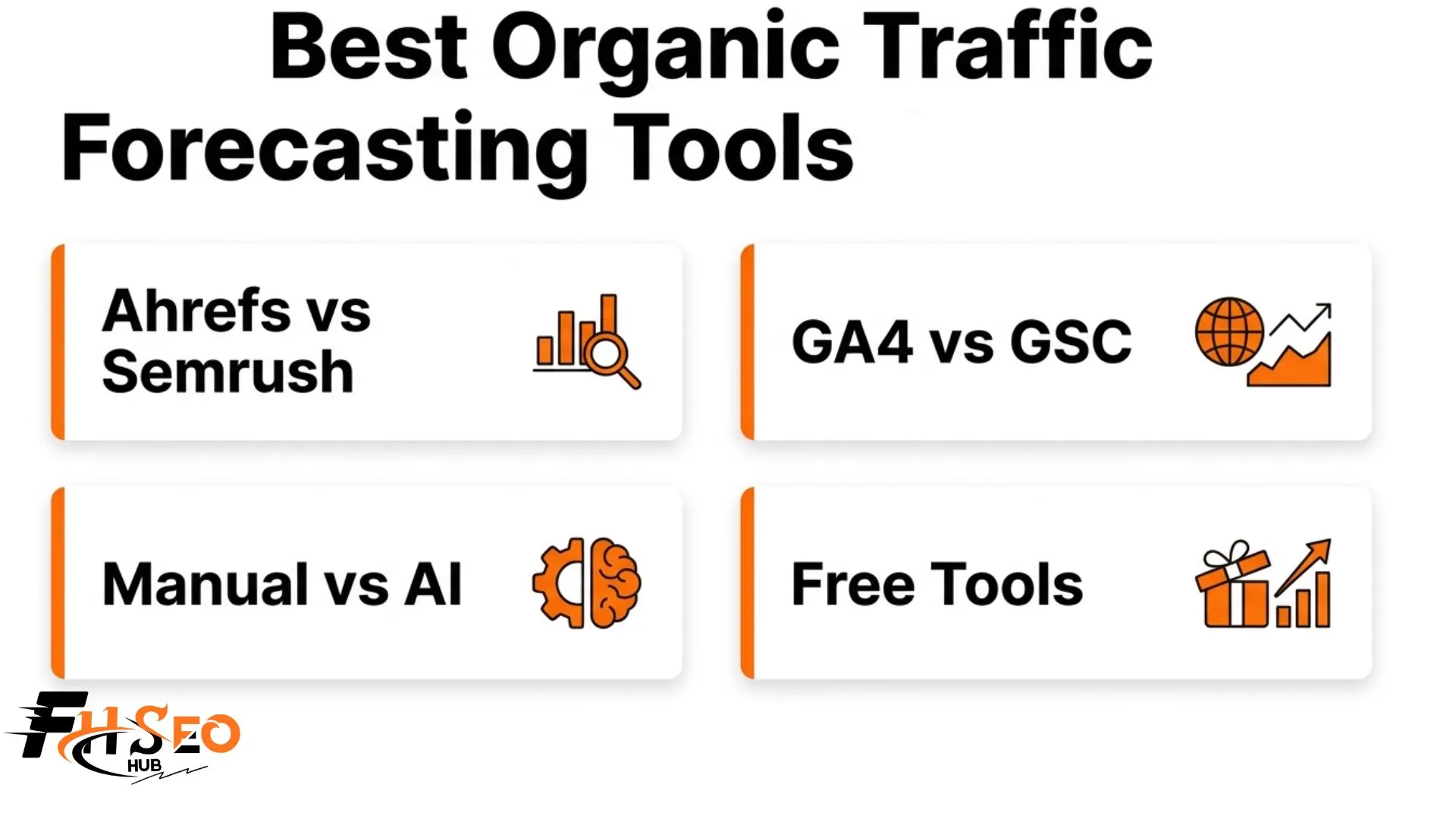
The best organic traffic forecasting tools in 2026 are Ahrefs and Semrush for keyword-level projections, Google Search Console and Google Analytics 4 for first-party historical data, and Google Sheets or the Animalz free tool for forecasting without a paid subscription. The right choice depends entirely on your budget, team size and what you need the forecast to prove.
Most SEO professionals already have two or three of these tools. The problem is they never use them for forecasting. They use Ahrefs for keyword research, Google Analytics 4 for traffic monitoring and Google Search Console for technical audits but never connect them into a single projection model.
What Separates the Best Organic Traffic Forecasting Tools from the Rest
Before comparing individual platforms, three factors determine whether a tool produces forecasts worth trusting:
A tool can have millions of keywords in its database and still produce unreliable forecasts if its CTR model uses outdated benchmarks or its volume data is six months stale. Keep this in mind throughout every comparison below.
Ahrefs vs Semrush for Traffic Forecasting: Which Wins?
Ahrefs and Semrush are the two dominant SEO forecasting platforms on the market and they approach forecasting very differently.
Ahrefs
Ahrefs is stronger for page-level forecasting. Its Traffic Potential metric shows the total organic traffic a page could receive if it ranked number 1 for its main keyword, but it accounts for all the related keywords that same page would also rank for. This is more useful than single-keyword volume estimates because it reflects how search actually works.
Ahrefs also provides keyword volume forecasts inside Keywords Explorer for projected future search demand. Its crawler updates data frequently and its keyword database accuracy is well regarded, particularly for international markets.
Semrush
Semrush has more granular data for US markets and tends to report higher search volume estimates for many keywords. Its Traffic Analytics feature estimates domain-level and page-level organic traffic in near real time, making it useful for competitive benchmarking inside your forecast model.
Semrush also has stronger white-label reporting features and a more polished client export experience, which matters for agencies building forecast reports for external stakeholders.
Head-to-Head Verdict
GA4 vs Google Search Console: Which Source Is Better for Forecasts?
This comparison confuses a lot of SEO practitioners because both tools show organic traffic data. They are not interchangeable and they answer different questions.
Google Search Console
Google Search Console is the better source for building keyword-level forecasts. It provides exact clicks, impressions, CTR and average position by search query directly from Google. No third-party interpretation sits between you and the data.
For forecasting specifically, Google Search Console lets you:
Google Analytics 4
Google Analytics 4 is the better source for extending your traffic forecast into business outcomes. Once you have projected organic visits, GA4 gives you the conversion rate, engagement rate and revenue per session data needed to translate those visits into leads or sales.
GA4 also provides a more complete picture of organic traffic by landing page, which helps you identify which content types produce the most valuable traffic, not just the highest volume.
The Right Answer
Use Google Search Console to build your traffic projection. Use Google Analytics 4 to connect that projection to conversions and revenue. Anyone presenting an organic traffic forecast without both data sources is working with half the picture.
Manual Spreadsheet Forecasting vs AI-Based Tools
The choice between a manual Google Sheets model and machine learning forecasting tools comes down to what you are optimizing for: transparency or statistical precision.
Manual Forecasting
A manual model in Google Sheets or Microsoft Excel gives you complete control over every assumption. Every input is visible and every calculation can be explained in plain English during a client meeting. This transparency is often more valuable than statistical sophistication when stakeholders want to understand how numbers were produced.
Manual models are also free, fast to update, and easy to share with anyone on the team regardless of their technical background.
AI and Machine Learning Tools
Python Prophet is an open-source time series analysis library that handles trend changes, seasonal patterns and outliers automatically using machine learning. For sites with 18 or more months of consistent traffic data, it produces statistically more reliable projections than a linear manual model.
Other automated forecasting tools worth knowing:
Which Produces More Accurate Forecasts?
For sites with strong historical data, Python Prophet and similar ARIMA-based models win on statistical accuracy. For most agency use cases, a manual Google Sheets model updated monthly with actual data performs reliably and produces forecasts that clients trust because the math is visible. Use both if you can: build the manual model for presentations and run the AI tool as an internal cross-check.
Best Free Organic Traffic Forecasting Tools in 2026
You do not need a paid subscription to forecast organic traffic accurately. These free tools together cover the complete process:
A freelancer or small business owner can produce a complete, credible organic traffic forecast using only this list. API access and enterprise features add convenience and depth but they are not required to build a projection that holds up in a client meeting.
Which Tool Fits Your Situation?
Freelancer or Solo SEO Consultant
Google Search Console plus Google Sheets plus Google Trends covers everything at zero cost. Add Ahrefs if budget allows since its keyword data is the cleanest for building cluster-level projections. Animalz free tool works well for quick client-facing estimates when you need a number fast.
SEO Agency (5 to 50 Client Accounts)
Semrush for keyword data, competitive benchmarking and white-label reporting exports. Google Search Console for first-party data on each client. Google Sheets for the model. SEOmonitor for agencies that need automated scenario modeling across a large client portfolio without rebuilding the model for every account.
In-House Enterprise SEO Team
Ahrefs for competitive keyword intelligence and traffic potential data. Google Analytics 4 connected to your CRM for revenue-linked forecasting. HubSpot for connecting organic traffic projections directly to sales pipeline. Python Prophet or a custom ARIMA model for statistical forecasting across large and complex datasets with confidence intervals.
Core principle: match the tool to the decision being made. A freelancer presenting to a local business client does not need enterprise software. An enterprise SEO director presenting to a CFO needs revenue-connected forecasting that simple spreadsheets cannot produce.
The Bottom Line
The best organic traffic forecasting tools are the ones that match your actual situation and the decision you are trying to make. A freelancer who needs a quick client projection does not need enterprise software. An agency presenting monthly to ten clients needs reporting features. An enterprise SEO director pitching to a CFO needs revenue-connected forecasts. Start with Google Search Console and Google Sheets because they are free and reliable for every situation. Add Ahrefs or Semrush when you need keyword data your own site has not yet generated.


