
Types of Search Engine Advertising: A Complete Guide

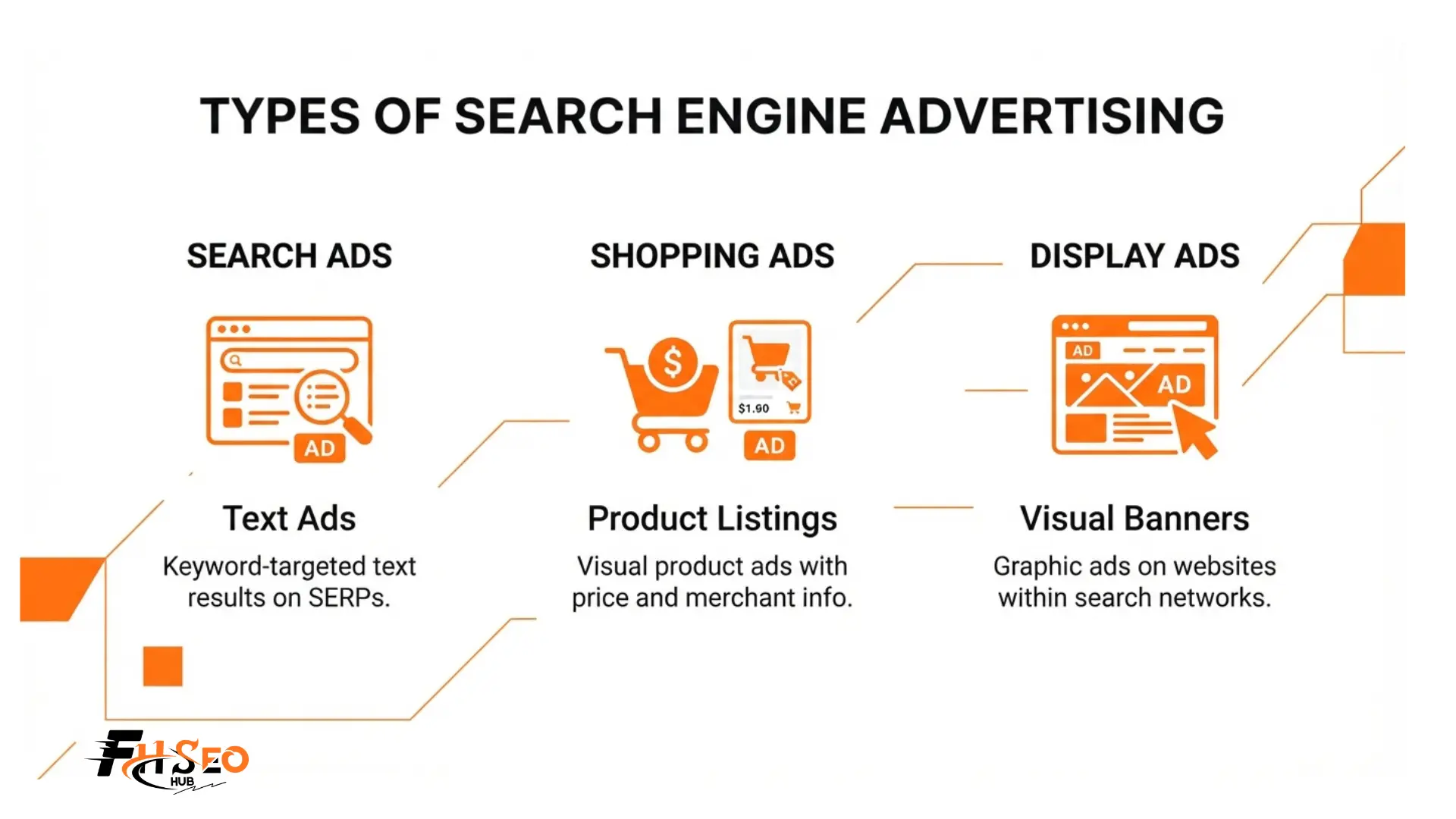
Search engine advertising is a form of paid marketing where businesses pay to display ads directly within search results, usually through a pay-per-click model. Most people confuse this with SEO or assume every paid ad works the same way, which wastes budget fast if you pick the wrong type for your goal.
What Is Search Engine Advertising?
SEA lets businesses bid on keywords so their ads appear exactly when someone searches for related products or services. Instead of waiting months for organic rankings to climb, you pay for a spot at the top of the results page the moment your campaign goes live.
This works because search reveals intent. Someone typing “emergency plumber near me” is ready to act right now, and paid search puts your business in front of them at that exact moment.
What Is the Difference Between Paid Search, PPC, and SEM?
Paid search is the channel, ads that show up on search results pages. PPC is a pricing model, paying per click, and it applies across search, display, and social, not just one channel. SEM is the broadest term, an umbrella covering both paid search and organic SEO working together.
A common mistake beginners make is treating these three words as interchangeable. Someone running Facebook ads on a PPC basis is not doing paid search at all, since that spend never touches a search results page.
What Are the Main Types of Search Ads?
The core formats of search engine advertising include search ads, shopping ads, display ads, video ads, local service ads, app ads, and call-only ads. Each one targets a different stage of intent, from someone actively typing a query to someone just browsing a website elsewhere.
| Ad Type | Where It Appears | Best For |
| Search ads | Text results on the SERP | High intent, ready to buy |
| Shopping ads | Product carousel on SERP | E-commerce with a product feed |
| Display ads | Websites and apps in the ad network | Brand awareness, retargeting |
| Video ads | YouTube search and video content | Storytelling, demonstrations |
| Local service ads | Local search results | Service businesses like plumbers |
| App ads | Search, display, and other apps | Mobile app installs |
| Call-only ads | Mobile search results | Businesses driving phone calls |
How Does the SEA Auction Work?
Every search triggers a real time auction. Advertisers set a maximum bid, and the platform combines that bid with a Quality Score to calculate Ad Rank. The highest Ad Rank wins the best position, but advertisers typically pay less than their maximum bid, based on the Ad Rank of the competitor just below them.
Quality Score reflects three things: expected click-through rate, ad relevance to the keyword, and how well your landing page matches what the ad promised. SEO professionals consistently find that a weak landing page quietly inflates cost-per-click even when the ad copy itself is strong, since a low Quality Score pushes CPC up regardless of how much you are willing to bid. Two advertisers can bid the exact same amount and pay very different prices per click, purely because one has a more relevant landing page experience than the other.
What Is Performance Max and How Is It Different?
Performance Max is Google’s AI driven campaign type that runs across Search, Display, YouTube, Gmail, and Discover from a single campaign. You provide creative assets and a conversion goal, and Google’s automation decides where and how to place your ads across all of it.
The trade-off is control. Performance Max can uncover audiences a manual campaign would miss entirely, but it also gives you far less visibility into exactly where your budget is being spent. Many experienced advertisers run Performance Max alongside a dedicated search campaign, keeping tight control over their highest intent keywords while letting the automated campaign explore new territory. This split approach tends to work better than going all in on either one, since it balances predictable performance against genuine discovery.
What Is Remarketing and How Many Types Are There?
Remarketing shows ads to people who already visited your site without converting. Standard remarketing keeps your brand visible as they browse elsewhere. Dynamic remarketing shows the exact product they viewed. RLSA adjusts your search bids specifically for past visitors. Video remarketing reaches them again through YouTube.
Most visitors never convert on a first visit, so remarketing gives you a second and third chance at the same traffic for a fraction of what it cost to acquire in the first place. Dynamic remarketing tends to perform especially well for e-commerce, since showing someone the exact item they browsed feels far more relevant than a generic brand ad.
How Much Does Search Engine Advertising Cost?
Average cost-per-click on Google Search typically runs $2 to $8, though competitive industries like legal services or insurance can push past $20 per click. Microsoft Advertising usually runs 30 to 35 percent cheaper than Google for comparable keywords, and video views on YouTube often cost just a few cents each.
| Platform or Format | Typical Cost Range |
| Google Search ads | $2 to $8 per click |
| Competitive industries (legal, finance) | $15 to $20+ per click |
| Microsoft Advertising | Roughly 30 to 35% cheaper than Google |
| Shopping ads | Often lower CPC than text ads |
| YouTube video views | A few cents per view |
These numbers vary by industry, competition, and Quality Score, so treat them as a starting reference rather than a fixed price list. A small business can realistically start testing search ads with a modest daily budget and scale up once a campaign proves profitable. Most agencies recommend a minimum of a few thousand dollars a month to gather enough data for meaningful optimization, though a single, tightly focused campaign can run on far less while you learn what converts.
Which Platforms Offer This Beyond Google?
Microsoft Advertising serves Bing, Yahoo, and AOL through one platform, often at a lower cost per click. Amazon Ads targets shopping intent directly on Amazon’s own marketplace. Yandex dominates search in Russia and parts of Eastern Europe, Baidu leads in China, and Brave Search Ads reaches privacy focused audiences without relying on behavioral tracking.
Choosing a platform beyond Google usually comes down to where your specific audience actually searches, not just which platform has the biggest overall reach. A B2B company selling into Eastern Europe gains far more from Yandex than most Western marketers would expect, while a business entering the Chinese market has little choice but to learn Baidu, since Google search is largely unavailable there.
What Tools Do I Need to Run These Campaigns?
Google Ads and Microsoft Advertising handle campaign management directly. Google Keyword Planner supports keyword research and rough cost estimates. Ahrefs and Semrush add competitor intelligence, showing which keywords rivals are bidding on. Looker Studio builds reporting dashboards once you are managing more than one channel.
How Do I Target the Right Audience With Search Ads?
Match types control how closely a search has to match your keyword before your ad shows, ranging from broad match for maximum reach to exact match for tighter targeting. Negative keywords exclude irrelevant searches entirely, and geotargeting or dayparting control when and where your ads actually appear.
A common mistake beginners make is starting with broad match on every keyword to maximize reach. This usually burns through budget quickly on searches that were never going to convert, so most experienced advertisers start narrower and expand match types only once they see which searches actually drive results.
Is Google Ads Worth It for a Small Business?
Often yes. Campaigns can be paused, scaled, or capped at any budget level, which limits downside risk while you learn what works. Most small businesses start with search ads alone, prove the channel is profitable, then expand into remarketing and other formats once that first channel is working.
How Do I Measure Paid Search Success?
Track click-through rate, cost-per-click, conversion rate, cost-per-acquisition, impressions, and return on ad spend together rather than watching any single number in isolation. A high CTR paired with a low conversion rate usually points to a landing page problem, not an ad problem.
| Metric | What It Tells You |
| CTR | How compelling your ad is to searchers |
| CPC | What you are actually paying per click |
| Conversion rate | Whether clicks turn into real results |
| CPA | Your real cost per customer or lead |
| ROAS | Revenue generated per dollar spent |
Final Thoughts
Search engine advertising works best when you match the ad type to the goal, search ads for ready to buy customers, shopping ads for product discovery, display and video for building awareness before someone ever searches. Start small, track the metrics that actually matter, and expand into new formats only once the first one is proven. Done this way, paid search remains one of the fastest, most measurable ways to reach people at the exact moment they are looking for what you sell.
FAQs
PPC stands for pay-per-click, a pricing model where you only pay when someone clicks your ad. It applies to search ads, display ads, and social ads alike, not just one specific channel.
Paid search is the channel, ads on search results pages. PPC is how you pay for them, per click, and that same pricing model can also apply to display or social ads outside of search entirely.
Ad Rank combines your maximum bid with your Quality Score, which itself reflects expected click-through rate, ad relevance, and landing page experience. A strong Quality Score can beat a higher bid from a competitor with weaker ads.
The main types include search ads, shopping ads, display ads, video ads, local service ads, app ads, and call-only ads, each suited to a different stage of buyer intent.
No. Campaigns can run on a modest daily budget, and most small businesses start narrow with search ads on a few high intent keywords before expanding into other formats.
Manual bidding works well when you are just starting out and need to gather clean data on what converts. Automated bidding tends to perform better once a campaign has enough conversion history for the algorithm to optimize against, usually after a few weeks of consistent activity.


