10 Best Surfer SEO Alternatives in 2026: Ranked by Workflow Bottleneck

A Surfer SEO alternative is any content optimization tool that replaces Surfer’s content editor, content score, and SERP analysis workflow. The best picks in 2026 include Clearscope for editorial quality, NeuronWriter for budget, MarketMuse for strategy, and Omnia for AI citation forecasting. This list ranks each option by the specific problem it solves, not by feature count.
A writer spends four hours getting a score to 82. It drops to 67 overnight when the model refreshes. That is the exact moment most teams start searching for something better.
What Is a Surfer SEO Alternative and Why Do Teams Look for One?
A Surfer SEO alternative is any content optimization tool that replaces or extends Surfer’s content editor, content score, and SERP analysis workflow. Teams switch for a few clear reasons that show up again and again in real usage.
Credit based pricing punishes content volume, since every draft and audit eats into a fixed monthly allowance. Score volatility after model refreshes erodes trust in the metric itself, especially when a score drops overnight with no content changes on your end. AI writing quality still lags behind dedicated tools built for that specific job. Surfer has no native rank tracking, forcing a separate subscription just to see if the optimization actually worked. And a growing number of teams now care more about AI Overview citations than Google rankings alone, a problem Surfer was never designed to solve.
How Do You Choose the Right Surfer SEO Alternative?
Match the tool to your actual bottleneck, not the tool with the longest feature list. If you want a closer scoring clone on a budget, prioritize term frequency accuracy. If you want strategy, prioritize topical authority. If your real problem is AI citations, prioritize pre-publish forecasting over another brief generator.
Four scoring philosophies drive this entire category, and most comparison articles never explain the difference:
| Methodology | What It Measures | Tools That Use It |
| Term frequency scoring | Keyword matching vs top-ranking pages | Surfer, NeuronWriter |
| Entity first scoring | Semantic and topic coverage | Clearscope, MarketMuse |
| Correlation based scoring | Statistical fit to one live SERP | Page Optimizer Pro |
| Topic authority modeling | Domain wide content gaps | MarketMuse, Content Harmony |
Know which philosophy a tool uses before you commit. It changes how you should interpret its score. A term frequency tool tells you how closely you match what already ranks. A topic authority tool tells you what your whole site is missing. Neither is wrong, but confusing one for the other leads to picking a tool that solves a problem you do not actually have.
Top 10 Best Surfer SEO Alternatives in 2026
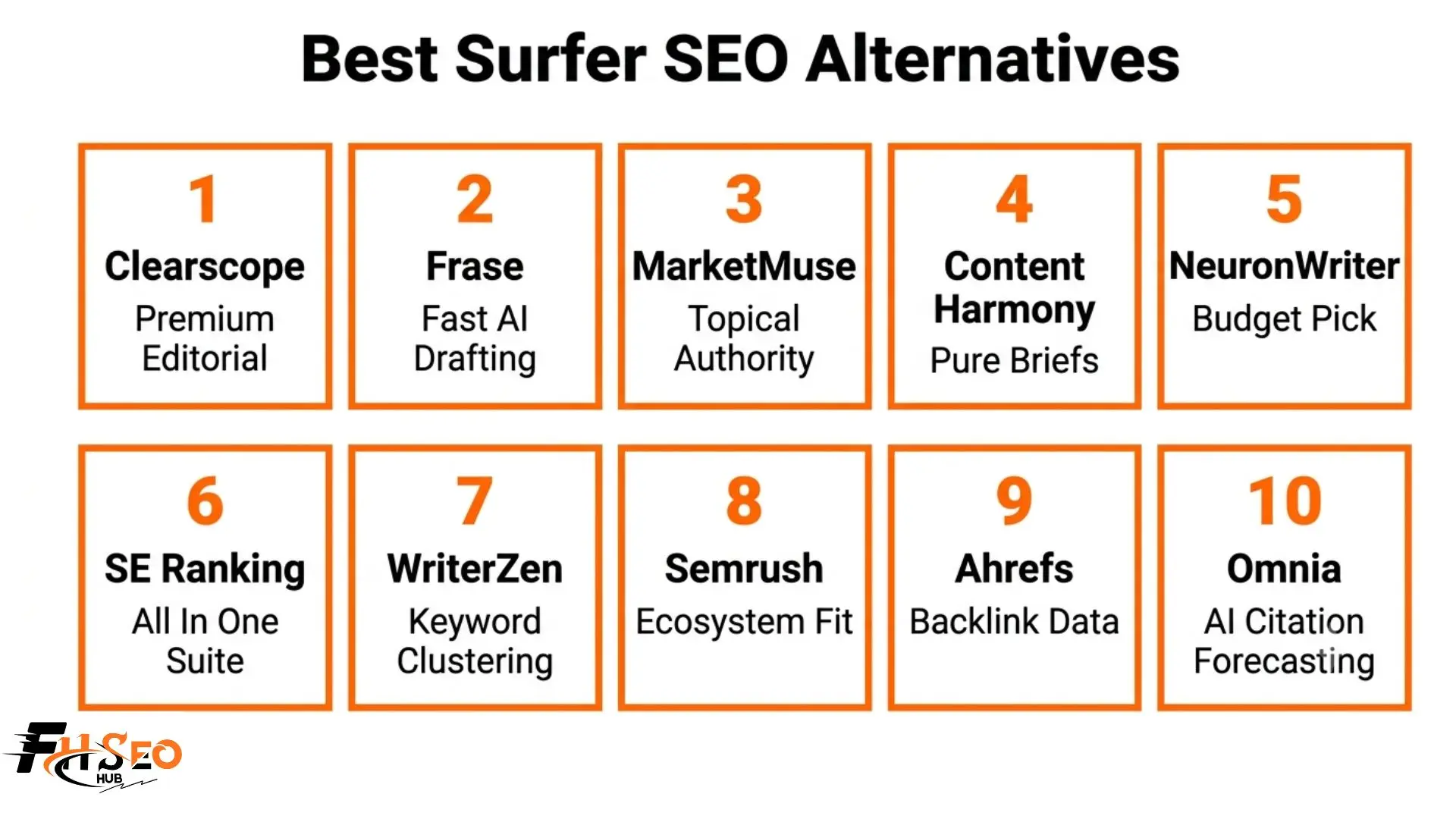
Ranked from the closest like for like scoring clone through progressively more specialized strategy and consolidation tools, ending on the most forward looking AI citation angle for teams who have outgrown page level scoring entirely.
1. Clearscope: Best Overall for Premium Editorial Quality

Clearscope earned the top spot because it solves the volatility problem head on. Instead of a raw number that can swing overnight after a model refresh, it grades content A through F based on topic coverage, which reads as far more stable to writers who need to trust the target they are working toward.
2. Frase: Best for Fast Research to Draft AI Writing

If your bottleneck sits before the writing stage even starts, Frase closes that gap directly. It pulls SERP data, builds a brief, and drafts inside one document window, which cuts out the fifteen open browser tabs most writers juggle during research.
3. MarketMuse: Best for Topical Authority and Strategy

MarketMuse steps back from single pages entirely and looks at your whole site instead. It models your domain’s topical authority and tells you what to write next based on where you are genuinely under covered, not where a template says you should be.
4. Content Harmony: Best for Pure Briefs without AI Generation

Content Harmony made a deliberate choice most competitors avoid entirely. It skips AI writing altogether and focuses purely on research and briefing, betting that better direction produces better content than better generation.
5. NeuronWriter: Best Budget Alternative at a Fraction of the Price

NeuronWriter is the closest thing to a direct Surfer clone, minus the price tag that makes most small teams hesitate. Its term frequency scoring mirrors Surfer’s own approach closely enough that the learning curve barely exists.
6. SE Ranking: Best All in One SEO Suite Consolidation

Teams currently paying for Surfer plus a separate rank tracker plus a separate keyword tool have a real consolidation option here. SE Ranking bundles all three plus content scoring into one login and one invoice.
7. WriterZen: Best for Keyword Clustering With One Time Pricing

WriterZen approaches content planning differently than everything else on this list. It groups related keywords into logical clusters before a single word gets written, treating the silo as the real unit of strategy.
8. Semrush: Best for Teams Already Inside the Semrush Ecosystem

If you already pay for Semrush, adding its content and AI visibility tools costs less friction than switching platforms entirely and retraining your whole team on something new.
9. Ahrefs: Best for Backlink Integrated AI Citation Data

Ahrefs takes a research database approach that nobody else on this list replicates. It ties AI citation data directly to real backlink and domain authority data instead of treating visibility as a standalone metric.
10. Omnia: Best for Pre Publish AI Citation Forecasting

Every other tool on this list scores content after it already exists. Omnia is the exception, and that difference matters more with each passing month as AI answers intercept more searches before they ever reach your site.
Which Surfer SEO Alternative Should You Choose At Start?
Match your pick to the specific problem you actually have, not the tool with the most features. Budget and closest clone points to NeuronWriter. Strategy points to MarketMuse. Pure human written briefs point to Content Harmony. Consolidation points to SE Ranking or Semrush. AI citation visibility points to Omnia.
| Your Bottleneck | Best Pick | Why |
| Closest Surfer clone on a budget | NeuronWriter | Same scoring approach, fraction of the cost |
| Editorial quality and simplicity | Clearscope | Clean grading, unlimited users |
| Fast AI drafting | Frase | Research and writing in one view |
| Domain wide strategy | MarketMuse | Topical authority modeling |
| Human written execution only | Content Harmony | Zero AI generation, structured briefs |
| Consolidating your tool stack | SE Ranking or Semrush | Rank tracking and AI visibility together |
| AI citation visibility specifically | Omnia | Pre publish forecasting |
Final Thoughts
The right Surfer SEO alternative depends entirely on which specific problem you are solving, not which tool has the longest feature list. Start with NeuronWriter if budget is the wall. Start with MarketMuse if strategy is the wall. Start with Omnia if your rankings look fine but your AI visibility does not. Pick the tool that matches your actual bottleneck and the rest of your content workflow gets noticeably easier from there.
FAQs
Surfer remains capable for individual page optimization, but its credit based pricing and score volatility push high volume teams toward alternatives. If you optimize a handful of pages monthly, it still delivers a solid workflow. If your real problem is AI citations rather than page scores, a dedicated visibility tool solves a fundamentally different problem that Surfer was never built to answer.
NeuronWriter is the most direct budget replacement, delivering comparable scoring and SERP analysis at roughly a fifth of Surfer’s cost. WriterZen’s one time payment model is also highly cost effective for teams with predictable, stable content volume rather than fluctuating monthly needs, since there is no recurring bill to track.
No tool fully replicates Surfer’s paid functionality for free. MarketMuse offers a limited free tier at ten queries per month, useful for occasional checks rather than regular production work. A realistic free workaround combines Google Search Console for keyword data with a manual competitor content review, though it takes far longer per article than any paid tool.
Content Harmony’s structured brief workflow suits agencies managing multiple freelance writers who need clear direction rather than raw AI output to fix. Clearscope’s unlimited users on every plan also favors agency use without per seat cost stacking up across clients. For agencies needing client reporting too, SE Ranking adds white label reporting into the same platform.
Surfer’s AI Search feature extracts facts from AI models to inform writing, but it does not forecast citation share or gaps before publishing. Dedicated tools like Omnia, or add ons inside SE Ranking, Semrush, and Ahrefs, are built specifically to monitor and project AI Overview citations over time, which is a different capability entirely.
Yes, both offer content optimization add ons covering similar ground to Surfer’s core workflow. Semrush’s toolkit adds the largest prompt database in this category with GA4 attribution tying citations to real traffic. Ahrefs’ AI Content Helper and Brand Radar correlate citation data with its own backlink index, working best for teams already using either platform for broader SEO research.
A content score from term frequency or entity based scoring tells you how well a page matches top ranking competitors on Google. Pre publish outcome projection instead forecasts whether AI engines will actually cite that page once published, a fundamentally different question traditional scoring was never built to answer. Both matter, but they solve separate problems.


