Featured Snippets and Types: The Optimization Guide

A featured snippet is a highlighted answer box Google displays above the organic results for a query, extracting content directly from a ranking page and linking back to the source. This format isn’t dead in the AI Overview era, but its share of the search engine results page has dropped sharply, and the honest 2026 picture requires knowing which query types still reward it before you invest real content structuring time in it.
If you have watched your snippet count quietly shrink over the past year and wondered whether it’s still worth chasing position zero, or you’re confused about how this feature actually relates to AI Overviews, here is the current, sourced answer to both.
What Are Featured Snippets?
This is an answer box, often called position zero, that Google extracts from a single ranking page and displays above the standard organic results, giving that page two listings on the same results page, the box itself and its regular organic position. It can also populate People Also Ask boxes and voice search answers, extending its reach beyond the main results themselves.
Google selects this content algorithmically based on how directly a page answers the query, its content structure, and its existing organic ranking strength, not through a separate submission or bidding process. The format has existed since 2014 and remains one of the few SERP features that credits a single source clearly rather than blending multiple sources together.
Are AI Overviews the Same as Featured Snippets?

No, they’re structurally different features that happen to compete for similar SERP real estate. One extracts and displays one page’s exact content with a direct link back to that source; an AI Overview reads content from roughly 7 to 12 sources and generates entirely new synthesized text, citing multiple sources rather than crediting one page as the definitive answer.
The decline in raw appearance rate has been real and well-documented. One large-scale Ahrefs study tracking 863,000 keywords found this format’s presence drop from roughly 15 percent of tracked queries in January 2025 to under 6 percent by June 2025, a steep decline that coincided directly with AI Overviews expanding from under 7 percent of US searches to an estimated 58 percent of queries in active markets by early 2026. Numbers vary meaningfully across studies depending on dataset and query mix, current estimates range roughly from 5 to 12 percent of queries, but the direction is consistent everywhere: fewer queries show this box than did a year ago, part of the same broader zero-click search trend AI Overviews have accelerated.
What most coverage of this shift misses is the more useful nuance underneath the decline. Pages that previously won this format get cited inside AI Overviews at roughly twice the rate of pages that never won one, meaning the structural discipline behind it, direct answers, clean heading hierarchy, demonstrated E-E-A-T, carries forward as a real AI Overview citation advantage even where the box itself has disappeared. It’s also possible for the same query to show both features on the same results page at once, your content appearing in the AI Overview’s citation list and separately holding the traditional answer box, a dual-coverage outcome most guides don’t mention as achievable. Query type still predicts which feature you’re more likely to compete for: simple factual, definition, and how-to queries continue to favor the traditional format since they load instantly with no generative processing required, while complex, multi-faceted queries increasingly trigger an AI Overview instead.
Why Featured Snippets Matter for SEO
Winning this box still delivers genuine SERP real estate advantage, since the page holding it appears both in the answer box and at its normal organic position, effectively doubling visibility for that query on the same results page. This matters even with AI Overviews eating into organic click-through rate broadly, one Ahrefs study of 300,000 keywords found AI Overviews reduce position-one organic click-through rate by roughly 58 percent, since holding this box still captures attention and brand visibility that a buried organic listing further down the page simply won’t.
The stronger long-term argument is the AI Overview citation connection covered above: content built around clear, direct answers and demonstrated topical authority isn’t just chasing a shrinking SERP feature, it’s building the same structural signals that determine AI Overview citation eligibility going forward. Treating this optimization work and AI Overview strategy as one connected discipline, rather than a legacy tactic worth abandoning, is the more accurate 2026 framing.
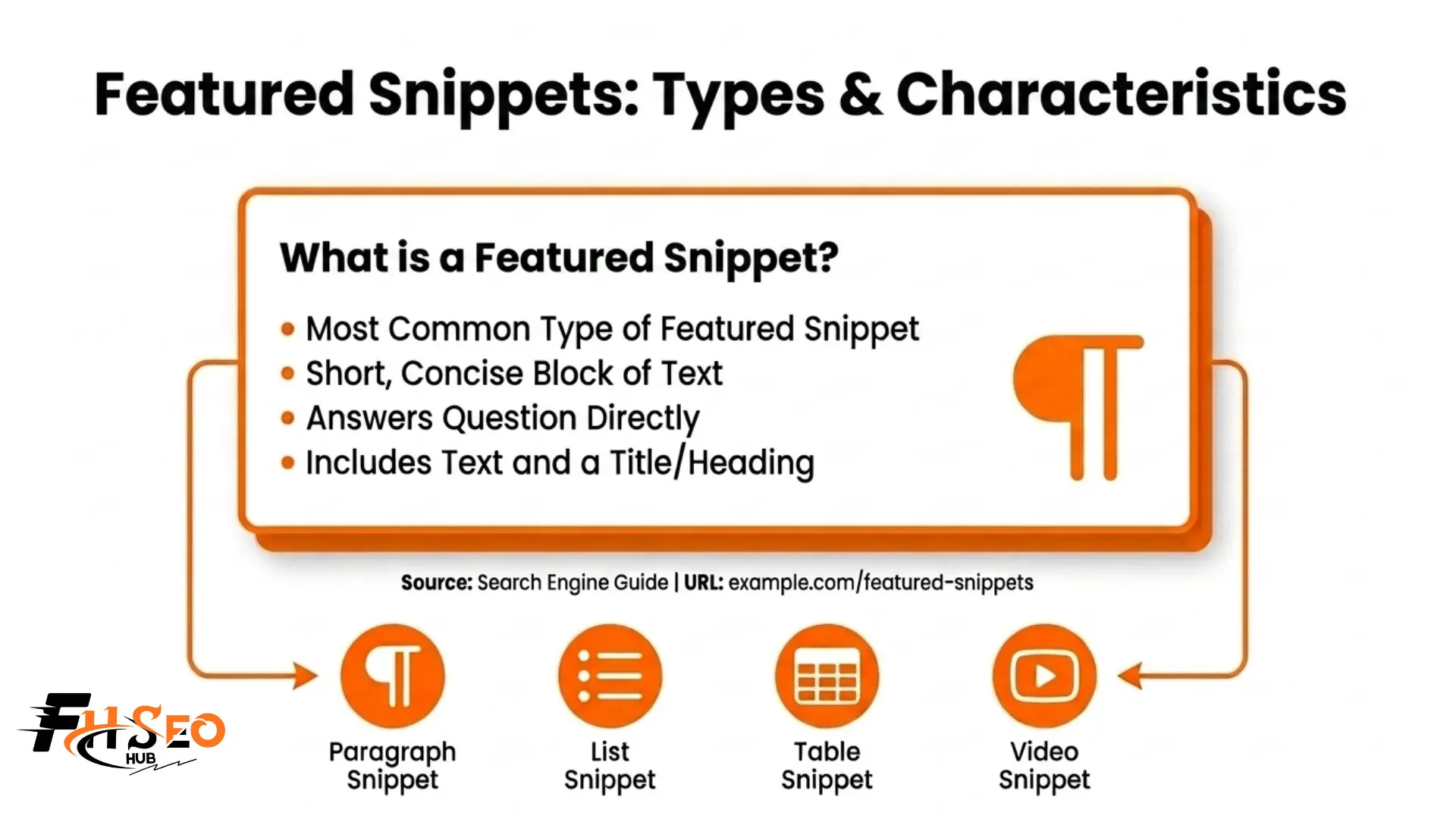
The 4 Types of Featured Snippets
Google displays four distinct formats for this feature, and matching your content structure to the right type for a given query matters more than generic “write a good answer” advice.
1. Paragraph Snippet
The most common format, this displays a concise, direct-answer block of roughly 40 to 60 words extracted from a page, typically positioned immediately under a clear question-format heading. This format wins for definition queries, “what is” questions, and single-concept explanations where one tight paragraph genuinely satisfies the search intent behind the query.
2. List Snippet
This format displays either an ordered list (numbered steps, sequential processes) or an unordered list (bullet points, non-sequential items), extracted directly from properly marked-up HTML list elements on the page. Process-based queries, “how to” searches, and ranking or roundup-style queries consistently favor this format, and Google pulls the list items in the exact order and structure they appear in the source HTML, which is why a list buried inside a paragraph rather than coded as a real list rarely wins this format even with identical content.
3. Table Snippet
This format extracts structured, tabular data, comparison metrics, pricing tiers, specification breakdowns, directly from a properly coded HTML table on the page. This format wins comparison queries and any search where the answer is inherently multi-dimensional data rather than prose, and clean table markup with descriptive headers and short cell content performs meaningfully better than a table built from merged cells or image-based formatting Google can’t parse.
4. Video Snippet
This format surfaces a timestamped moment within a video directly in the SERP, typically for visual how-to queries where a demonstrated process communicates faster than text. This format depends on proper video schema markup and timestamp data being available for Google to extract a specific relevant segment rather than just linking to the video’s start, and the same schema investment often pays off separately in video-specific search results beyond this feature alone.
How to Find Featured Snippet Opportunities
Start by identifying queries where you already rank in the top 5 to 10 organic positions but don’t currently hold this box, since Google pulls this format almost exclusively from pages already ranking well for that query, making near-miss rankings your highest-probability opportunity list. Ahrefs Site Explorer and Semrush Position Tracking both include filtered views specifically for pages ranking without it, and the Semrush Keyword Magic Tool helps expand that list with genuine long-tail keyword opportunities at reasonable keyword difficulty, giving you a realistic prioritized target list rather than chasing high-competition head terms unlikely to shift.
AlsoAsked and the native People Also Ask box both surface real question variations searchers ask around a topic, useful for identifying paragraph and list opportunities your existing content doesn’t explicitly answer yet. Google Search Console’s performance report, filtered by query, also reveals which of your existing pages already rank on page one for question-format queries, a strong signal for where a structural tweak might be enough to win the box without writing new content at all. Prioritize opportunities where the query volume justifies the effort too, a near-miss ranking on a genuinely low-volume long-tail term rarely pays back the time spent restructuring content around it, even when the win itself is technically achievable.
How to Optimize Your Content for Each Snippet Type
Structure paragraph-format content using the inverted pyramid method, the direct 40-to-60-word answer comes first immediately under a clear H2 or H3 heading phrased as the actual question, with supporting detail and nuance following afterward rather than building up to the answer gradually. This structure serves both the extraction algorithm and a reader who wants the answer immediately, which is exactly the overlap that makes this kind of structured content also perform well for AI Overview citation.
For list snippets, use genuine semantic HTML, proper <ol> tags for sequential steps and <ul> tags for non-sequential items, rather than manually numbered paragraphs Google’s extraction can’t parse as a real list. Table snippets need the same code hygiene: real <table> markup with clear <th> header cells, short and consistent cell content, and no merged cells or nested tables that break clean extraction. Video snippets require accurate timestamp data and, where relevant, VideoObject schema markup identifying key moments, since Google can’t extract a specific segment it can’t confidently locate within the video’s structure.
Across all four types, heading hierarchy matters more than most content teams treat it: using H1-H6 tags consistently to mirror your content’s actual logical structure, rather than styling text to look like a heading without the underlying tag, is a basic but frequently skipped technical requirement for reliable extraction across every format covered above.
How to Opt Out of Featured Snippets
Most sites want this visibility, but there are legitimate reasons to opt out, protecting proprietary phrasing, preventing a competitor-facing comparison table from being extracted into someone else’s search journey, or avoiding display for content where the full page context matters more than an isolated extracted answer. Three distinct controls exist, and they’re not interchangeable.
The nosnippet robots meta tag is the only guaranteed opt-out, blocking both this format and regular text snippets for the entire page with no exceptions. The data-nosnippet HTML attribute is more surgical, applied directly to a specific span, div, or section element to exclude just that portion of content from extraction while leaving the rest of the page fully eligible, useful when only one section, not the whole page, needs protecting. The max-snippet rule sets a maximum character length and can reduce the likelihood of selection when set low, but Google’s own documentation is explicit that this provides no guaranteed opt-out, since there’s no fixed minimum length threshold published for what qualifies as a usable answer box. If both nosnippet and data-nosnippet directives appear on the same page, nosnippet takes priority and nothing shows at all.
How to Track Your Featured Snippets (and AI Overviews)
Google Search Console remains the foundation for tracking this feature’s performance, though it doesn’t cleanly separate its impressions from regular organic impressions in its default reporting, requiring some manual cross-referencing against known target queries to isolate genuine position zero performance. Ahrefs Rank Tracker and Semrush Position Tracking both flag SERP feature ownership directly, including whether a tracked keyword currently holds this box, giving a cleaner dedicated view than Search Console alone provides.
Tracking AI Overview citations specifically is a newer, less mature discipline than tracking this older format, since neither Google Search Console nor most third-party rank trackers cleanly isolate AI Overview citation data the way they do for classic SERP features yet. The most reliable current approach combines periodic manual SERP checks on your priority queries with whatever AI Overview visibility reporting your existing rank tracking tool has added, treating this as a metric worth monitoring consistently even while the tooling around it continues to mature through 2026. Set a recurring monthly review rather than checking sporadically, since both this format’s ownership and AI Overview citation status shift more often than most teams assume between full SERP feature audits.
Final Thoughts
Featured snippets are a smaller share of the SERP than they were a year ago, but the content discipline behind winning this format, direct answers, clean semantic structure, genuine topical authority, has become more valuable, not less, since that same structure now drives AI Overview citation eligibility too. Match your content format to the actual type a query rewards, use nosnippet or data-nosnippet deliberately rather than by accident, and track both this feature and AI Overview performance together rather than treating them as separate reporting lines. The pages built for position zero in 2026 are the same pages earning citation inside the AI answers replacing a growing share of it.
FAQs
Yes, though the raw opportunity has shrunk. Pages that win this format get cited in AI Overviews at roughly twice the rate of pages that don’t, meaning the same optimization work now serves two visibility goals instead of one.
This format extracts one page’s exact content and links directly to that source. An AI Overview reads multiple sources, typically 7 to 12, and generates new synthesized text citing several sources rather than crediting one page as the definitive answer.
Rank in the top 5 to 10 organic positions for a query first, since Google pulls this format almost exclusively from already-ranking pages, then structure the specific content type, paragraph, list, table, or video, that query’s format favors, using clean semantic HTML and a direct answer positioned immediately under a question-format heading.
Use the nosnippet robots meta tag for a guaranteed, page-wide opt-out, or the data-nosnippet HTML attribute to exclude just a specific section while keeping the rest of the page eligible. Lowering the max-snippet length can reduce the odds but doesn’t guarantee opt-out.
Yes, positively for the page that holds it, since it captures both the answer box position and its regular organic listing on the same results page. Overall organic click-through rate across the board has dropped significantly where AI Overviews now appear, independent of this.
Yes. This dual-coverage outcome happens when Google shows both features on the same results page, with your content holding the traditional answer box while also appearing in the AI Overview’s citation list, a real and achievable outcome most guides don’t mention.
Simple factual, definition, and how-to queries continue to favor it since they load instantly without generative processing. Complex, multi-faceted queries increasingly trigger an AI Overview instead.


