10 Benefits of Link Building for SEO in 2026

Link building matters because it drives higher rankings, more organic traffic, stronger brand trust, and better visibility inside AI search results like Google AI Overviews and ChatGPT. The catch is that most sites do it wrong, spending money on risky links or agencies that overpromise, then wonder why nothing moves.
How to Get the Most from Link Building
You get the full value of link building only when your backlinks are relevant, editorially placed, and earned from sites your actual audience trusts. A handful of contextual, high-authority links beats hundreds of random ones. Quality, relevance, and consistency decide whether link building pays off or just drains your budget.
Most sites fail here, not because they lack links, but because they chase volume instead of fit. A single relevant, well-placed backlink from a site your customers already read will outperform a stack of unrelated directory links every time. Tie your outreach to pages that can actually convert, your comparison pages, feature pages, and cornerstone guides, instead of just your homepage. Track which links stay live, which anchor text you are using, and how each placement affects both rankings and referral traffic. Treat backlinks as an ongoing asset you maintain, not a box you check once and forget.
What Makes a High-Quality Backlink?
A high-quality backlink comes from a site that is relevant to your niche, has real organic traffic, and places your link naturally inside the body content, not a sidebar or footer. Strong Domain Rating or Domain Authority helps, but relevance and real readership matter more than any single metric.
Six factors decide whether a backlink actually helps: relevance to your niche, real organic traffic on the linking page, in-content placement, a dofollow attribute, natural anchor text, and a clean domain history. Most agencies set a minimum Domain Rating or Domain Authority before accepting a placement, often DR 30 or higher for general niches and DR 50 or higher for competitive ones like finance or SaaS.
| Signal | Strong Backlink | Weak or Risky Backlink |
| Relevance | Same or adjacent niche | Unrelated topic |
| Traffic | Real visitors on the page | Little to no real traffic |
| Placement | Inside the body content | Sidebar, footer, or widget |
| Link attribute | Dofollow | Nofollow or hidden |
| Anchor text | Branded or descriptive | Exact-match keyword stuffing |
| Domain history | Clean and established | Recycled or spam-flagged |
Domain Rating and Domain Authority are useful shorthand, but Ahrefs and Moz calculate them differently, so treat either score as a starting filter, not the final word. A lower-DR page with real, engaged readers usually beats a higher-DR page nobody actually visits.
10 Link Building Benefits
Link building benefits go far beyond rankings. Done well, it compounds into more organic traffic, stronger brand trust, faster indexing, and better visibility in AI search tools. Here are the 10 benefits that matter most for SEO teams, content marketers, and any business trying to grow organic visibility in 2026.
1. Higher Search Engine Rankings
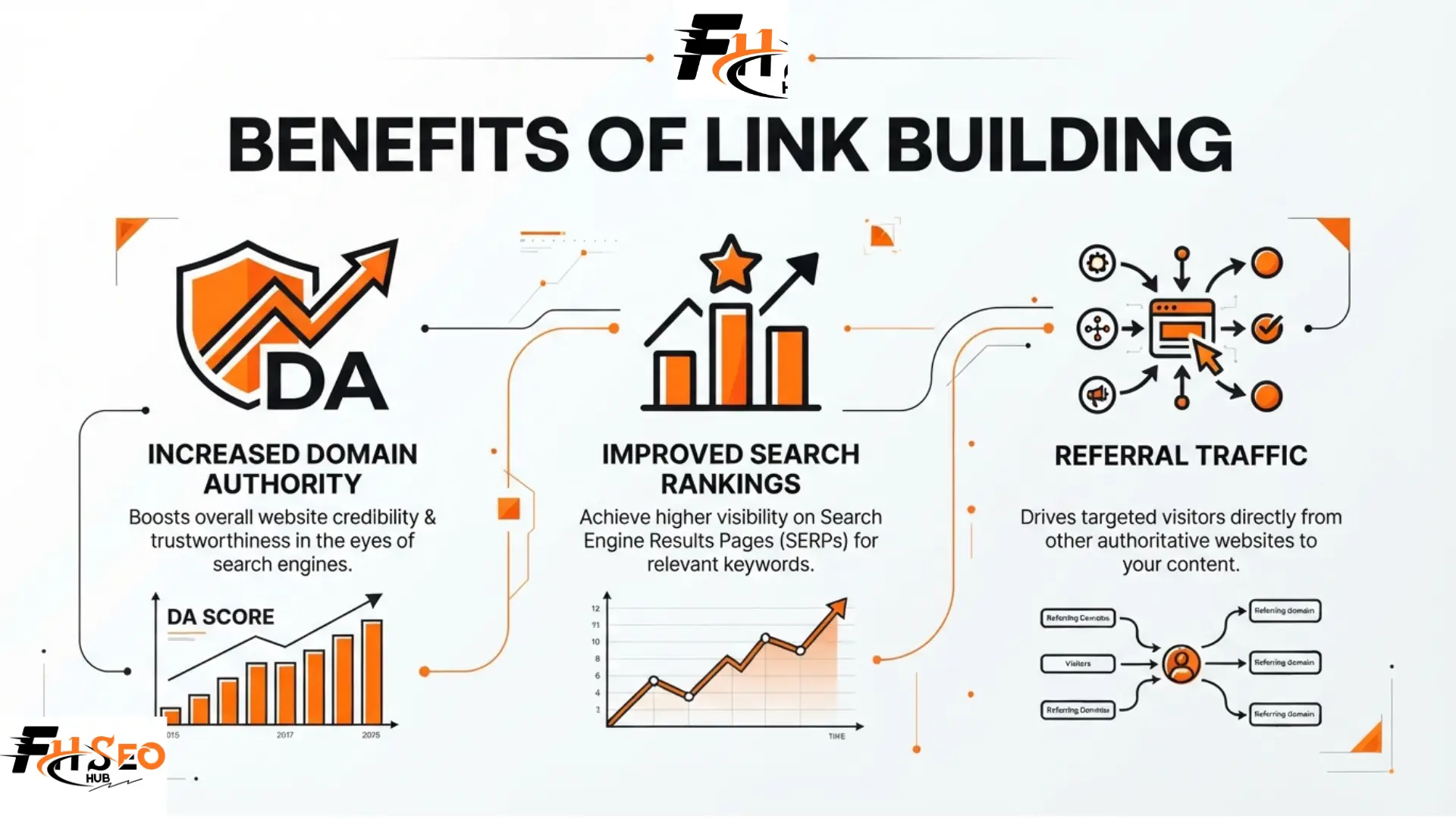
Backlinks remain one of the strongest ranking factors going into 2026. Pages with at least one quality backlink are far more likely to reach page one than pages with none. The logic is simple: when trusted, relevant sites link to you, search engines read that as a vote of confidence, and more relevant votes from authoritative sources usually mean stronger rankings for the keywords that matter to your business.
2. More Organic Traffic
Higher rankings lead directly to more organic traffic, since most clicks go to the top few results on any search page. A well-linked page also gets discovered and indexed sooner, so it starts earning impressions earlier. Over time, a strengthening backlink profile compounds, and each new relevant link adds a little more visibility on top of what you already have.
3. Quality Referral Traffic, Not Just More Traffic
A backlink from a relevant, high-traffic page sends visitors who already care about your topic, which means lower bounce rate and a better shot at conversion compared to random traffic that lands and leaves. This is why relevance beats raw Domain Rating. A niche-specific link with modest traffic often outperforms a generic high-authority link that sends visitors who never convert.
4. Stronger Domain Authority and Domain Rating
Every relevant, high-quality link you earn adds to your backlink profile and nudges your Domain Authority or Domain Rating upward over time. Neither score is a direct Google ranking factor, but both work as useful shorthand for how competitive your site looks next to others in your niche, and they shape how outreach targets judge your site too.
5. Better Brand Authority and Credibility
When respected publishers, bloggers, and journalists link to you, it signals to readers and search engines that your brand is worth citing. That credibility compounds. Once a few trusted sites vouch for you, the next placement gets easier to earn, because editors start treating your brand as a known, safe reference instead of a cold pitch.
6. Stronger E-E-A-T Signals
Google’s E-E-A-T framework (Experience, Expertise, Authoritativeness, and Trustworthiness) leans heavily on outside validation, and backlinks are one of the clearest signals of that validation. A journalist naming you as a source, or an industry site linking to your original research, tells Google’s quality raters that independent parties trust your expertise, not just your own homepage copy. Responding to journalist queries through platforms built for expert sourcing is one of the more reliable ways to earn this type of link today, since a reporter choosing you as a source is a strong, independent trust signal.
7. Faster Crawling and Indexing
External links help search engines discover your pages sooner, especially new content that has not built up internal link equity yet. A link from a frequently crawled, established site can pull a search engine’s crawler toward your page faster than waiting on organic discovery alone. Pair this with clean internal linking so authority flows from your best-linked pages to the ones you most want to rank.
8. Better AI Search Visibility
Backlinks and brand mentions increasingly shape whether AI Overviews, ChatGPT, and Perplexity cite your site when answering questions in your space. Brand mentions, even unlinked ones, can correlate with AI visibility even more strongly than raw backlink counts alone. A steady mix of backlinks and earned mentions gives you a real shot at both traditional rankings and AI answer boxes.
9. A Real Competitive Advantage
Most pages on the web have zero backlinks, which means a modest, consistent backlink strategy can put you ahead of competitors who rely on content and on-page SEO alone. In competitive niches, the sites ranking above you are almost always the ones with stronger, more relevant backlink profiles, not just better articles.
10. Long-Term ROI and Revenue Growth
Unlike paid ads, a backlink keeps working after you stop paying for it, which is where the real return on investment shows up over time. Most SEO professionals report a positive return from their backlink campaigns, and organic leads tend to close at a meaningfully higher rate than outbound leads, since the person already trusts what they clicked on. The tradeoff is patience. Expect early signals around the three-month mark, with real ranking movement typically showing up between six and twelve months.
How to Start Building Links: DIY vs. Outsourcing
You can start building links yourself through guest posting, broken link outreach, and journalist queries, or you can outsource to an agency that already has relationships and systems in place. DIY costs less money but far more time. Outsourcing costs more money but moves faster and avoids the steepest learning-curve mistakes.
Doing it yourself means running your own prospecting, writing personalized outreach, and following up consistently, week after week. Response rates on cold outreach typically sit under 10%, so plan on sending dozens of pitches to land a handful of placements. This path costs little in cash but a real amount of time, usually 10 to 20 hours a month if you want steady output.
Outsourcing means paying a specialist to run that same pipeline using existing publisher relationships. A single guest post on a relevant site typically runs $300 to $1,000 or more, depending on authority and niche. A niche edit, which inserts your link into an already-indexed page, usually costs less, often $200 to $700, and can show ranking movement faster since the host page already carries authority. Digital PR placements cost more but add brand mentions and press-level credibility that plain guest posts cannot match. Full programs typically run $1,000 to $10,000 or more a month, depending on competition.
Whichever path you choose, avoid vendors selling links from private blog networks or promising a specific ranking by a set date. Spam detection systems flag manipulative patterns quickly in 2026, and once the ranking value of a spammy link gets neutralized, you do not get it back.
| Tactic | Typical Cost | Best For |
| DIY outreach | Your time, 10-20 hrs/month | Small budgets, patient teams |
| Guest post | $300-$1,000+ per placement | Long-term authority and brand building |
| Niche edit | $200-$700 per placement | Faster movement on aged, ranking pages |
| Digital PR | $1,000-$5,000+ per placement | AI visibility, press credibility, brand mentions |
| Full agency retainer | $1,000-$10,000+ per month | Hands-off, ongoing programs |
Enjoy the Benefits of Link Building Today with FHSEOHub
If you want these benefits without managing outreach, vetting, and reporting yourself, FHSEOHub runs the entire process manually, from auditing your current backlink profile to securing and monitoring live placements. Every link is vetted for relevance and traffic, placed in the body content, and backed by a replacement guarantee.
FHSEOHub audits your existing backlink profile first, then builds a plan around your goals instead of a one-size package. Every prospective site gets checked for Domain Rating, real organic traffic, and spam risk before outreach starts, and links go into the body content where they carry the most weight. Plans start around $400 for a foundational package built on DR 20+ sites, scale to $750 for niche-specific placements on DR 30+ sites, and reach $1,250 or more for competitive, DR 50+ placements. Every plan includes a one-year live-link guarantee, so a dropped placement gets replaced at no extra cost. If you want to talk through your options, that conversation costs nothing to start.
Conclusion
Link building works when you treat it as a long game built on relevance, not a shortcut you rush through. The real payoff (stronger rankings, better referral traffic, more credibility, and a real shot at AI search visibility) shows up when your links come from real, relevant sites and stay live for years, not weeks. Start with an honest audit of your current backlink profile, decide whether DIY or a managed campaign fits your time and budget, and stay consistent. Consistency, more than any single tactic, is what turns a handful of backlinks into compounding organic growth.
FAQs
Link building is the process of earning links from other websites that point back to yours. Search engines read those links as votes of confidence, using them to judge how trustworthy and relevant your site is compared to others competing for the same keywords.
Yes. Backlinks remain one of the strongest ranking signals search engines use, even with AI Overviews and generative search reshaping how results get presented. Sites with zero backlinks rarely reach page one in competitive niches, no matter how strong the on-page content is.
Most sites see early signals, small ranking movement or new impressions, around the three-month mark. Real, durable ranking gains usually show up between six and twelve months, and the full compounding value often takes a full year or two of consistent effort.
Domain Authority is Moz’s proprietary score, and Domain Rating is Ahrefs’ equivalent metric. Both estimate how strong a site’s backlink profile is on a 100-point scale, but they use different data and formulas, so the same website usually shows two different numbers.
It depends on your time and budget. DIY works if you can commit 10 to 20 hours a month to outreach, every single month. If you cannot sustain that pace, an agency with existing publisher relationships will usually get you live placements faster.
Yes. Brand mentions and backlinks from credible, relevant sites influence whether AI systems cite you when answering questions in your space. A steady base of earned links and press mentions improves your odds of showing up in both traditional results and AI-generated answers.
Watch for guaranteed rankings, refusal to name the sites they plan to use, prices far below market rate, and no reporting on live links. A legitimate agency shows you real websites, real traffic data, and a plan for replacing any link that goes down.
Most SEO professionals report a positive return, and organic leads tend to close at a noticeably higher rate than outbound leads because visitors already trust what they clicked on. The catch is that returns build slowly and reward sites that stay consistent for months, not weeks.
Volume itself is not the problem, unnatural patterns are. A sudden spike of low-quality, unrelated, or exact-match anchor text links can trigger spam detection systems. A natural mix of branded, descriptive, and varied anchor text protects you far better than chasing a raw link count.
Budgets vary widely by competition and niche, but many active campaigns run somewhere between a few hundred dollars for a single placement and several thousand dollars a month for an ongoing program. Treat any price far below that range as a red flag, not a bargain.


