Disadvantages of Digital Marketing: The Risks Businesses Need to Plan For

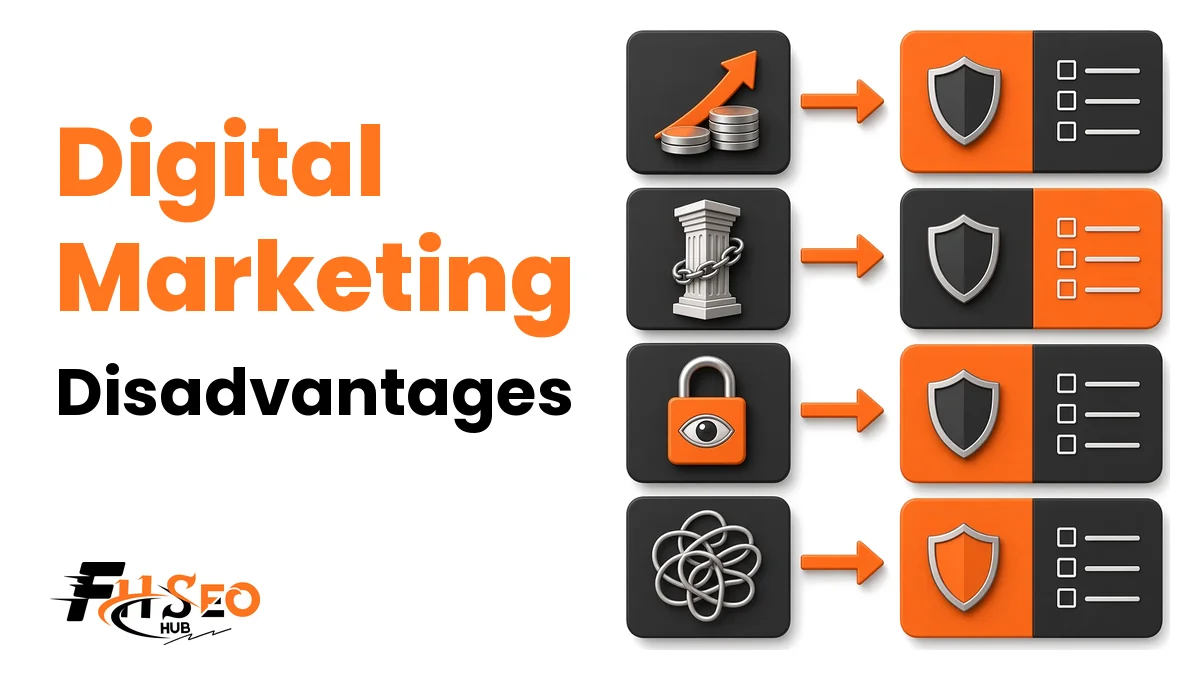
The disadvantages of digital marketing are manageable risks, not reasons to quit: high competition that can raise customer acquisition costs, platform dependency when algorithm changes cut visibility, privacy regulations that restrict targeting, imperfect attribution, ad blockers, and delayed organic results from SEO and content. Teams that plan for these still get useful returns from paid and organic channels.
The usual strain is a budget that climbs while reports disagree and organic reach softens. That mix tempts people to slash channels that still work, or to ignore the risk until a policy shift or a public complaint arrives.
Treat the downsides as planning constraints. Decide where paid media, organic search, and owned channels should share the load, and be honest about measurement before you scale spend. Online marketing still rewards businesses that avoid betting everything on one platform.
What These Disadvantages of Digital Marketing Usually Look Like
These disadvantages of digital marketing show up as higher costs or slower proof, not as a single failure. Competition can inflate bids. A platform change can cut visibility. Privacy rules and consent can shrink targeting, and attribution can leave ROI messy. Ad blockers and delayed SEO results add friction. The pattern is uneven performance, not a channel that never works.
| Disadvantage | Typical impact | First response |
|---|---|---|
| Competition, rising costs | Higher CAC in crowded auctions | Improve conversion before raising bids |
| Platform dependency | Sudden drops after algorithm changes | Split traffic; build site and email |
| Privacy, weaker tracking | Smaller audiences, noisier measurement | First-party data with consent |
| Attribution gaps | Unclear ROI across channels | Use more than one method |
| Ad blockers and banner blindness | Missed or ignored paid reach | Change placements and creative |
| Delayed organic results | SEO and content lag behind ads | Keep paid coverage during the lag |
High Competition: Why Crowded Channels Push Customer Acquisition Costs Up
Crowded channels can push customer acquisition costs up because more advertisers bid on the same terms, audiences, and placements. The pressure is sharpest in paid search and social in saturated categories. It is a common trend, not a rule that every market gets more expensive.
Market saturation shows up in Google Ads and social media marketing, where auction prices rise when rivals spend more or inventory tightens. Pay-per-click advertising can still produce leads, but a weak landing page or a loose keyword strategy makes the increase worse. You pay more for the same click, then convert at the same rate, so CAC climbs.
Organic listings get crowded too. Ranking for a commercial query often takes stronger content and more authoritative links than it did when fewer brands published. That does not shut small businesses out. It does mean broad, generic copy wastes money faster than it used to.
Improve conversion and creative before you raise bids, and pick narrower terms or audiences where the auction is less brutal. Compare cost per acquired customer against margin, not against last year’s cheaper clicks. If costs rise faster than revenue quality, shift budget toward owned media and a tighter offer rather than assuming more spend will help.
Platform Dependency: How Algorithm Changes and Policy Shifts Cut Visibility
Platform dependency is the risk that a large share of your visibility or leads sits on a property you do not control. Algorithm changes, ad policy updates, or account problems can cut traffic quickly. Brands that lean on one social network or one ad account feel this first.
Social platforms have reduced organic reach for many business pages over time, though the size of the drop varies by network and format. A feed change can bury posts that used to reach customers for free, pushing the brand into paid media to recover distribution. Search is not immune either. New result features or quality updates can move clicks even when your pages did not get worse.
Policy shifts matter as much as ranking changes. An ad account restriction, a banned category, or a verification delay can pause campaigns with little warning. Technical downtime on your site or on a platform compounds the loss, because paid clicks and email traffic have nowhere reliable to land.
Keep a website and an email list you own, and split paid spend across more than one traffic source when the economics support it. Use platforms as distribution, not as the only storefront.
Privacy Regulations: Compliance Burden, Targeting Restrictions, and Weaker Tracking
Privacy regulations add compliance work, limit some targeting tactics, and make conversion tracking less complete. Rules such as GDPR and CCPA are familiar examples, not a complete legal map, and they can require consent before certain data uses. The marketing effect is smaller audiences and noisier measurement, not a ban on advertising.
Browser changes get overstated too. In April 2025, Google said Chrome would keep its current third-party cookie choice and would not roll out a new standalone prompt. People can still change that setting themselves. Other browsers already restrict much cross-site tracking, and consent still determines how much data a campaign can use.
Data compliance also covers how you store and protect first-party data. Data security failures create legal and reputation problems that no media plan can repair. Targeting restrictions show up when remarketing lists get smaller, lookalike audiences shrink, or you cannot join events across sites the way older setups allowed.
Plan around consent and first-party relationships. Ask clearly for permission, honor it, and build audiences from people who already know you. Tracking will be weaker than it was in a looser era. It does not have to be useless.
Attribution Complexity: When Measurement No Longer Shows a Clear ROI
Attribution gets harder when journeys cross devices, channels, and consent states, so reports no longer show a clean ROI. That measurement complexity is now a normal part of the work. Last-click models over-credit the final ad or search, and platform dashboards can each claim the same sale. The picture is imperfect, but it is still usable.
Conversion tracking lost some user-level signal as people decline cookies, switch devices, or arrive from a channel that never passed a click ID. Attribution models then fill gaps or drop credit entirely. If finance trusts only last-click, brand search and content can look weak while they still assist conversions.
Read more than one view: platform-reported conversions, your own analytics, and, when the spend is large enough, incrementality tests or media mix analysis. Expect the numbers to disagree. Use them to bound the truth rather than to pick the most flattering chart.
Paid and organic work should still have goals, but “clear ROI” may mean a reasoned range, not a single precise dollar. That is enough to cut waste and keep budget, as long as everyone agrees on the method in advance.
Ad Blockers and Banner Blindness: Reach You Pay For but May Never Get
Ad blockers and banner blindness can mean you pay for reach that some people never see, or see and ignore. Display and some social placements feel this most. That does not make paid ads ineffective. Search ads and many carefully targeted campaigns still generate demand.
People install blockers to cut clutter and tracking. Information overload and repetitive creatives also train the eye to skip banners, a habit often called banner blindness. Ad fatigue sets in when the same message follows someone around the web. In that case the impression was delivered, but attention was not.
You cannot force a blocked ad through, and you should not try to dodge blockers with aggressive workarounds that damage trust. You can change the mix: lean more on search, email, and content, plus formats people choose to watch or read. Refresh creative before frequency gets irritating. Judge display on incremental outcomes, not on served impressions alone.
If a large share of your best customers use blockers, paid display will under-deliver for that group. Move those dollars toward owned media and placements that still render, rather than concluding that advertising as a whole has stopped working.
Delayed Organic Results: The Time Lag Behind SEO and Content Marketing
SEO and content marketing often show results later than paid campaigns, because rankings and trust take time to build. There is no fixed minimum timeline. The lag depends on competition, site quality, existing authority, and how consistently you publish and earn links.
Businesses get into trouble when they treat delayed organic results as a failure after a few weeks, or when they switch off ads the moment a few keywords move. Organic reach can also fluctuate when search features take more space on the results page. That is real pressure in many categories, not proof that organic is fading everywhere.
A better plan runs paid and organic together. Ads cover demand you need this month. Content and SEO aim at queries that can compound if you keep the work up. Set review points, but judge organic on leading indicators such as indexation, rankings for realistic terms, and qualified engagement, as well as revenue. Allow enough cycles to learn. If leadership needs a short-term pipeline, do not promise that a blog alone will replace it.
Skill Gaps: Why Digital Marketing Demands Ongoing Specialized Skills
Digital marketing demands specialized skills that keep changing, including campaign optimization, analytics, creative testing, technical SEO, and privacy-aware tracking. A skill gap appears when one generalist is expected to run every channel at a competitive level, or when a team stops training after the first tool setup.
The work is broad. Google Ads, social media marketing, email marketing, and content each have their own quality bar. Add consent configuration, tagging, and reporting, and the job exceeds a description that still reads “do our social.” Agencies feel this too when they staff juniors on accounts that need senior judgment.
An older ads setup can also break after a platform redesign or a change in how conversions are reported, which is why ongoing investment in skills is part of the cost, not a one-time hire. Buying more tools will not close a skill gap if no one has time to interpret the data. Be honest about coverage. It is better to pause a weak channel than to run it badly and then blame the medium.
Public Negative Feedback: Brand Reputation Risk That Spreads Fast
Public negative feedback is a brand reputation risk because reviews, comments, and screenshots travel faster than a formal statement. A poor experience, a tone-deaf ad, or an ignored complaint can become the first thing a prospect sees. The exposure is sharper in digital channels than in a private conversation.
Negative reviews are often fair, and they can sit next to your ads and product pages. Public backlash can also be out of proportion, but arguing in public usually makes it worse. The operational failure is delay: nobody owns monitoring, so the first response arrives after the thread has already hardened.
Plan for speed and tone. Watch mentions and review sites, reply factually, and take detailed complaints into a private channel. Fix the underlying product or service issue when the criticism is valid. Even a weekly check of reviews and mentions can prevent a complaint from sitting unanswered and then showing up in a brand search. Marketing cannot hide a pattern of bad experiences, but it can keep a single incident from defining the brand.
The Content Treadmill: Consistency Costs That Rarely Pause
The content treadmill is the ongoing cost of publishing at a pace that search, social, and email seem to demand. Consistency rarely pauses, because feeds and audiences move on quickly when you go quiet. Teams feel this as a calendar that must be filled even when ideas and editors are thin.
The treadmill gets expensive when every asset is original, every channel gets a unique post, and nothing is reused. That habit also invites thin work, which helps neither users nor SEO. Readers already face plenty of average posts, so only useful pieces earn attention.
A sustainable approach is to pick fewer formats, refresh pages that already attract demand, and turn one strong article into email and social derivatives. Usefulness beats volume. A short, specific page that answers a real query will outperform a stack of generic posts. If the calendar exists only to avoid silence, cut the quota to a pace you can maintain, and put the saved hours into distribution and updates.
How to Mitigate These Digital Marketing Challenges
You can reduce these challenges by spreading your traffic across more than one source, building owned media such as a website and an email list, collecting first-party data with consent, and setting realistic timelines for SEO, content, and paid campaigns.
The goal is to keep useful channels running, and to reduce the damage if one of them dips after a policy change or a weak month.
Diversify Traffic Sources and Strengthen Owned Media
Diversify traffic sources so a single algorithm change or ad account issue cannot stall the business. Strengthen owned media first: a site you control and an email list of people who asked to hear from you. Paid media and social still matter for reach, but they should send people into properties you keep.
When you add a channel, give it a clear job and a minimum standard of execution. If one platform supplies most leads, that is the dependency to work down.
Invest in First-Party Data and Consent-Based Tracking
Invest in first-party data and consent-based tracking so targeting and measurement depend less on signals you do not control. First-party data is information people give you or generate on your properties, such as purchases, email engagement, and site behavior. Collect it with a clear request and honor opt-outs.
Use that data to build audiences, personalize email, and improve conversion tracking within the limits of consent. This will not restore every older targeting tactic, but it gives you a durable base for campaign optimization when reports get noisier.
Set Realistic Timelines and Close the Skill Gap
Set realistic timelines and close the skill gap before you scale spend. Paid campaigns can produce early data, but still need testing time. SEO and content should be judged over a horizon that fits the difficulty of your queries, not against an arbitrary deadline.
If the team lacks specialized skills, train or hire for the channels you intend to keep. A smaller plan executed well beats a broad plan nobody can optimize. Write the assumptions down so leadership does not treat a normal lag as a failed strategy.
Mistakes That Make These Drawbacks Worse
Several mistakes make these drawbacks worse, and most of them are planning errors rather than channel failures.
One is concentrating budget and creative on a single platform because it is working this quarter. That turns ordinary algorithm changes into an emergency. Another is treating platform-reported ROI as exact, then cutting brand or content work that does not win last click. A related error is promising that SEO will replace paid media on a short, fixed timetable.
Privacy mistakes are common too: collecting more data than you have a use for, skipping consent where it is required, or ignoring data security until a scare forces a rewrite of your stack. On the creative side, running the same ads until fatigue sets in, or pouring money into display without checking whether ads render, wastes budget that search or email might have used better.
Teams also let the content treadmill produce thin pages, leave negative reviews unanswered, and ask one junior generalist to cover SEO, Google Ads, and social without training. Any one of those choices magnifies a manageable risk. Before you scale a digital plan, write down your dependencies, your measurement method, and who owns skills, compliance, and reputation response.
Weighing the Downsides Before You Scale a Digital Plan
The disadvantages of digital marketing should change how you plan, not whether you participate. Price in competition, platform risk, privacy limits, slower organic gains, and messier ROI, then build a mix that can absorb a bad month on any one channel. If most leads come from a single ad account or social feed, fix that concentration before you raise spend. Scale only after owned media, consent-based first-party data, and honest timelines are in place.
FAQs
No. Digital marketing can be measurable, but attribution is often incomplete when journeys cross devices, channels, and consent states. Platform reports may disagree with your own numbers. Use more than one method, and treat ROI as a reasoned range rather than a single precise figure.
Algorithm changes can reduce organic reach, reshuffle search rankings, or alter which ads get shown, sometimes quickly. The effect is largest when most of your traffic depends on one platform. Diversifying sources and building email and site traffic reduces the damage when a feed or results page changes.
No. Ad blockers can hide some display and other placements, and banner blindness can reduce attention even when an ad renders. Search ads and many other formats still work. Shift budget toward channels that still reach people, and judge campaigns on outcomes, not on impressions alone.
There is no fixed timeline. SEO can take longer than paid campaigns because rankings and trust build gradually, and the wait varies with competition, site quality, and resources. Set review points, track leading indicators, and keep paid coverage in place while organic work compounds.
Not automatically. High competition can raise costs in crowded auctions and search results, which is harder on thin margins and broad targeting. Small businesses can still compete by narrowing the offer, improving conversion, and focusing on channels they can execute well rather than matching a larger rival's spend.