SEO Migration Services: How FHSEOHub Protects Rankings During a Site Move

SEO migration services protect organic rankings and traffic when a website changes domain, platform, structure, or design. At FHSEOHub we handle the full process so ranking signals transfer cleanly instead of dropping after launch. Most traffic loss after a migration comes from missing redirects, content changes, or staging settings left live.
A well-planned migration keeps visibility stable. A poorly planned one can erase months of ranking progress. FHSEOHub combines technical SEO, content mapping, and post-launch monitoring so clients retain the majority of their organic performance.
Why SEO migration services matter
Search engines use URLs, internal links, content, and backlinks to decide rankings. Changing any of these without a plan disrupts the signals Google already trusts. Industry analyses show many sites lose significant traffic after migrations, and recovery can take months when redirects or content parity are incomplete.

FHSEOHub treats migration as a technical project with clear stages. We document the current site, map every important URL, test on staging, and monitor Search Console after launch. This reduces the risk of sudden ranking drops and gives clients a clear recovery path if temporary fluctuations appear.
Types of website migrations we support
Domain migrations move a site to a new address. They require a complete 301 redirect map and the Change of Address tool in Google Search Console. CMS migrations change platforms and often alter templates, metadata, and structured data. Protocol upgrades move a site from HTTP to HTTPS with sitewide redirects.
Structural changes revise URL paths or navigation. Design migrations refresh layouts while keeping content and links intact. Content consolidations merge or retire pages. Each type needs a different mix of redirects, testing, and monitoring. FHSEOHub scopes the work to the specific changes so no ranking signal is left unmapped.
The FHSEOHub SEO migration process
We start with a full baseline. This includes a complete crawl of every URL, export of Search Console performance, analytics traffic by landing page, and a backlink inventory. The baseline becomes the reference we compare against after launch.
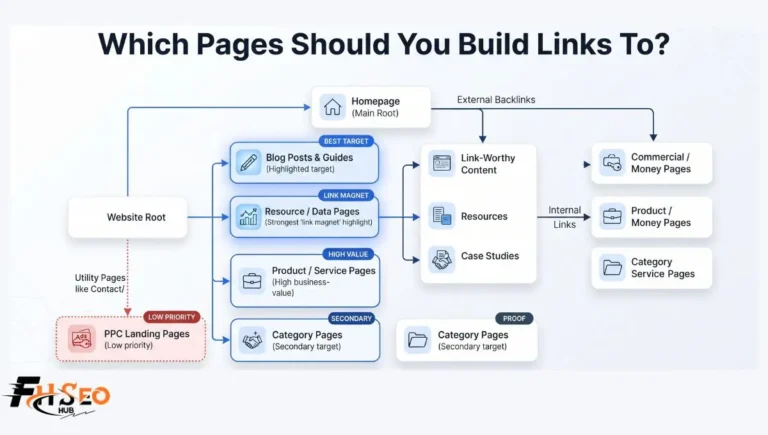
Next we build a one-to-one redirect map. Every high-value URL points to its closest matching new page with a single 301 redirect. We avoid blanket redirects to the homepage. Staging environments stay blocked from indexing while we verify titles, canonicals, structured data, and internal links.
On launch day we confirm redirects, update sitemaps, remove any noindex tags, and submit the new sitemap. Post-launch monitoring tracks indexing, crawl errors, rankings, and traffic for 30 to 90 days. We adjust redirects or fix issues as they appear.
Pre-migration checklist
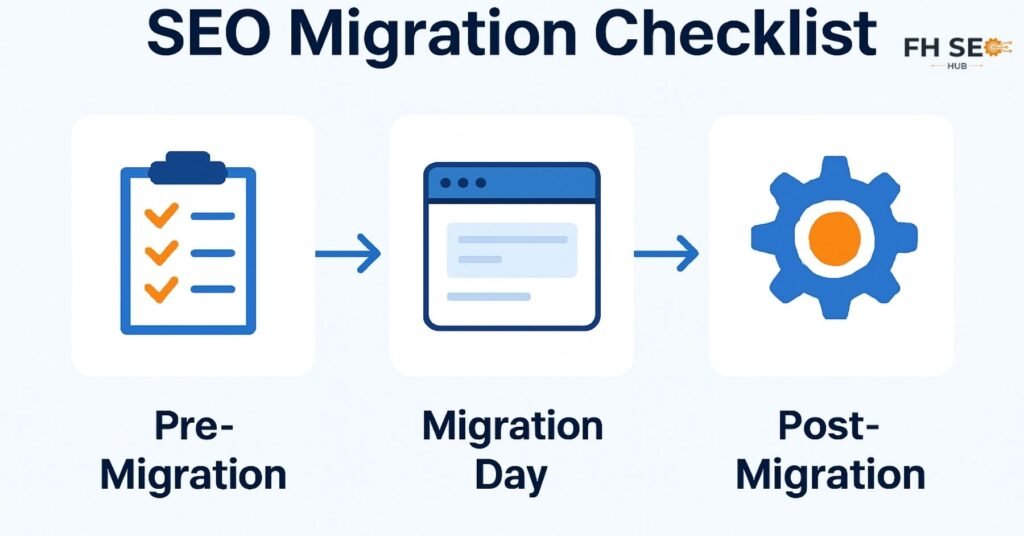
Crawl the entire current site and export every URL with status codes, titles, and canonicals. Pull 12 months of Search Console and analytics data. Document backlinks that point to important pages. Decide what happens to each URL: keep, merge, rewrite, or retire.
Build the redirect map and test it on a staging site that is blocked from search. Confirm metadata, structured data, and internal links transfer correctly. Update analytics and tracking codes so historical data remains continuous. These steps happen before any DNS or platform switch.
Launch day and post-migration monitoring
Remove staging blocks and confirm robots.txt allows crawling. Activate the redirect map and test the top traffic pages plus a sample of others. Submit the new XML sitemap and use the Change of Address tool for domain moves. Check that forms, tracking, and mobile speed still work.
In the first two weeks we watch Search Console coverage, 404 errors, and ranking movement. Temporary dips are common while Google re-crawls. We fix missing redirects or indexing issues quickly. Longer monitoring covers 30, 60, and 90 days so recovery stays on track.
Common migration risks and how we reduce them
Missing or chained redirects send equity to the wrong place or create loops. Incomplete content parity means important pages disappear. Staging noindex tags left live block the new site. Analytics or tracking breaks hide performance data.
FHSEOHub reduces these risks with a complete URL inventory, page-level redirect mapping, staging verification, and immediate post-launch checks. Clients receive regular updates so they can see indexing and traffic recovery in real time.
FAQs
They are the technical and content steps that protect rankings and traffic when a website changes domain, platform, structure, or design. FHSEOHub handles the full process from baseline to post-launch monitoring.
Planning and mapping usually take weeks. Launch itself is a single day. Full recovery monitoring runs 30 to 90 days while Google re-crawls and rankings stabilize.
Temporary fluctuations are normal. With complete redirects, content parity, and monitoring, most of the ranking value transfers. Large permanent losses usually come from incomplete mapping or technical blocks.
A complete one-to-one 301 redirect map from every old URL to its closest new equivalent. Blanket homepage redirects lose ranking signals.
Yes for domain migrations. It tells Google the site has moved. It is not required for platform or design changes on the same domain.
We scope each project to the changes involved. Domain, CMS, HTTPS, structural, and content migrations each receive the specific redirects, testing, and monitoring they need.
We monitor indexing, crawl errors, rankings, and traffic for 30 to 90 days. Issues are fixed as they appear so recovery stays on schedule.