What are Social Media Backlinks: How They Work and the Top 20 Platforms to Build Backlinks?

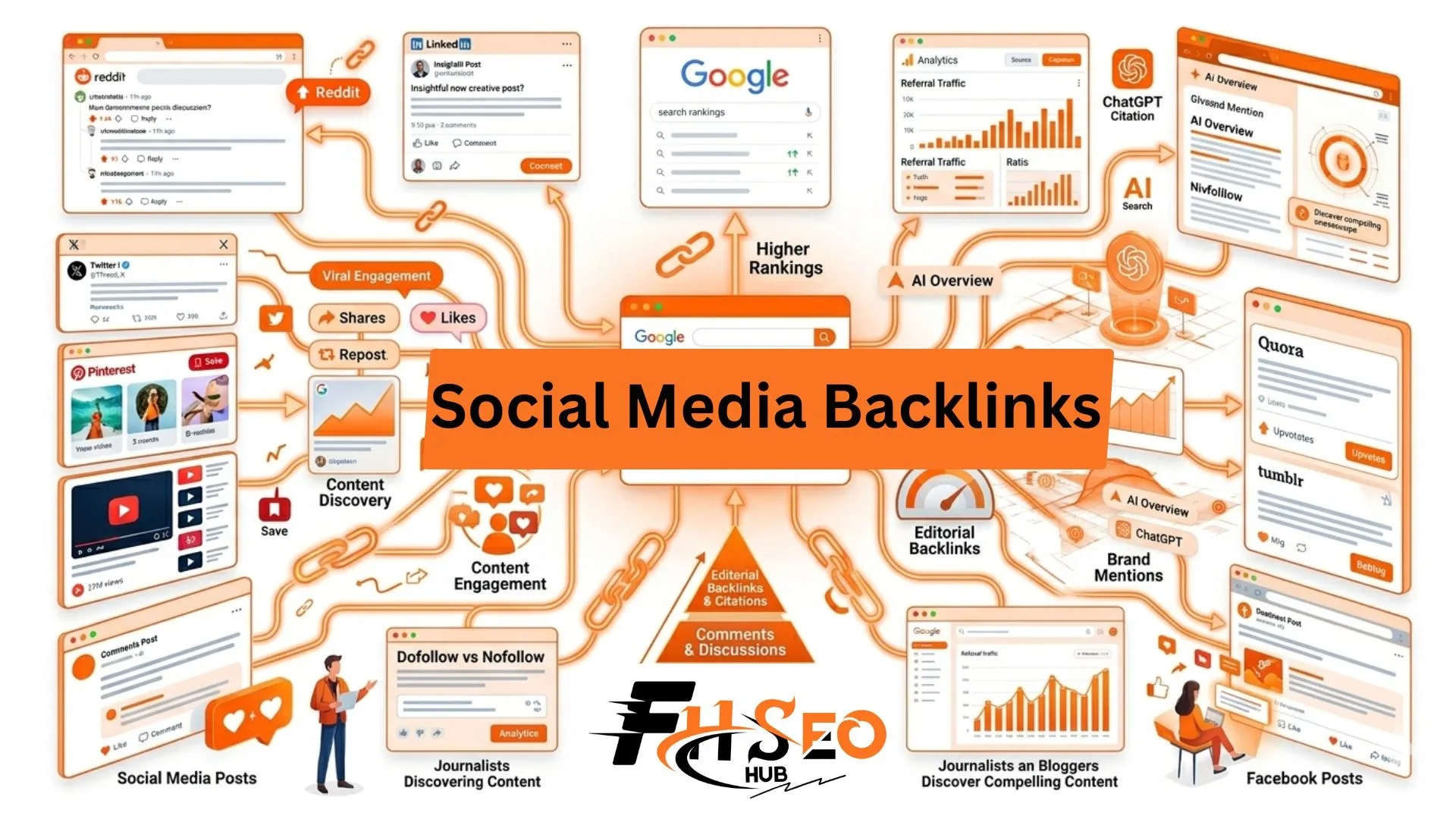
Social media backlinks are links placed on social platforms that point back to your website. Almost every one of them is nofollow, meaning they pass zero link juice directly. These links trigger a chain reaction that produces the editorial backlinks Google uses to rank pages.
What are social media backlinks?
Social media backlinks are hyperlinks from social platforms pointing to your website. They appear in profile bios, post captions, comment threads and shared content. Almost all carry the nofollow attribute (rel=”nofollow”) or the UGC tag (rel=”ugc”), which tells search engines not to pass link equity. Despite that technical limitation, they play a real and measurable role in any off-page SEO strategy.
These links are not the destination. They are the spark that leads to editorial dofollow links from journalists, bloggers and creators who discover your content through social platforms.
Why do nofollow social links still matter for SEO?
Since Google’s 2019 nofollow update, search engines treat nofollow links as hints rather than strict directives. Google may choose to follow and credit them when they appear relevant and trustworthy. Beyond that technical nuance, social media links improve content discovery, accelerate indexation speed, drive referral traffic, and increase branded search volume. All of those are indirect signals that influence organic rankings without passing a single unit of link juice directly.
How do these links help SEO through the indirect chain reaction?
The indirect SEO chain reaction works in five stages. You share a content asset on a social platform. It gains social velocity through likes, shares and comments. Creators and journalists discover it. They reference it in their own content. You earn editorial backlinks without cold outreach. Those editorial links are the dofollow backlinks that Google uses as direct ranking signals.
How does social velocity speed up Google indexing?
Social velocity is the rate at which your content gains engagement in a short time window. High social velocity correlates with faster Google crawling because Google’s crawlers visit high-traffic platforms like Reddit and Twitter/X frequently. Content shared with strong social velocity typically gets indexed within 48 hours compared to several weeks for unpromoted pages that sit untouched. This alone makes social sharing worth doing for any new piece of content.
What is the Social Engagement Pyramid and how does it trigger real backlinks?
Not all social engagement is equal for SEO. The Social Engagement Pyramid ranks user actions by their link trigger potential from passive to critical:
| Tier | Action Type | Platform Examples | SEO Impact |
| 1 | Passive (likes, hearts) | All platforms | Low |
| 2 | Semi-active (shares, saves, reposts) | LinkedIn, Pinterest, Twitter | Moderate |
| 3 | Active (comments, tags, replies) | Reddit, LinkedIn, Twitter | High |
| 4 | Content creation (blog links, citations) | External blogs, newsletters | Critical |
Tier 3 and Tier 4 are where real backlink potential lives. A SaaS founder shared a breakdown of their first $10K MRR on Twitter. The post reached 8,000 retweets. Within two weeks, three SaaS growth blogs featured it, a newsletter linked to it, and it was referenced in a YouTube video description. Total: 11 organic backlinks, two from domains with DR 70+. The original tweet had no SEO value. The social velocity it created did all the work.
Top 20 social media platforms for building backlinks in 2026?
| # | Platform | DA | Link Type | Best Placement | Primary SEO Benefit |
| 1 | Reddit (reddit.com) | 91 | UGC/Nofollow | Post body, profile | Highest link trigger potential |
| 2 | LinkedIn (linkedin.com) | 98 | Nofollow | Bio, articles, posts | Brand trust + editorial discovery |
| 3 | Twitter/X (x.com) | 94 | Nofollow | Thread, bio, pinned post | Fast indexation, viral trigger |
| 4 | Pinterest (pinterest.com) | 94 | Nofollow | Pin descriptions, bio | Image SEO, referral traffic |
| 5 | YouTube (youtube.com) | 100 | Nofollow | Video description, channel bio | E-E-A-T signal, referral traffic |
| 6 | Facebook (facebook.com) | 96 | Nofollow | Page bio, group posts | Brand awareness signals |
| 7 | Medium (medium.com) | 95 | Nofollow + canonical | Articles, bio | Editorial authority, syndication |
| 8 | Quora (quora.com) | 92 | Nofollow | Expert answers | LLM citation + topical authority |
| 9 | Instagram (instagram.com) | 93 | Nofollow | Bio link only | Brand signals |
| 10 | TikTok (tiktok.com) | 95 | Nofollow | Bio link | Fast brand discovery |
| 11 | Tumblr (tumblr.com) | 92 | Dofollow (posts) | Blog posts, reblogs | Direct link equity |
| 12 | Flipboard (flipboard.com) | 91 | Nofollow | Magazine curations | Content discovery |
| 13 | SlideShare (slideshare.net) | 95 | Nofollow | Presentation bio | B2B authority |
| 14 | Mix.com (mix.com) | 73 | Dofollow | Curated submissions | Link equity |
| 15 | Pocket (getpocket.com) | 91 | Nofollow | Saved bookmarks | Content discovery |
| 16 | Diigo (diigo.com) | 71 | Nofollow | Bookmarks + annotations | Niche content discovery |
| 17 | Scoop.it (scoop.it) | 78 | Mixed | Curated topics | Niche authority |
| 18 | BizSugar (bizsugar.com) | 56 | Dofollow | Community submissions | SMB/B2B dofollow equity |
| 19 | Minds (minds.com) | 67 | Dofollow | Profile + posts | Alternative social dofollow |
| 20 | Mastodon (mastodon.social) | 75 | Dofollow | Bio + posts | Decentralized dofollow equity |
Five platforms on this list provide dofollow links: Tumblr, Mix.com, BizSugar, Minds and Mastodon. For a healthy backlink profile, aim for a 70:30 dofollow to nofollow ratio. Social links naturally fill the nofollow side of that balance while you earn dofollow editorial links through content quality.
Why do Reddit, LinkedIn and Twitter generate the most backlink value?
Reddit (DA 91), LinkedIn (DA 98) and Twitter/X (DA 94) consistently produce the highest link trigger value because their content gets publicly indexed by Google, their communities include the journalists, bloggers and creators who build real backlinks.
A niche real estate tech brand repurposed one blog post into a Reddit AMA, a LinkedIn carousel, a Twitter/X thread and a Pinterest infographic. Within 10 days, blog traffic grew 3x, the post earned six organic backlinks from industry blogs and Google indexed it within 48 hours. No outreach emails sent.
Quora is worth specific attention in 2026. Expert answers on Quora appear in LLM citations. Being the cited expert answer in a Google AI Overview starts with being the answer people trust on Quora first.
Why does content distribution beat cold outreach for link building?
Cold outreach achieves a 1 to 5% response rate. Social content distribution generates 15 to 30% engagement on the same content with a single post.
| Feature | Traditional Cold Outreach | Social Content Distribution |
| Response rate | 1-5% | 15-30% engagement |
| Effort per link | High (manual emails) | Low (one post, many views) |
| Scalability | Slow, manual | Massively scalable |
| Link intent | Passive (you ask for it) | Active (they choose to link) |
| Brand trust | Low (cold contact) | High (social proof) |
How do social media backlinks compare to traditional editorial links?
This is where social media backlinks position themselves in the broader SEO picture: they are the visibility engine, not the ranking engine.
| Factor | Traditional Editorial Backlinks | Social Media Backlinks |
| Link type | Dofollow (usually) | Nofollow / UGC |
| Direct ranking impact | Yes | Indirect only |
| Speed to go live | Days to months | Minutes |
| Visibility boost | Limited | High |
| Content discovery | Slow | Fast (social-first) |
| Scalability | Manual outreach | Platform amplification |
| AI citation potential | High | Growing rapidly in 2026 |
The most effective off-page SEO strategy in 2026 uses social links as the visibility layer that creates conditions for editorial links to emerge organically.
How do these links feed Google AI Overviews and LLM citations?
In 2026, Google AI Overviews, ChatGPT and Perplexity use brand entity recognition signals when generating answers. Brands consistently mentioned in Reddit threads, LinkedIn posts and Quora answers build entity-level authority that AI systems recognize as credibility markers.
This is the main reason to invest in social link building beyond traditional SEO. When your brand appears across indexed social platforms consistently, AI-powered search systems begin treating your content as a trustworthy source.
The core takeaway
Social media backlinks work best as a visibility engine that triggers the editorial backlinks Google uses to move rankings. Start with the top three platforms in your niche, focus on content that reaches Tier 3 and Tier 4 engagement, and add one dofollow platform like Tumblr or Mastodon to your rotation. The next step is picking one piece of existing content and distributing it natively across three platforms this week.


