Social Signals SEO: What Moves Rankings and What Experts Still Get Wrong

Social signals SEO is the practice of using likes, shares, comments, brand mentions, and social engagement to indirectly influence your search engine rankings. While Google has confirmed that social signals are not direct ranking factors, they trigger a chain of behavioral and authority signals that create real, measurable SEO benefits. Understanding this indirect chain is what separates brands that grow from brands that post and wonder why nothing changes.
Here is a problem. You spend hours posting on social media and your rankings do not move. Your competitor with 50,000 followers somehow ranks above you. Every article you read either tells you social signals matter or that they do not. Both camps are missing the full picture.
What Are Social Signals in SEO and Why Do They Matter?
Social signals in SEO are measurable user interactions your content receives on social media platforms. That includes likes and reactions, shares and reposts, comments, saves and bookmarks, brand mentions, click-throughs from social posts, and follower growth.
Most people get confused here because they focus on the numbers themselves. Social signals SEO is not about vanity metrics. It is about what those interactions trigger downstream. A post that earns thousands of saves and shares exposes your content to new audiences. Some of those people visit your website. Others link to it from their own blogs. Journalists discover it. Industry influencers cite it. That chain reaction creates the actual SEO value, not the engagement count itself. Think of social signals as the spark. The SEO benefit is the fire that follows.
What Counts as a Social Signal Across Different Platforms?
Every measurable social interaction qualifies. On Facebook it is likes, shares, and comments. On X (formerly Twitter) it is reposts and quote posts. On TikTok and Instagram it is saves, shares, and video views. On LinkedIn it is reactions and reposts. On Reddit it is upvotes and comment threads. On Pinterest it is repins. Even brand mentions without a direct link count as social signals search engines register.
Are Social Signals a Direct Google Ranking Factor?
No. Google has confirmed this for over a decade. John Mueller stated in 2015 that social signals do not directly help organic rankings. Matt Cutts confirmed the same in 2014. Gary Illyes reinforced it in 2017, describing social media links as a single drop in an ocean of PageRank value.
Google does not count your likes or follower count when deciding where to rank your page. But this is only half the answer. The real question is what happens after your content gets shared widely on social platforms. And that story is far more important than the direct-versus-indirect debate most articles get stuck on.
What Did the 2024 Google API Leak Reveal About Social Traffic?
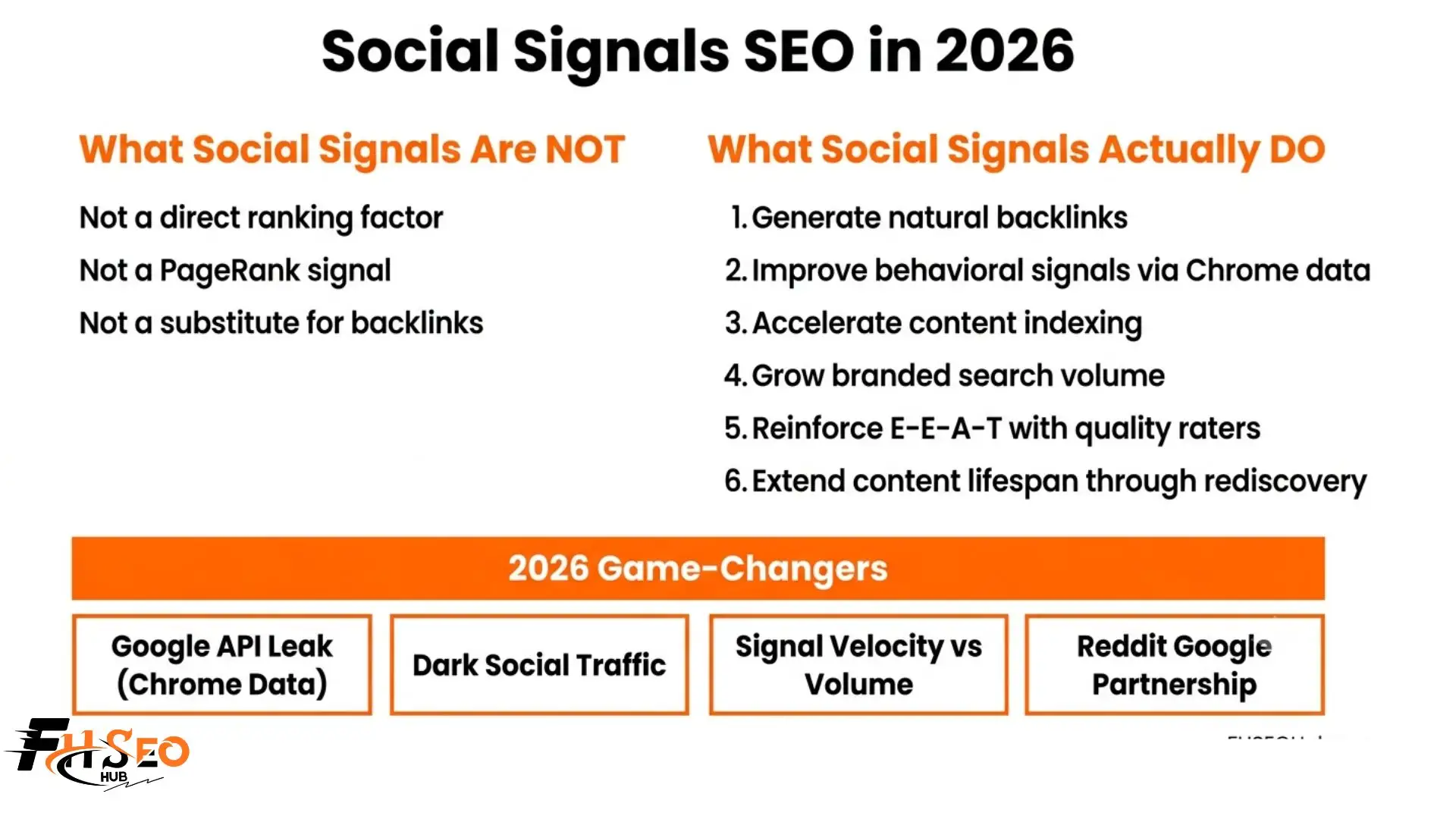
In May 2024 a significant leak of internal Google documents suggested that Chrome user behavior data, including how often users click a site and how long they stay, may influence rankings in ways Google has never publicly confirmed.
This changes how we think about social signals SEO in a meaningful way. High-quality traffic arriving from social platforms often produces strong on-site behavioral signals. Users who arrive from a relevant social post tend to stay longer, read more pages, and return more often. If Google’s systems register this engagement from Chrome data, then the quality of traffic your social media drives carries hidden ranking weight that goes far beyond what Google has officially acknowledged. This is the most underexplained development in social signals SEO right now.
How Do Social Signals Improve Your SEO?
Social signals improve SEO through six specific indirect mechanisms. Not through a single direct vote in Google’s algorithm. Here is how the chain reaction works:
How Do Social Signals Generate Natural Backlinks?
When your content earns significant social engagement it lands in front of people who create content for a living. Bloggers reference it. Journalists cite it as a source. Industry influencers share it to their networks. Each of these moments can produce an editorial backlink that is a direct ranking factor. Social media is the distribution channel that puts your content in front of the exact audience most likely to link to it. This is why link bait content and ego baiting outreach strategies consistently use social amplification as their first step.
What Is Social Signal Velocity and Why Does It Beat Total Volume?
Most marketers track total social engagement numbers over time. But social signal velocity, meaning how fast content accumulates engagement immediately after publication, matters more for two specific outcomes.
First, velocity drives Google Discover performance. Google Discover pushes content that trends quickly into personalized mobile feeds. A post that earns 500 shares in its first two hours sends a stronger trending signal than a post that earns 5,000 shares over six months.
Second, velocity triggers faster indexing. Google detects content being rapidly shared and discussed and crawls it more urgently. For product launches, news, or trending topics this first-mover indexing advantage can be the difference between ranking first or fifth. Total volume builds long-term topical authority. Velocity builds immediate visibility. A smart social media content strategy needs both.
What Is Dark Social and How Is It Quietly Moving Your SEO Metrics?
Dark social is the sharing that happens through private channels. WhatsApp messages. iMessage threads. Email forwards. Slack channels. Discord servers. This sharing generates real website traffic that appears as direct traffic in Google Analytics because the referral source is invisible.
Most brands have no idea that a significant portion of their direct traffic actually comes from people sharing links privately. That traffic produces genuine dwell time, click behavior, and branded search signals. If Google’s Chrome data tracks engagement from all traffic sources, then dark social may be influencing your SEO metrics daily without appearing in any social media dashboard.
The practical implication is straightforward. Create content worth sharing privately, not just publicly. Useful guides, exclusive data, and genuinely helpful resources travel through dark social far more than promotional content does.
How Do Google’s Quality Raters Use Social Profiles to Evaluate E-E-A-T?
Google’s Search Quality Rating Guidelines explicitly instruct human quality raters to actively visit and evaluate authors’ and brands’ social media profiles as part of their E-E-A-T assessment.
Raters check whether your social presence demonstrates real-world expertise, genuine authority, and operational legitimacy. A sparse profile, inconsistent brand information, or absent social presence is treated as a trust signal deficit. Their feedback directly calibrates how Google’s ranking algorithm weights certain signals.
Your social media profile is being read by people whose assessments shape the algorithm. The fix is profile optimization across every platform: consistent name, description, logo, and website URL. Then implement sameAs schema markup using Rank Math or Yoast SEO to connect your social profiles to your website entity inside Google’s Knowledge Graph.
Can Negative Social Signals Hurt Your SEO?
Yes. Negative social signals including viral brand criticism, brand crises, and widespread negative brand mentions damage the exact same indirect SEO metrics that positive signals improve.
When a brand trends negatively, people who search for that brand click organic results with suspicion. They bounce quickly. They visit fewer pages. They do not return. Google’s Chrome behavioral data potentially captures all of this. The result is that a PR crisis does not just hurt brand reputation. It can measurably damage click-through rate, increase bounce rate, and reduce dwell time on pages that previously performed well. Social listening tools like Hootsuite and Semrush Social matter for SEO risk management, not just marketing strategy.
Why Does Reddit Have a Unique SEO Advantage in 2026?
In 2024 Google signed a content licensing deal with Reddit to use Reddit content for AI model training. As a result, Reddit content now receives preferential crawling frequency, faster indexing, and elevated SERP placement. Reddit threads regularly appear at the top of search results for informational and product comparison queries. Active genuine participation in relevant Reddit communities is one of the highest-leverage social signal opportunities for branded visibility in 2026.
Final Thoughts
Social signals SEO is not about chasing likes. It is about understanding the chain reaction that follows strong social engagement and engineering content that sets that chain in motion. The 2024 Google API leak, dark social, signal velocity, quality rater evaluations, and Reddit’s preferential indexing are important. Build consistent social profiles. Implement sameAs schema. Measure branded search volume growth quarterly. The brands that treat social media and SEO as one integrated system will consistently outperform the brands that run them separately.
FAQs
No. Google has confirmed that likes, shares, and comments are not direct ranking factors. However they indirectly improve rankings by driving referral traffic that produces behavioral signals, exposing content to audiences who link editorially, and growing branded search volume that signals brand authority over time.
YouTube and Pinterest offer the strongest direct Google indexing. Reddit has preferential Google placement following the 2024 content licensing deal. LinkedIn drives B2B branded search volume. TikTok builds brand awareness that triggers branded searches, which indirectly improves organic rankings for non-branded keywords.
Indexing speed improvements can appear within days of content trending on social platforms. Backlinks generated from social discovery typically materialize within two to eight weeks. Branded search volume growth from consistent social media brand building takes three to six months to produce measurable ranking impact.
Yes. Negative social signals including viral brand criticism and widespread negative brand mentions damage SEO indirectly. They trigger branded search traffic with high bounce rates, reduce CTR for organic results, and create poor behavioral signals that Chrome data may capture.
Paid social campaigns boost social signal velocity. Faster social engagement accelerates Google Discover performance and content indexing speed. Ads also drive referral traffic that generates quality behavioral signals. They do not directly improve rankings but accelerate the indirect chain reaction that does.
Both have specific roles. SEO captures intent-driven search demand. Social media builds brand authority, drives content distribution, and generates the backlinks and behavioral signals that make SEO compound faster. Treating them as competing budget items is the wrong frame.
Use Google Analytics for referral traffic and behavioral metrics from social sources. Check Google Search Console for branded search volume growth. Use Ahrefs Site Explorer to track backlinks earned after social distribution. Monitor engagement rates in Semrush Social or Hootsuite to identify which content earns the most downstream SEO value.


