Best Outreach & Link Building Softwares (Pitchbox, Link Whisper & More)

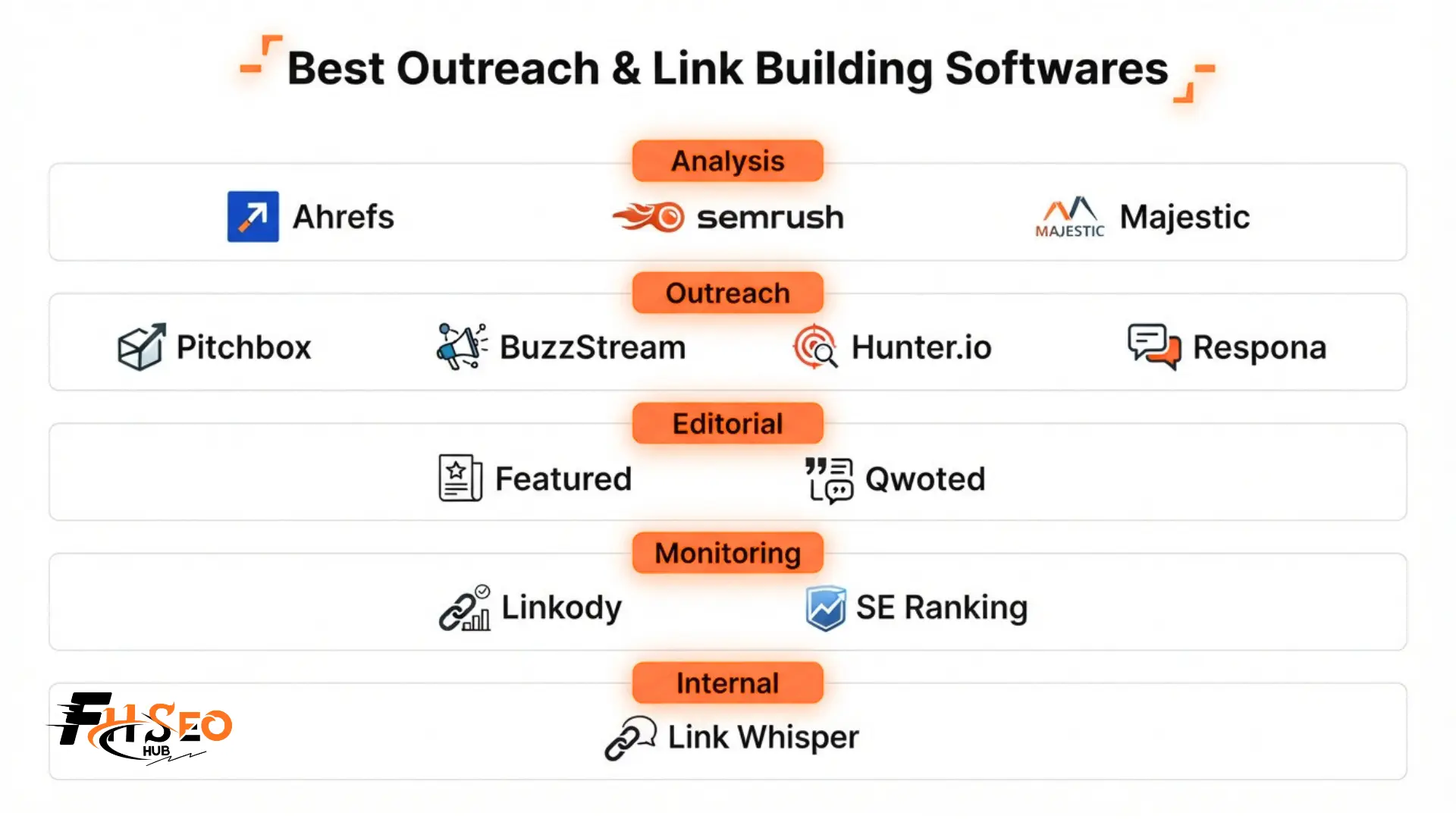
The best link building software falls into four jobs that rarely live in one tool: backlink and competitor analysis (Ahrefs, Semrush, Majestic), contact discovery and outreach automation (Pitchbox, BuzzStream, Hunter.io, Respona), backlink monitoring (Linkody, SE Ranking), and internal linking (Link Whisper). Most link builders run three or four of these together, not one all-in-one platform.
What Link Building & Outreach Software Really Does
Link building software covers four distinct jobs: analyzing backlink profiles and competitor links, finding and verifying contact details, automating and tracking outreach emails, and monitoring links once they’re live. No single tool does all four well, which is why most link builders run a small stack of specialized tools instead.
A common source of wasted budget is treating these as one category. A backlink analysis tool like Ahrefs tells you which sites link to a competitor, but it won’t send a single outreach email. An outreach platform like Pitchbox manages your email sequences, but its backlink data isn’t as deep as a dedicated analysis tool. Contact-finding tools like Hunter.io do one narrow thing well and nothing else. Understanding which job you’re really trying to solve is the difference between a lean, effective stack and three overlapping subscriptions that each do 60% of what you need.
What to Look for in a Link Building Tool
The right tool depends on the specific bottleneck in your workflow: prospecting, contact discovery, outreach management, or monitoring. Beyond fit, the factors that separate strong tools from weak ones are backlink data freshness, email verification accuracy, deliverability protection, and whether pricing scales sensibly as your volume grows.
Data freshness matters most for analysis tools. Ahrefs refreshes backlink data every 15 to 30 minutes, while most competitors update daily, which matters if you’re tracking link velocity on an active campaign. For outreach tools, the deciding factors are email verification accuracy, since sending to invalid addresses damages sender reputation, and whether the tool protects deliverability with features like sending limits and domain warming. Watch the per-seat pricing too. Some platforms advertise a low base price, then charge $45 to $100 per additional user, which changes the real cost for any team above one person.
Best Tools for Backlink & Competitor Analysis
These tools show you who links to your competitors, where your backlink gaps are, and which linking opportunities are worth pursuing. They form the research layer of any link building operation, the step before outreach even begins.
1. Ahrefs
Ahrefs is the strongest tool for backlink and competitor analysis, with the freshest link data in the category and features like Site Explorer, Content Explorer, and Link Intersect built specifically for finding link opportunities. Pricing runs roughly $108 to $129 a month for the Lite tier up to $199 to $249 for Standard.
Ahrefs earns its reputation on backlink data depth and refresh speed, updating every 15 to 30 minutes against competitors’ daily cycles. Its Link Intersect (backlink gap) feature finds sites linking to several competitors but not you, which is the single most useful prospecting report in link building. The Content Explorer surfaces linkable content and broken pages across a massive index. The main downsides are real: there’s no free trial, the Lite plan limits report rows, and API access requires a separate subscription starting around $500 a month on top of your plan.
2. Semrush
Semrush is the better pick when link building sits alongside broader SEO work, since it bundles backlink analysis with keyword research, PPC data, content tools, and AI visibility tracking. Pricing runs roughly $117 to $139 a month for Pro, up to $417 to $500 for Business.
Where Ahrefs goes deep on links, Semrush goes wide across the whole SEO workflow. Its Backlink Gap tool mirrors Ahrefs’ Link Intersect, and its backlink analytics pair well with toxic link detection for cleanup work. The trade-offs are per-seat costs, additional users run $45 to $100 a month each, and add-ons like AI Visibility at around $99 a month that push the real total well above the sticker price. For teams whose main job is link analysis alone, Ahrefs has the data edge. For teams doing content, PPC, and links together, Semrush covers more in one subscription.
3. Majestic
Majestic is a backlink-specialist tool built around its own Trust Flow and Citation Flow metrics, useful as a second data source to cross-check the link quality numbers from Ahrefs or Semrush. Pricing runs roughly $50 to $400 a month depending on tier.
Majestic does one thing: backlink data, through its own index and quality metrics. Trust Flow (link quality) and Citation Flow (link quantity) give a different read on a domain’s authority than Domain Rating alone, which makes Majestic valuable as a corroborating source rather than a primary tool. It lacks the broader SEO features of Ahrefs or Semrush, so most teams use it alongside one of them, not instead.
| Tool | 2026 Price (approx) | Best For | Key Limitation |
| Ahrefs | $108-249/mo | Freshest backlink data, link gap analysis | No free trial, API costs extra |
| Semrush | $117-500/mo | All-in-one SEO plus link analysis | Per-seat fees, paid add-ons |
| Majestic | $50-400/mo | Second-opinion link quality metrics | No broader SEO toolkit |
Best Tools for Contact Discovery & Outreach Automation
Once you know who to pitch, these tools find the right contact, verify the email, and manage the outreach sequence. This is where most link building campaigns are won or lost, since a great prospect list means nothing without deliverable emails and organized follow-up.
4. Pitchbox
Pitchbox is a full outreach automation platform built for agencies running high-volume campaigns, combining prospecting, multi-step email sequences, and native integrations with Ahrefs, Semrush, and Moz. Pricing starts around $165 a month for the Pro plan.
Pitchbox is the outreach engine most agencies graduate to once spreadsheet-and-Gmail stops scaling. It automates follow-up sequences, separates client campaigns into workspaces, and pulls SEO metrics directly into your prospect lists so you can filter by DR or traffic before pitching. The value is real at scale, five or more concurrent campaigns, but the price is hard to justify for a solo link builder or a single in-house site. For that use case, a cheaper tool covers the same core workflow.
5. BuzzStream
BuzzStream is a link building CRM that tracks relationships, email history, and outreach sequences at a lower entry price than Pitchbox, starting around $24 a month. It suits small teams that build links through ongoing relationships rather than one-off blasts.
BuzzStream’s strength is relationship memory. Every past email, reply, and note tied to a contact stays organized across campaigns, which prevents the mistake of re-pitching someone who already declined. Its ListIQ feature assists with contact discovery. The trade-offs are that it’s email-only, with no LinkedIn or multichannel outreach, and its automation is lighter than Pitchbox’s. For relationship-driven link building at a small-team scale, that’s usually an acceptable trade.
6. Hunter.io
Hunter.io is a dedicated email finder and verifier, built to turn a domain into verified contact emails with a confidence score attached. It offers a genuinely useful free tier of around 25 to 50 credits a month, with paid plans running roughly $34 to $269 a month.
Hunter does one job cleanly: enter a domain, get associated professional emails with deliverability scores. Its free tier alone makes it worth keeping in any stack for occasional lookups. The credit model is the thing to understand, a domain search returns multiple emails and each one consumes a credit, so credits burn faster than expected on bulk work. Its built-in Campaigns feature handles basic sending, but it’s too light for serious outreach, so most teams pair Hunter with a dedicated outreach platform rather than relying on it end to end.
7. Respona
Respona is an outreach platform that has moved toward a managed, per-placement model, combining AI-assisted personalization with done-for-you campaign execution. It’s better suited to teams that want links without running outreach themselves, with placement costs varying widely by target site.
Respona’s AI reads a target site’s recent content and drafts contact-specific pitches, and its media list tool researches journalists automatically. The company has shifted toward handling placement end to end for a fee rather than selling pure software seats, which puts it closer to an agency retainer than a self-serve tool. If your bottleneck is time rather than budget, that model works. If you want to run campaigns hands-on, a self-serve tool like Pitchbox or BuzzStream fits better.
| Tool | 2026 Price (approx) | Best For | Key Limitation |
| Pitchbox | From $165/mo | High-volume agency outreach | Overkill for solo or single-site use |
| BuzzStream | From $24/mo | Relationship-driven outreach CRM | Email-only, lighter automation |
| Hunter.io | Free to $269/mo | Finding and verifying emails | Sending feature too light for campaigns |
| Respona | Per-placement, varies | Managed, hands-off link building | Not built for hands-on control |
Best Tools for Authority Backlinks & Editorial Placements
Getting mentioned by journalists and editors produces some of the strongest, most natural editorial links available. These platforms connect you with reporters actively looking for expert sources, the modern replacement for the original HARO model.
8. Featured (formerly HARO)
Featured now runs the HARO brand as a scaled-back service, connecting expert sources with journalists writing relevant stories. It offers a free tier with limited pitches, with paid plans typically running around $99 to $149 a month.
HARO in its original free-for-all form was scaled back after a change in ownership, and Featured is what carries the brand now. You respond to journalist queries with a quotable answer, and if it gets used, you earn a mention and often a link on a high-authority publication. Most pitches don’t get picked up, that’s the nature of the channel, but the ones that land reach authority levels a guest post budget rarely touches.
9. Qwoted
Qwoted is a journalist-sourcing platform widely used for digital PR in 2026, connecting sources with reporters across business, tech, and finance beats. Its free tier allows a limited number of pitches a month, with paid access typically around $99 to $149 a month.
Qwoted has become one of the more actively used HARO successors, with a cleaner interface and a strong base of business and finance journalists. Like Featured, it’s a numbers game with a high reward when a pitch lands. Running both Featured and Qwoted together widens the pool of queries you can respond to, which is what most serious digital PR operations do rather than betting on one platform.
| Tool | 2026 Price (approx) | Best For | Key Limitation |
| Featured | Free to ~$149/mo | Authority links via journalist queries | Low hit rate per pitch |
| Qwoted | Free to ~$149/mo | Digital PR in business and finance niches | Same numbers-game dynamic |
Best Tools for Backlink Monitoring
Building links is only half the job. These tools watch your backlink profile for lost links, new links, and toxic ones, so you catch problems before they cost you rankings.
10. Linkody
Linkody is a dedicated backlink monitoring tool that tracks your links continuously and alerts you when one is lost or changed, at a lower price than a full SEO suite. Pricing typically runs around $15 to $50 a month depending on the number of links tracked.
Linkody focuses on one job: watching your backlink profile so you don’t have to check manually. It flags lost and new links, tracks anchor text distribution, and integrates a disavow tool for cleaning up toxic links. For a site that has invested in link building and wants to protect that investment, a focused monitoring tool like this costs far less than catching link loss late through a full suite.
11. SE Ranking
SE Ranking is a broader, budget-friendly SEO platform with strong backlink monitoring, white-label reporting, and rank tracking bundled in. Its Core plan runs around $103 a month on annual billing, making it a lower-cost all-rounder for freelancers and small agencies.
SE Ranking sits between a single-purpose monitor and a premium suite. Its backlink monitoring and white-label reporting make it popular with agencies that need to show clients link progress without paying Ahrefs or Semrush prices. The backlink data isn’t as deep as the premium tools, but for monitoring and client reporting rather than heavy competitive research, it covers the job at a meaningfully lower price.
| Tool | 2026 Price (approx) | Best For | Key Limitation |
| Linkody | ~$15-50/mo | Focused, low-cost link monitoring | Monitoring only, no prospecting |
| SE Ranking | From ~$103/mo | Budget all-rounder with white-label reports | Shallower backlink data than premium tools |
Internal Linking Software: A Different Job
Internal linking tools connect pages within your own site, which supports rankings but is a separate job from off-site link building. Link Whisper is the best-known tool here, and it belongs in a link building stack for a different reason than the outreach tools above.
12. Link Whisper
Link Whisper is a WordPress plugin that automates internal linking, suggesting relevant links between your own pages and flagging orphaned content. Pricing runs roughly $77 to $187 a year depending on the number of sites, which is a yearly license rather than a monthly subscription.
This is the tool most often misfiled in “link building software” lists, so it’s worth being clear: Link Whisper does not do outreach, find prospects, or build backlinks from other sites. It automates internal links within your own WordPress site, suggesting contextual links as you write and adding them in bulk across an existing archive. That’s genuinely useful for SEO, internal linking spreads authority and helps rankings, but it solves a different problem than everything else on this list. Pair it with the outreach and analysis tools above, don’t expect it to replace them. Its main limitation is that link suggestions sometimes miss relevance, so the suggestions still need a human review.
How to Build a Link Building Software Stack by Budget
The right stack depends on team size and budget, not on buying the most expensive tool. A solo link builder can run an effective stack for under $150 a month, while an agency managing multiple clients needs $400 or more across specialized tools.
Here’s how the stack scales in practice. A solo link builder or small blog can pair Google Search Console (free) with Hunter’s free tier and one analysis tool like Ahrefs Lite. Add the free tiers of Featured or Qwoted, and total spend stays near the cost of a single subscription. A small agency adds a real outreach CRM like BuzzStream and a monitoring tool like Linkody or SE Ranking, landing somewhere around $150 to $300 a month. A larger agency running concurrent client campaigns moves up to Pitchbox for outreach and a premium analysis tool like Ahrefs Standard or Semrush Guru. Add white-label reporting through SE Ranking, and that’s where the $400-plus range comes from.
| Stage | Suggested Stack | Rough Monthly Cost |
| Solo / blog | GSC + Hunter free + Ahrefs Lite + Featured free | Under $150 |
| Small agency | Add BuzzStream + Linkody or SE Ranking | $150-300 |
| Large agency | Pitchbox + Ahrefs Standard/Semrush Guru + SE Ranking | $400+ |
The principle underneath every stage is the same: buy the tool that fixes your actual bottleneck, not the one with the longest feature list. Overlapping subscriptions that each half-solve the same problem are the most common way link building budgets get wasted.
Final Thoughts
The best link building software is the one that fixes your specific bottleneck, not the one with the most features or the highest price. For backlink analysis, Ahrefs leads on data and Semrush on breadth. For outreach, Pitchbox scales for agencies while BuzzStream serves small teams affordably. For authority links, Featured and Qwoted reach journalists on free tiers. And Link Whisper handles internal linking, a related but separate job. Start by naming the single step in your workflow that costs you the most time, buy the tool that solves that one thing, and add to the stack only when a real gap appears.
FAQs
There’s no single best tool, because the category covers four different jobs. Ahrefs leads on backlink analysis, Pitchbox on high-volume outreach, BuzzStream on relationship-driven outreach at a lower price, and Featured or Qwoted on authority links from journalists. Most link builders run several together.
Link Whisper automates internal linking within your own WordPress site, which supports SEO but is a different job from off-site link building. It doesn’t do outreach, find prospects, or build backlinks from other sites, so it complements outreach tools rather than replacing them.
Ahrefs is a backlink analysis tool that shows you who links to competitors and where your link gaps are. Pitchbox is an outreach automation platform that manages the emails you send to those prospects. They solve sequential steps in the same workflow, and many teams use both together.
Yes, up to a point. Google Search Console, Hunter’s free tier, MozBar, and the free pitch tiers of Featured and Qwoted cover monitoring, contact finding, and even authority-link outreach at no cost. Free tools cap on volume, so scaling a serious operation eventually needs paid tools, but the entry point can genuinely be zero.
A solo link builder can run an effective stack for under $150 a month, a small agency for $150 to $300, and a larger agency managing multiple clients for $400 or more. The number scales with team size and campaign volume, not with how many features you buy.
Usually yes. Backlink analysis tools like Ahrefs don’t send outreach emails, and outreach platforms like Pitchbox don’t match a dedicated analysis tool’s link data depth. Trying to force one tool to do both is why many stacks end up with expensive gaps.


