How to Outsource Backlink Building the Right Way in 2026

To outsource backlink building the right way, choose a partner who shows live placements, lets you approve every site before publication, and replaces lost links. Expect to pay $300 to $700 per quality link, or $2,000 to $10,000 a month for a managed campaign. Fix your site first, track results monthly, and allow three to six months.
Most site owners know they need links. The hard part is handing off the work without losing control of quality, budget, or safety. A clear process fixes that, starting with what you are buying.
What link building outsourcing includes
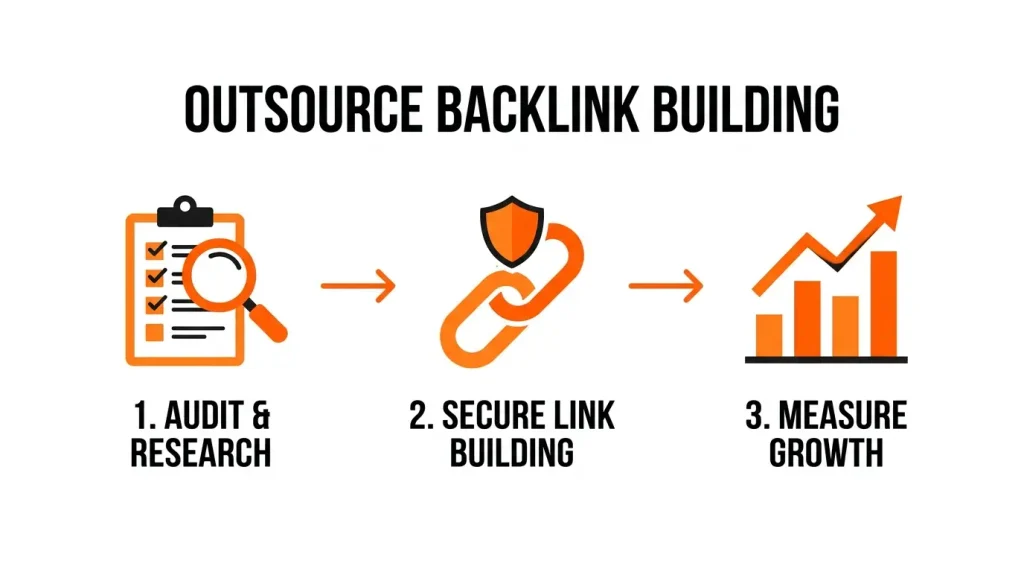
Link building outsourcing means paying outside specialists to find publishers, pitch them, write content, and place links to your pages. You can hire a freelancer, an agency, or a white label team. The right choice depends on your budget and how many links you need each month.
Freelancers cost less, often $200 to $1,000 a month, but quality varies and one person can only handle so much. Agencies charge more, usually $2,000 to $10,000 a month, and bring writers, outreach staff, and reporting. A white label team builds links under an agency’s own brand. That helps firms sell white label link building to clients without hiring staff.
Pay per link or managed campaign
Pay per link works when you already know your targets and want specific placements, such as guest posts or niche edits. A managed campaign covers strategy, content, site selection, and anchor text for a monthly fee. Many teams keep strategy in house and outsource only the outreach, which gives them control without the workload.
When outsourcing makes sense
Consider it when outreach eats 10 to 20 hours of your week or you want more than 10 links a month. One survey found that 73.5% of link builders produce fewer than 10 links a month. Scaling past that usually takes a team. Hold off if your page does not rank in the top 100 for its keyword, because links cannot rescue thin content. A new site with three weak pages gains little from ten placements.
Why links still matter in 2026
Links still matter, but they are one signal among several. A Google representative has said links have not been a top three ranking signal for some time. Even so, pages with strong link profiles still tend to rank higher. Brand mentions now carry weight too, especially in AI search.
A study of 75,000 brands found that brand web mentions correlated with AI Overview visibility at 0.664, while backlinks correlated at 0.218. Correlation does not prove cause. Still, the gap suggests that editorial placements naming your brand help twice. They pass link value and create brand mentions that AI systems can cite. About 73.2% of link builders in one survey also believe backlinks influence AI search visibility.
For answer engine optimization, ask your partner to place your company name in the article text, not only behind a generic anchor. A roundup that names your brand and links to your pricing page serves both goals. The common mistake is dropping links entirely because AI search feels new. With that context, the next question is what outsourcing costs.
What it costs compared with hiring in house
An in house link builder costs about $92,000 a year once you add tools, which works out to roughly $767 per link at 10 links a month. Outsourced links usually cost $300 to $700 each, or $2,000 to $10,000 a month for a managed campaign. Outsourcing also skips hiring and training time.
The in house math
A US link builder earns about $80,000 a year. Tools such as Ahrefs, Semrush, and an outreach platform can top $1,000 a month together. That brings the total near $92,000 before you pay for content, prospect lists, or paid placements. A new hire also needs time to build publisher relationships.
Outsourced price ranges
Most businesses spend $1,000 to $5,000 a month on link building. Premium retainers can reach $12,000. For example, a $4,000 campaign that delivers six to eight editorial placements costs $500 to $667 per link.
| Option | Typical price | Best for | Main risk |
|---|---|---|---|
| Freelancer | $200 to $1,000 per month | Small budgets and specific pages | Uneven quality and limited volume |
| Pay per link | $300 to $700 per link | Teams with a clear target list | Paying for volume instead of fit |
| Managed agency campaign | $2,000 to $10,000 per month | Steady growth and reporting | Weak vetting hides low quality sites |
| White label partner | Custom quotes | Agencies serving clients | Brand damage if quality slips |
A monthly retainer suits steady growth, while pay per link suits one off pushes. Prices far below these ranges signal trouble. A flat $20 per link, or 50 guest posts for $100, almost always means link farms or private blog networks. Ask for pricing by link type, since a flat rate hides what you receive. Compare at least three quotes before you outsource backlink building, and confirm prices again before signing because they change often.
How to vet a link building partner
A good partner shows live examples, lets you approve each publisher before it goes live, and puts a replacement policy in writing. Reject any provider that guarantees rankings or sells fixed lists of sites. Verify claims yourself instead of trusting a sales deck.
Ask for case studies you can check in an SEO tool, such as referring domain growth and ranking changes for a named client. Review the backlink profile of the provider’s own site, since a firm that cannot earn good links for itself will struggle for you. Read client reviews on third party platforms and look for long partnerships rather than star ratings. Shortlist white hat link building agencies first.
Five questions to ask before signing
- Can I see live placements from recent clients?
- Do I approve every site before you publish?
- What happens if a link disappears after payment?
- Do you use manual link building or automated outreach tools?
- What is your process if a link triggers a penalty signal in Search Console?
A trustworthy partner answers all five directly and backs each answer with an example.
Warning signs that should end the conversation
Walk away from guaranteed rankings, promises of hundreds of links in days, vague answers about methods, and reports with no live URLs. Be wary of providers who work from a list of guest post sites, because that signals inventory, not outreach. Paid link schemes can trigger a manual action, which appears in Search Console. Algorithmic devaluation is silent, so you notice it only when rankings stall. Sudden ranking jumps can also point to tactics you never approved.
Run a small trial first
Start with a paid test of two or three links before you outsource backlink building at full scale. Afterward, pitch each linked site yourself and read the replies. If every editor mentions payment, you probably bought paid placements. Trials cost little and expose weak vendors early.
Set quality standards for every link
A good outsourced link sits inside relevant article content on a site with real readers. It is permanent, indexed, and uses natural anchor text. Judge each placement against a written checklist before you approve it.
Use these six checks:
- The page is topically relevant to your niche.
- The site earns real organic traffic, ideally 1,000 visits a month or more, with a stable trend.
- The link sits in the body content, not a footer or sidebar.
- The link is permanent and passes authority as a followed link.
- The anchor text reads naturally, and exact match phrases stay rare.
- The site does not sell the same placement to many clients.
Treat domain authority and Domain Rating as a rough filter, not a goal. Neither is a Google ranking factor, and both are easy to inflate. A DR 35 site with a loyal audience in your niche often beats a DR 70 site that publishes on every topic. If a vendor leads with the metric, ask about relevance and traffic instead. A frequent mistake is repeating the same exact match anchor across most placements, which looks unnatural.
Prepare your site before the first placement
Links amplify what a page already does, so weak pages waste good placements. Confirm your target pages are indexable, fast, and useful before outreach starts. Then decide which pages deserve links first.
Before you outsource backlink building, check each target page. It should return a 200 status and carry no noindex tag. It should also appear in your sitemap and not be blocked by robots.txt. Test mobile speed and fix broken links on those pages. A pricing page with a stray noindex tag, for example, will collect links and never rank.
Next, choose targets with care. Money pages convert visitors but attract links slowly. Research, data, and free tools attract links easily. Many teams point outreach at a linkable asset and pass authority to money pages through internal links. See which pages to build links to for the full approach. Then set a specific goal, such as six new referring domains to your pricing page in 90 days, instead of “get more links.”
Track results and set a realistic timeline
Track referring domains, rankings, organic traffic, and revenue every month. Most campaigns need three to six months before rankings move in a meaningful way. Judge success by pages that moved and leads that arrived, not links placed.
Watch the relevance of linking sites, your anchor text mix, and referral visits from each placement. Check whether your brand appears in AI answers for your topics. Use Ahrefs or Semrush for audits and a backlink monitoring tool to catch lost links early. You can also check backlinks in Google Search Console without extra software.
ROI math keeps budgets honest. A $10,000 campaign that produces $50,000 in organic revenue returns 400%. Use real revenue from organic leads, and wait long enough to see it.
Expect links to go live in the first month. Early ranking signals appear between months one and two, and meaningful movement comes at three to six months. Traffic can take up to 12 months to move. Teams often quit at month two, just before gains appear. That habit is one of several costly mistakes.
Mistakes that waste an outsourcing budget
Most wasted budgets trace back to choosing on price, skipping site fixes, and ignoring what happens after a link goes live. Five mistakes cause most of the damage.
Choosing the cheapest quote comes first. Low prices usually mean low quality sites, and cleaning up bad links through disavowal is slow. The second mistake is approving placements without checking the site. Review traffic and topic fit before every approval, even with a trusted provider.
Third, many buyers build links and then stop watching them. Publishers sometimes remove links, so audit your profile monthly and claim replacements under your agreement. Fourth, some teams stop after reaching page one and then lose ground when link growth halts. Fifth, micromanaging slows good builders. Give clear goals, review work monthly, and let experienced people run outreach.
Conclusion
Outsource backlink building only when you can verify the work: live placements, approved sites, and a written replacement policy. Fix your target pages first, and set a goal for each page you want to lift. Budget for three to six months, because links compound slowly. Track referring domains and rankings every month, and drop any partner who cannot show them. This week, write down your five target pages, a monthly budget, and the five vetting questions, then book two vendor calls.
FAQs
Most businesses spend $1,000 to $5,000 a month. Quality placements run about $300 to $700 each, and managed agency campaigns cost $2,000 to $10,000 a month. Freelancers charge less, often $200 to $1,000 a month, but deliver less volume. Prices below $100 per link usually mean low quality or private blog network placements.
Yes, when the provider uses white hat methods, approves every site with you, and avoids paid link schemes and private blog networks. The risk comes from vendors who sell fixed site lists or guarantee rankings. Check live placements and the replacement policy before you pay.
Links usually go live within the first month. Early ranking signals often appear between months one and two, and meaningful gains typically take three to six months. Traffic can take longer, so judge progress by referring domains and keyword positions for your target pages.
Hire a freelancer for a small budget and a few specific pages, but vet quality carefully because results vary. Choose an agency when you need steady volume, content, and reporting. Either way, ask for live examples and a written replacement policy.
Pay per link means you buy specific placements, which suits teams with a target list. A managed campaign covers strategy, content, site selection, and reporting for a monthly fee. You can start with pay per link and move to a managed plan once quality is proven.
White label link building means a partner builds links for your clients under your brand. SEO agencies use it to sell link building without hiring outreach staff or writers. Choose a partner that delivers reports with live URLs that you can hand to clients.
Yes. Start with a freelancer or a few pay per link placements, often $1,000 to $2,000 a month. Aim for three to five quality links. Spend on relevance rather than volume, and add budget only after rankings move.
Ask for a monthly report with live URLs, anchor text, and site metrics. Check the links yourself with a backlink checker and Google Search Console. Monitor lost links so you can claim replacements.