
What are Google Stop Words and When They Matter

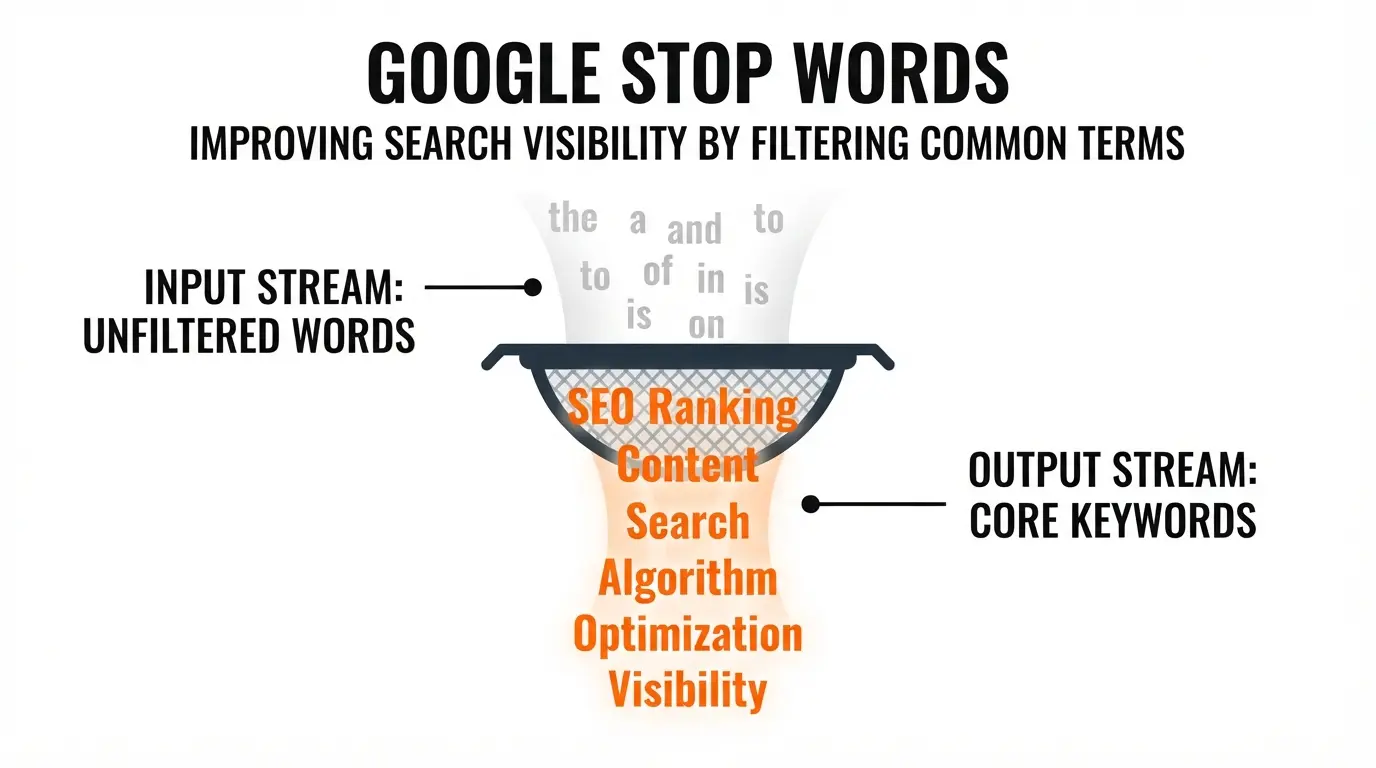
Google stop words are common words like “the,” “a,” and “in” that search engines historically ignored during crawling and indexing since they carry little standalone meaning. Google patented a more sophisticated approach to this back in 2004, one that treats some stop words as genuinely meaningful rather than automatically discarding them, and most current content on this topic still hasn’t caught up to what that patent actually says.
If you have argued with a colleague over whether “the” belongs in a URL slug, or you’re trying to figure out whether stripping stop words from your title tags is still good practice or a holdover from an outdated SEO checklist, here is the accurate, current picture.
What Are Stop Words?
Stop words are common words, articles, prepositions, and conjunctions like “the,” “a,” “an,” “in,” “of,” and “and,” that occur so frequently in language they carry little meaning on their own and were historically excluded from search indexes to save processing power and storage. Hans Peter Luhn, an early information retrieval pioneer, is generally credited with coining the concept decades before Google existed, as part of broader information science work on indexing large text collections efficiently.
Stop-phrases extend the same idea to multi-word combinations, “show me” or “I want,” phrases that add no real search intent beyond the actual keywords surrounding them. Both concepts predate modern search engines by decades, though how they get handled has changed substantially since natural language processing matured well past simple word-frequency filtering.
The History of Google’s Stop Word Patent
Google was granted US Patent 7,409,383, titled “Locating meaningful stopwords or stop-phrases in keyword-based retrieval systems,” on August 5, 2008, after filing it back on March 31, 2004. The inventors listed are Simon Tong, Uri Lerner, Amit Singhal, Paul Haahr, and Steven Baker, and Google continued extending this same underlying concept through a series of continuation patents for more than a decade afterward, a sign the approach remained genuinely relevant to Google’s engineering rather than a one-off idea that got shelved.
The patent describes a Google Stopword Detection Component that first identifies potential stopwords by comparing query terms against a known list, then retrieves context data, either documents from the search index or a category relevance score for categories relevant to the query, for the search both with and without the potential stopword included, using placeholders to represent a removed word’s position during that comparison rather than simply deleting it. If that context data comes back substantially similar either way, the stopword gets treated as safe to ignore. If the context data differs meaningfully, the word gets flagged as material to the query and preserved rather than dropped.
The patent also discusses a simpler, alternative approach worth knowing about directly: building a known list of exceptional phrases, specific combinations like “the matrix” or “show me the money” where a stopword is manually flagged as meaningful whenever the query contains the phrase’s other terms. The patent itself notes this simpler method’s real limitation, that identifying every phrase where a stopword matters and keeping that list current is genuinely difficult to do comprehensively, which is exactly why the more dynamic context-data comparison became the patent’s primary proposed solution instead. Bill Slawski, the SEO patent analyst behind the SEO by the Sea blog, covered this patent in depth when it was granted, noting it marked a real shift from Google’s earlier, cruder handling of stop words in search queries.
Does Google Still Ignore Stop Words Today?
Not in the simple, blanket way older SEO advice describes. The 2004 patent’s core logic, checking whether a word’s presence or absence changes what a query actually means, has only become more relevant as Google’s natural language processing capability has matured well beyond the original patent’s implementation. Modern systems built on top of transformer-based language models understand contextual meaning at a level the 2004 mechanism could only approximate through document and category comparison.
The practical upshot for SEO in 2026: assuming Google treats every stop word as meaningless clutter is a genuine, checkable mistake, since Google’s own patented approach explicitly rejects that blanket assumption, and current NLP capability makes the distinction between meaningful and non-meaningful stop words more precise than it was when the patent was first filed.
Meaningful Stop Words: When “The” or “A” Matters
The patent itself gives the clearest illustration of this distinction directly: searching “a London hotel” treats “a” as a genuine throwaway stopword, since removing it doesn’t change what the searcher wants. Searching “the matrix,” by contrast, treats “the” as meaningful, since dropping it shifts the query toward the mathematical concept of matrices rather than the film franchise the searcher almost certainly meant.
This example set holds up as a genuinely useful mental model for SEO work today: a stop word attached to a proper noun, a title, or a specific named entity tends to carry real search intent weight, while a stop word functioning purely grammatically, connecting a generic noun phrase together, usually doesn’t. Testing whether removing a specific stop word changes the actual meaning of a phrase, not just its grammar, is the practical test worth applying before deciding whether a given instance is safe to drop from an optimization standpoint.
Stop Words in Page URLs
Current practitioner consensus favors removing stop words from URL slugs specifically, shortening a URL like “the-best-restaurants-in-london” down to “best-restaurants-london” without losing any real meaning for either users or search engines. SEO plugins like Yoast and Rank Math both flag stop words in slugs by default for exactly this reason, treating brevity here as a genuine, low-risk win rather than a purely cosmetic preference.
The clear exception: keep a stop word in a URL slug when it’s actually part of how people search, “what-is” or “how-to” slugs match real long-tail query phrasing directly, and stripping them produces a slug that no longer mirrors the way searchers actually type the question. Keep URL slugs to roughly three to five words where possible, since the first several words carry the most weight for both search relevance and readability in a shared link.
Stop Words in Title Tags

The consensus here runs in the opposite direction from URLs: keep stop words in title tags, since removing them produces an awkward, ungrammatical title that reads badly to an actual human scanning search results. A title stripped down to bare keywords, something like “Best Shows Movies Streaming HBO Max” with every connecting word removed, looks obviously broken rather than optimized, and that awkwardness has a real, measurable cost since title tags directly influence click-through rate from the SERP.
Title tags display directly to users browsing search results, unlike a URL slug most people never actually read character by character, making natural, grammatically correct phrasing a genuine user experience factor here in a way it isn’t for a URL. Keep title tags within roughly 55 to 60 characters, and prioritize natural readability over squeezing out every stop word to save a few characters.
Stop Words in Body Content
Never strip stop words from actual body content, prose written for human readers needs natural grammar and flow, and modern natural language processing evaluates content quality and contextual meaning at a level where mechanically removing common words provides zero benefit while making writing sound robotic and unnatural. This is a different context entirely from URL slugs or keyword lists, where compression genuinely serves a purpose; body content exists to communicate clearly, and stop words are structurally necessary for that.
The instinct to remove stop words from content in pursuit of “keyword density” or an exact-match phrase is a holdover from an era before Google’s algorithm could parse natural language contextually, and current guidance treats this practice as actively counterproductive rather than a neutral, outdated habit.
Why Stop Words Matter for Search Intent and User Experience
Stop words genuinely shape search intent interpretation in cases exactly like the patent’s own “the matrix” example, where the presence of a specific stop word signals a searcher wants a named entity rather than a generic concept. Google’s current systems weigh this kind of contextual meaning as part of understanding query meaning overall, not stop word handling as an isolated, separate mechanism from the rest of natural language processing.
User experience considerations run parallel to this technical point directly: content and titles that read naturally, with stop words included where grammar calls for them, serve real readers better than content optimized around an outdated assumption that every common word is dead weight. Treating stop word decisions as a user experience question first, and a technical SEO question second, tends to produce better outcomes on both fronts simultaneously.
How to Find the Best Keywords Despite Stop Words
Keyword research tools like Semrush’s Keyword Magic Tool return broad match keywords that often include natural stop words exactly as real searchers type them, “best pizza in london” rather than an artificially stripped “best pizza london,” since real query data reflects how people actually search, not how a stripped-down URL slug looks. Building keyword lists directly from real search query data, rather than assuming stop words should be trimmed everywhere uniformly, produces content more aligned with genuine search behavior.
The practical workflow: pull broad match keyword data showing full, natural phrasing, identify which stop words in that phrasing are structurally necessary for the query to make sense, “in,” “for,” “how to,” and build content and headings around that natural phrasing rather than a keyword-research-tool-generated stripped version that no real person actually searches.
Full List of Common Stop Words

Common English stop words include articles (“a,” “an,” “the”), common prepositions (“in,” “on,” “at,” “by,” “for,” “with,” “of,” “to”), conjunctions (“and,” “but,” “or,” “so,” “yet”), and a range of other high-frequency function words including pronouns and common verbs like “is,” “are,” “was,” “be,” “do,” “have.” No single universal list exists across every tool or search engine, and different SEO platforms and NLP libraries maintain their own slightly varying stop word lists, meaning a word flagged as a stop word by one tool might not appear on another’s list at all.
Conclusion
Google stop words deserve more nuance than the blanket “search engines ignore these” framing most SEO advice still repeats, since Google’s own 2004 patent explicitly built a system to distinguish meaningful stop words from genuinely disposable ones, a distinction current NLP capability handles with far more precision than the original mechanism could. Strip stop words from URL slugs where brevity genuinely helps, keep them in title tags and body content where natural readability matters more, and test whether a specific stop word changes real meaning before deciding it’s safe to drop. Get this right, and you’re optimizing around how Google actually evaluates meaning rather than a decades-old assumption about how search engines handle common words.
FAQs
Not universally. Google’s own 2004 patent specifically distinguishes meaningful stop words, ones that change a query’s actual meaning, from genuinely disposable ones, and modern natural language processing makes this distinction with more precision than the original patented mechanism.
Generally yes, since a shorter URL without unnecessary stop words loses no real meaning. Keep the exception in mind: stop words that are part of a genuine search pattern, like “what-is” or “how-to,” are worth preserving since they match real long-tail query phrasing.
No, keep them. Title tags display directly to users in search results, and removing stop words produces an awkward, ungrammatical title that reads poorly and can hurt click-through rate, a real cost that outweighs the minor character savings.
Google’s own patent uses “the matrix” directly: removing “the” shifts the query toward the mathematical concept of matrices rather than the film, making “the” meaningful in that specific context even though it’s a stop word in most other queries.
No. Different SEO tools and natural language processing libraries maintain their own stop word lists, and a word treated as a stop word by one platform may not appear on another’s list at all.


