Pay-For-Performance SEO: How It Works and What It Costs

Pay-for-performance SEO ties an agency’s payment directly to results, keyword rankings, traffic, or leads, rather than billing a flat monthly retainer regardless of outcome. It sounds like risk-free SEO in reality. In practice, the payment structure itself can quietly push an agency toward the fastest billable win rather than the growth that genuinely helps a business.
What Is Pay-for-Performance SEO? (Definition)
Pay-for-performance SEO is a pricing model where an SEO agency’s fee depends on achieving specific, pre-agreed results. That might be keyword rankings hitting a target position, traffic growth, or lead generation, rather than a fixed monthly retainer paid regardless of outcome. The agency carries the financial risk of the campaign not working.
The model applies performance-based pricing to organic search specifically, borrowing a structure more common in PPC and affiliate marketing. Instead of billing a flat fee for time and activity, the agency agrees on measurable targets before work starts and gets paid when, and only when, those targets are hit.
How Pay-for-Performance SEO Works (Payment Structure & Mechanics)
Pay-for-performance SEO typically works by selecting 10 to 20 commercial-intent target keywords, recording a baseline ranking for each, then triggering payment once a keyword reaches an agreed position, commonly top 3, top 5, or page one. Some agencies charge per keyword that hits the target. Others use tiered pricing based on how many keywords land overall in a given period.
The payment trigger is the part worth scrutinizing most closely. A vague trigger, “improved visibility,” gives an agency room to claim success on a technicality. A specific trigger, keyword X reaching position Y by a defined date, measured against a documented baseline, leaves far less room for dispute. Keyword difficulty and Domain Authority both factor into what a realistic target genuinely looks like. A keyword you already ranked position 4 for shouldn’t trigger the same payment as one that started at position 40 or didn’t rank at all.
Pay-for-Performance SEO vs. Traditional SEO: Key Differences
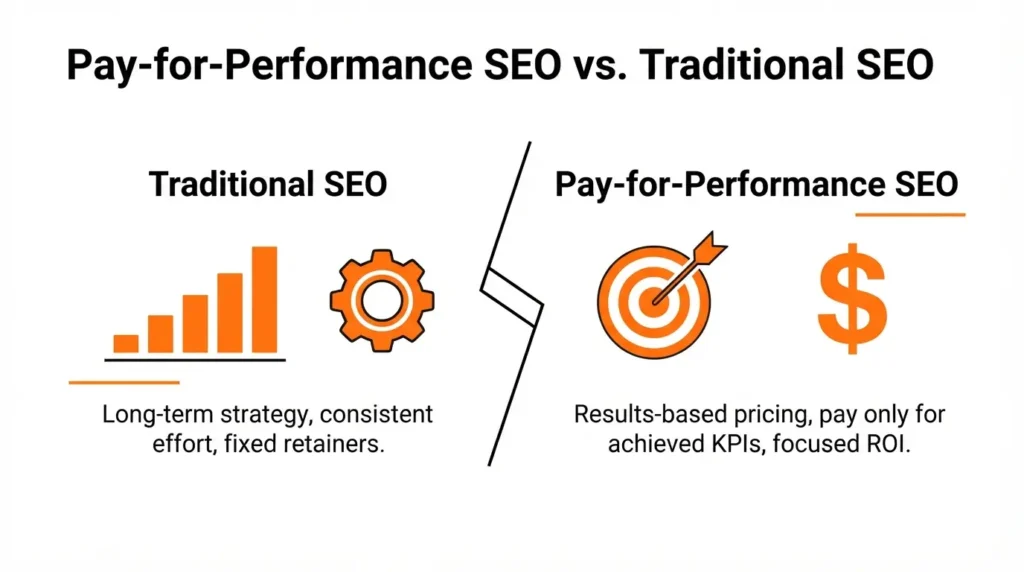
Pay-for-performance SEO shifts financial risk to the agency and ties payment directly to results, while traditional SEO bills a fixed monthly retainer for time and activity regardless of whether rankings move. The trade-off runs deeper than just who pays when.
| Factor | Pay-for-Performance SEO | Traditional SEO (Retainer) |
| Payment trigger | Rankings, traffic, or leads hit | Monthly, regardless of outcome |
| Typical cost | Varies per result, often higher per outcome | $1,500-$10,000+/month |
| Contract length | Often shorter, tied to targets | 6-12 months typical |
| Reporting focus | Outcomes: rank position, traffic, leads | Activity: content published, links built, audits done |
| Risk to client | Lower financial risk, real penalty and quality risk | Higher financial commitment, more stable tactics |
| Incentive alignment | Favors fastest billable win | Favors sustainable, longer-term strategy |
Traditional SEO’s activity-based reporting, content published, backlinks built, technical fixes completed, gives visibility into the work even during a slow month. Pay-for-performance’s outcome-only reporting means a client sees results or nothing, with less insight into what’s genuinely happening on the site in between.
Benefits of Pay-for-Performance SEO
The genuine benefits of pay-for-performance SEO are lower upfront financial risk, direct accountability tied to measurable outcomes tracked through organic traffic forecasting, and a lower barrier to entry for a business that can’t commit to a large retainer before seeing results. A slow month costs less, sometimes nothing, compared to a fixed retainer that bills the same regardless of outcome. The model still says nothing about whether that traffic genuinely converts into revenue.
This model can work reasonably well in a narrow set of conditions. It needs a business with a genuinely strong product, real commercial-intent keywords with realistic difficulty, and an agency using white hat SEO tactics with full transparency into methodology. Outside those conditions, the benefits shrink fast and the structural risks below start to dominate.
The Risks and Dangers of Pay-for-Performance SEO
The core risk of pay-for-performance SEO is a structural misalignment. The payment model rewards an agency for hitting the narrowest, fastest billable target, not for building sustainable SEO that serves the business long-term and delivers real ROI. An agency paid only when a keyword ranks has every incentive to chase vanity keywords with achievable difficulty over the commercial terms that genuinely drive revenue.
Transferring financial risk to the agency doesn’t transfer the bigger risk to the client, since the client still owns the website that absorbs any damage from short-term tactics. If an agency uses spammy link building, keyword stuffing, or other black hat SEO to hit a fast target, the resulting Google penalty, manual action, or de-indexation lands on the client’s domain. It doesn’t land on the agency’s business, regardless of who paid for what.
Attribution creates a second, quieter problem. If organic traffic grows during a performance contract, separating the agency’s contribution from seasonal trends, brand awareness, or the client’s own content work is genuinely difficult. That creates real room for dispute over what the agency should get credited, and paid, for.
Black-Hat Tactics Some PFP Agencies Use
Some pay-for-performance agencies lean on private blog networks, keyword stuffing, cloaking, and spammy link building specifically because these black hat SEO tactics can move a vanity keyword’s ranking fast enough to trigger payment before Google’s detection systems catch up. The speed these tactics offer is exactly what a payment-on-ranking structure rewards, and the line between an aggressive but legitimate approach and a genuine grey-hat SEO technique gets blurrier under this kind of pressure.
PBNs deliver a fast, if temporary, ranking lift by funneling authority from a network of controlled sites, but they carry real de-indexation risk once identified, and an entire network going down can erase the ranking gain overnight. Keyword stuffing and cloaking are lower-effort, higher-risk tactics that can trigger an immediate manual action once flagged, turning a short-term win into a documented Google penalty that takes real time and cost to recover from. An agency confident in its methodology explains it. One relying on these tactics generally doesn’t, since disclosure would undercut the client’s confidence in the arrangement.
How Much Does Pay-for-Performance SEO Cost?
Pay-for-performance SEO costs vary by payment trigger and keyword difficulty. Pricing typically runs higher per outcome than the equivalent traditional retainer would cost per month, since the agency prices in the risk of months where nothing hits target. Traditional retainer SEO commonly runs $1,500 to $10,000 or more a month depending on scope, with 6 to 12 month minimum contracts typical.
| Model | Typical Cost Structure | What Drives Price |
| Pay-per-ranking | Fee per keyword hitting target position | Keyword difficulty, target position, competition |
| Pay-per-lead | Fee per qualified lead generated | Lead value, industry, conversion rate |
| Pay-per-traffic | Fee tied to traffic growth milestones | Baseline traffic, target increase |
| Revenue share | Percentage of attributed revenue | Overall campaign scope, attribution complexity |
| Traditional retainer | Flat monthly fee | Scope of work, market competitiveness |
Adoption of pure performance-based pricing remains a minority approach industry-wide. One 2025 industry pricing survey put it at roughly 6 percent of agencies, reflecting both the model’s complexity to structure fairly and the real risks documented throughout this guide.
Is Pay-for-Performance SEO Right for Your Business?
Pay-for-performance SEO fits a business with a genuinely strong product, clear commercial-intent keywords, and the ability to closely audit an agency’s methodology throughout the engagement. It’s a poor fit for a business hoping to outsource both the work and the oversight. A business unable to evaluate whether an agency’s tactics are white hat or black hat takes on real risk it can’t genuinely assess.
It fits poorly for a business in a highly competitive niche, where realistic keyword difficulty makes fast wins nearly impossible without cutting corners. It also fits poorly for a business whose real growth depends on long-term brand authority and content depth rather than a handful of rankings. Sustainable SEO and fast, payment-triggering SEO pull in different directions more often than sales pitches for this model admit.
Red Flags to Watch For When Choosing a PFP SEO Provider
The clearest red flags are guaranteed rankings with no explanation of methodology, and a payment trigger based on vanity keywords with low commercial value. A third is an agency unwilling to disclose specific tactics or name the target keywords in writing before work starts. Guaranteed SEO of any kind is itself a signal worth treating with real suspicion, since no legitimate agency controls Google’s algorithm.
An agency proposing keywords with unrealistic ease relative to your actual market, high-volume but low-competition terms nobody searches for commercial reasons, is optimizing for its own fastest payment, not your business outcome. Ask directly how the agency plans to hit each target, and treat vague answers, “proven techniques,” “our proprietary method,” with the same skepticism you’d apply to any unverifiable claim.
How to Choose a Reliable Pay-for-Performance SEO Agency
Choosing a reliable provider means demanding specific, written payment triggers tied to real commercial-intent keywords, full transparency into tactics before signing, and a track record you can independently verify rather than case studies the agency curated itself. Compare candidates against a real list of top SEO consultants or highest rated SEO companies, and ask for references you can contact directly, not just testimonials on the agency’s own site.
Request a documented baseline audit before any contract starts, current rankings, current organic traffic, current backlink profile, so both sides agree on the starting point results get measured against. A reliable agency welcomes this scrutiny. One avoiding it is signaling something worth taking seriously before any money changes hands.
Real-World Examples: What Can Go Right (and Wrong)
The documented pattern when pay-for-performance SEO goes right involves a realistic keyword list, transparent white hat tactics, and a business whose product can convert the resulting traffic. Together these produce a genuinely profitable arrangement for both sides over a sustained period. The pattern when it goes wrong involves vanity keyword targets, undisclosed black hat tactics, and a ranking win that triggers payment shortly before a Google penalty erases the gain entirely.
Neither pattern is unique to this pricing model specifically, traditional retainer SEO can go equally wrong with the wrong agency. What’s specific to pay-for-performance is how directly the payment structure itself can incentivize the second pattern. An agency optimizing purely for the fastest billable trigger has less reason to weigh the client’s long-term risk against its own short-term payday.
Alternatives to Pay-for-Performance SEO
The main alternatives to pay-for-performance SEO are a traditional monthly retainer, a hybrid model combining a reduced base fee with performance bonuses, and project-based pricing for defined, one-time work like a technical audit or a site migration. Each option shifts the risk and incentive balance differently.
A hybrid model often captures the better parts of both approaches: a smaller guaranteed monthly fee that keeps an agency committed to ongoing, sustainable work, plus a bonus structure that still rewards genuine results. SEO as a service arrangements often fold this kind of hybrid structure into a single flexible contract. This avoids the all-or-nothing incentive problem pure performance pricing creates, while still giving a client some downside protection a pure retainer doesn’t offer.
Conclusion: Is Pay-for-Performance SEO Worth It?
Pay-for-performance SEO is worth considering only with an agency that discloses its methodology fully, targets genuine commercial-intent keywords, and welcomes independent verification of its track record. A meaningful share of providers offering this model don’t meet those conditions. The “risk-free” framing sold in most pitches is incomplete. The financial risk shifts to the agency. The much larger risk, a Google penalty or brand damage from tactics chosen to hit a fast payment trigger, stays with the client regardless of who wrote the check.
For most businesses, a well-structured hybrid model or a traditional retainer with clear activity reporting offers a more honest risk balance than pure pay-for-performance pricing. If you choose performance-based pricing anyway, treat the vetting process, methodology disclosure, references, a documented baseline, as non-negotiable, not a courtesy the agency can skip.
FAQs
It can be, with the right agency and the right conditions: transparent methodology, realistic commercial-intent keywords, and independently verifiable results. The model itself isn’t inherently a scam, but its payment structure creates a real incentive toward short-term, risky tactics that a meaningful share of providers don’t resist.
Pay-for-performance pricing varies by keyword difficulty and payment trigger, and typically costs more per achieved outcome than the equivalent traditional retainer, which commonly runs $1,500 to $10,000 or more a month. The agency prices in the risk of months where no targets get hit.
No legitimate agency can guarantee a specific ranking, since Google’s algorithm isn’t controlled by any agency and rankings depend on many factors beyond one provider’s work. Any agency offering a guaranteed position for a fee is either overpromising or planning to use tactics that carry real penalty risk.
The penalty affects your domain regardless of the payment structure, and most performance-based contracts don’t cover recovery costs or protect you from the ranking and traffic loss a manual action or de-indexation causes. The agency’s financial risk in the original contract doesn’t extend to cleanup after a penalty.
Neither is universally better. Pay-for-performance offers lower upfront financial risk but real incentive misalignment toward short-term tactics. Traditional retainer SEO costs more upfront but generally supports more sustainable, transparent, activity-based work. The right choice depends on your ability to vet an agency’s methodology closely, regardless of which pricing model you choose.