SaaS Link Building Strategies That Drive Pipeline

SaaS link building is the process of earning backlinks to a software company’s site to improve rankings on competitive, high-intent keywords, with one added requirement most programs skip: the links need to touch pages and audiences that actually convert into demos, trials, and closed-won revenue, not just traffic. If you’ve run a link building program that moved domain rating without moving a single number your CFO cares about, you already know why that distinction matters.
That gap is common, and it’s rarely about link quality. It’s usually about which pages got the links, which tactics got picked, and whether anyone set up a way to connect a backlink to a deal six months later. Here’s how to fix all three.
What Is SaaS Link Building?
SaaS link building is the practice of acquiring backlinks specifically for software companies, where the target pages, buyer intent, and competitive landscape look different from e-commerce or local SEO. Instead of homepage citations or product listings, SaaS link building typically targets SEO-driven blog content, comparison pages, feature pages, and integration pages, each built around a specific keyword a buyer searches while evaluating software.
B2B SaaS backlinks also compete against a different kind of SERP. Review aggregators like G2 and Capterra, listicle sites, and established category leaders already occupy much of page one for high-intent terms, which means a new or mid-size SaaS brand is fighting aggregators as much as direct competitors. That changes which tactics are worth the effort, since beating a review site on a comparison keyword takes a different link profile than beating a single competitor.
Why Most SaaS Link Building Fails to Move Pipeline
Most SaaS link building programs fail not because the links themselves are low quality, but because they’re sent to the wrong pages, chosen by domain rating instead of buying intent, and never connected to a system that reports back to revenue. A program can hit every link building KPI on a vendor’s dashboard and still produce zero change in demo volume.
Building Links to the Wrong Pages
Agencies and in-house teams often default to linking the homepage or whatever blog post is easiest to pitch, rather than the specific page that drives conversions. A backlink to a thought-leadership post that nobody converts on helps domain-level authority a little, but a backlink to a comparison page or a bottom-of-funnel feature page helps that specific page rank for the keyword a buyer is searching right before they request a demo. Money pages should get priority, even when they’re harder to pitch than a listicle-friendly blog post.
Chasing Domain Rating Instead of Buying Intent
A link from a DR70 general business blog and a link from a DR35 niche software directory are not interchangeable, even though most reporting treats them that way. The directory link often sits closer to an actual purchase decision, because the visitor arriving through it is already comparing vendors. Optimizing purely for domain rating, the most common mistake in vendor-driven SaaS link building, ignores topical relevance and page authority, both of which matter more for traffic that converts than raw domain-level numbers.
Map Your Tactics to the Pipeline, Not Just the SERP
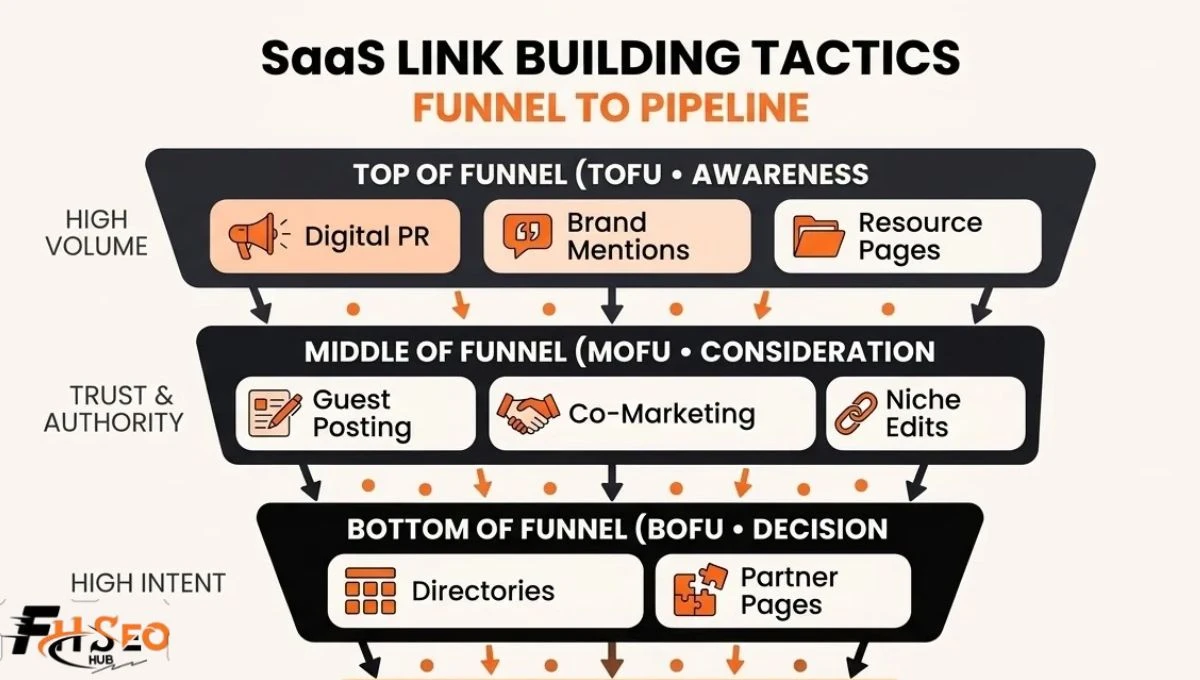
Not every link tactic sits the same distance from a buying decision, and treating them as interchangeable is why so many programs can’t explain their pipeline impact. Software directories and integration pages sit closest to purchase intent, since the visitor is already comparing specific vendors. Guest posts and digital PR sit mid-funnel, building category authority and bringing in an audience that’s problem-aware but not yet vendor-aware. Broad resource content and original research sit furthest out, building top-of-funnel visibility and brand mentions that compound slowly rather than converting directly.
This ordering matters for budgeting. A SaaS company with a short runway to prove SEO value should weight directories, review sites, and integration pages first, since they’re the fastest tactics to connect to a pipeline number. A company already past that proof point can afford to invest more in digital PR and original research, which take longer to pay back but build durable category authority that compounds.
Software Directories and Review Sites: Your Highest-Intent Backlinks
Software directories and review sites sit closer to a purchase decision than almost any other link source, because the visitor arriving through one is already comparing vendors rather than researching a concept from scratch. Beyond the obvious listings on G2 and Capterra, smaller category-specific directories and review platforms often convert better precisely because the audience is narrower and further along in the buying process.
| Directory/Review Site | Typical Link Value | Best For |
| G2, Capterra, GetApp | High intent, strong brand visibility, usually dofollow | Any B2B SaaS with enough reviews to build a credible profile |
| TrustRadius, FinancesOnline, Crozdesk | Moderate intent, good for mid-market and enterprise categories | Companies competing on feature depth and enterprise trust signals |
| Software Advice, PeerSpot | Moderate to high intent depending on category | Vertical and technical buyers doing deeper comparison research |
| Niche category directories (found via “[industry] + software directory” searches) | Lower domain rating, but often the highest buying intent per visitor | Vertical SaaS competing in a narrow, specialized category |
Which Directories Actually Move the Needle by Category
The big-name directories are table stakes, but the real pipeline gains often come from the smaller, category-specific ones most competitors skip entirely because they don’t show up in a generic “best SaaS directories” list. A quick search for “[your category] software directory” or “[your niche] review platform” usually surfaces several relevant, lower-competition listing opportunities that put a brand in front of buyers who have already narrowed their search to that exact category.
Product-Led Link Building: Turning Your Product Into a Link Asset
Product-led link building uses the software itself, free tools, calculators, embeddable widgets, and documentation, as the thing other sites want to reference, which earns links without ongoing outreach once the asset exists. This is one of the few link building approaches that scales with product growth rather than requiring constant new content or pitching.
Free Tools, Calculators, and Embeddable Widgets
A genuinely useful free tool or calculator built from a feature already inside the product tends to earn links passively over time, since other sites link to it as a resource rather than as a favor. Review-and-reputation SaaS tools that ship an embeddable rating widget are a well-known example: every customer who embeds the widget on their own site creates a backlink automatically, and at scale this can produce backlink volume that dwarfs anything outreach could achieve. The trade-off is upfront product or engineering time, which makes this a slower-starting but highly compounding tactic.
API Documentation and Integration Guides
Well-structured API documentation and how-to guides get referenced naturally by developers, technical bloggers, and partner companies writing their own integration tutorials. This works best when documentation is public, well-organized, and specific enough that other sites find it easier to link to than to rewrite the same explanation themselves.
Integrations and Partner Pages as a Backlink Channel
Every integration a SaaS product ships is a potential backlink, since partner marketplaces and integration pages on the partner’s domain often link back to the integrating product by default. Major platforms like Salesforce or HubSpot carry meaningful authority on their own app marketplace listings, and even a mid-market partner’s dedicated integrations page passes real link equity along with qualified referral traffic from users already searching for that exact combination of tools.
This channel scales automatically as the product adds integrations, which makes it one of the lowest-maintenance link sources available. The practical step most teams skip is simply confirming, for every existing integration, whether the partner’s directory or integrations page actually links back, and following up directly with the partner’s marketing team when it doesn’t.
Digital PR and Guest Posting for B2B SaaS Backlinks
Digital PR and guest posting still earn high-authority B2B SaaS backlinks in 2026, but mainly when the pitch leads with original data or genuine expertise rather than generic company news, since editors and journalists have no shortage of SaaS pitches competing for the same placements.
Original Research and Data Studies
Original surveys, product-usage data, and industry studies are consistently the highest-leverage digital PR asset a SaaS company can produce, because journalists and bloggers need a citable source and a company sitting on genuine usage data has something nobody else can republish. A single well-promoted study can earn links for years after publication, unlike a press release that has a shelf life of days.
Journalist Query Platforms: HARO, Connectively, and Qwoted
HARO went through a turbulent stretch, rebranded as Connectively, shut down entirely in December 2024, and was revived by Featured.com in 2025 as a free service again, with Connectively continuing as a separate platform product. Qwoted has grown into a strong alternative in the meantime, particularly well-regarded by journalists covering finance, technology, and B2B topics, which overlaps heavily with where SaaS pitches land best. Treat these platforms as a channel for earning editorial backlinks through genuine expert commentary, not as a shortcut, since generic, non-specific answers get ignored regardless of which platform they’re submitted through.
Guest Posting Done Right vs. Guest Posting That Wastes Budget
Guest posting still works, but only when the target page already has traffic and page authority, and when the content is genuinely useful to that site’s audience rather than built purely to carry a link. A guest post on a brand-new page with zero existing authority provides minimal benefit, no matter how high the hosting domain’s overall rating is. Budget for guest posting should go toward relationship-building with a shorter list of genuinely relevant sites, not a high-volume, low-personalization outreach blast.
Link Building for Vertical SaaS: Fintech, HR Tech, Healthtech, and Martech
Vertical SaaS companies get more pipeline value from a handful of category-specific directories, compliance-focused publications, and niche editorial sites than from broad SaaS roundups, since buyers in regulated or specialized categories trust narrower, more credible sources more than general “best software” lists. A fintech SaaS benefits more from a link in a compliance or finance-industry publication than from a generic business blog, because the audience reading that publication is already pre-qualified as relevant.
This also changes outreach economics. Horizontal SaaS competes for attention against hundreds of similar pitches; vertical SaaS competing in HR tech, healthtech, or martech often faces less saturated outreach inboxes in its specific niche, making relationship-based guest posting and niche directory placement comparatively easier to land, even if the total pool of relevant sites is smaller.
Fast-Win Tactics: Competitor Gaps, Unlinked Mentions, and Broken Links
Competitor backlink gap analysis, unlinked brand mention recovery, and broken link building are the fastest tactics to execute because the opportunity, and often a willing site owner, already exists. A tool like Ahrefs can surface every site linking to a direct competitor but not to you, which usually produces a list of site owners already comfortable linking to companies in the category. Unlinked mentions, where a site references the brand by name without a link, convert at a high rate with minimal outreach effort, since the site owner already decided the brand was worth mentioning. Broken link building works the same way: find a dead link on a relevant, authoritative page and offer a working replacement, which benefits the site owner as much as it benefits the link.
How to Attribute Pipeline and Revenue to Link Building
Attributing pipeline to link building means tracking which backlink-driven pages touched an opportunity before it became pipeline, using sourced and influenced pipeline reporting in the CRM rather than relying on last-click attribution, which systematically undercounts organic search’s real contribution to long B2B sales cycles.
Sourced Pipeline vs. Influenced Pipeline
Sourced pipeline credits the channel that generated the very first touch on a contact, which for link building might be a visitor who discovered the brand through a directory listing or a guest post and later became an opportunity. Influenced pipeline is broader: it credits any channel that touched a contact at any point before the opportunity closed, even if organic search wasn’t the first or last touch. For link building specifically, influenced pipeline is usually the more honest number, since a buyer might discover a brand through a review site, research it further through organic blog content, and eventually convert through a demo request weeks later, with link-driven pages touching the journey more than once.
Setting Up Tracking Without Overbuilding It
A workable setup doesn’t require an enterprise attribution platform. Tag link-driven landing pages distinctly in analytics, make sure the CRM captures the first-touch and all-touch source data on every contact, and run a quarterly report comparing organic-influenced pipeline against the typical sales cycle length, since B2B SaaS deals often take one to six months or longer to close. The goal is a credible directional story for stakeholders, not perfect multi-touch modeling, which even enterprise marketing teams rarely get fully right.
What to Avoid: Link Schemes, Paid Placements, and Vendor Red Flags
The biggest pipeline risk in SaaS link building isn’t a missed tactic, it’s a vendor selling an arbitrary batch of DR50-plus links with no relevance filter, which wastes budget immediately and risks a link scheme penalty that undermines the attribution story a marketing team has to defend later. Google’s spam policies classify paid links and participation in link schemes as manipulation intended to influence rankings, and its SpamBrain system evaluates link patterns at a network level, which makes irrelevant, high-volume link packages increasingly easy to flag.
A useful vendor-vetting question is simple: can this vendor explain why this specific link, on this specific site, helps this specific page rank for a keyword a real buyer searches. If the answer is a domain rating number and nothing else, that’s the same failure mode that burns SaaS marketing budgets every year and leaves teams with nothing to show a skeptical board.
Building a Program That Scales: In-House, Agency, or Hybrid
Most SaaS companies run a hybrid model, in-house ownership of product-led and integration links paired with an agency or specialist for digital PR and guest posting outreach, since outreach at scale requires dedicated capacity most in-house marketing teams don’t have alongside everything else on their plate.
| Tactic | Typical Cost (2026) | Typical Timeline to Pipeline Impact |
| Directory and review site listings | Mostly free to low-cost for premium placements | Weeks to a few months |
| Integration partner links | Internal time cost; occasional partnership negotiation | 1 to 3 months once the integration ships |
| Guest posting | Roughly $150 to $500 per quality placement | 1 to 3 months per placement |
| Digital PR campaigns | Roughly $3,000 to $10,000 per campaign, or $1,250-plus per placement via agency | 3 to 6 months for full payoff |
| Product-led assets (free tools, widgets) | Engineering/design time rather than per-link cost | 6-plus months to build momentum, then compounds |
Budget allocation should follow the sales cycle math. A company that needs to prove pipeline impact within one or two quarters should weight the cheaper, faster-paying tactics, directories, integrations, and targeted guest posts, before committing serious budget to a multi-month digital PR or product-led play.
Conclusion: Turning Backlinks Into Pipeline
SaaS link building that actually drives pipeline looks different from a generic tactic checklist. It means sending links to money pages instead of whatever’s easiest to pitch, weighting directories and integrations for their buying intent rather than dismissing them as low-authority, and setting up just enough attribution tracking to show a credible, honest connection between a backlink and a closed deal. None of this requires abandoning guest posting or digital PR, it requires sequencing them against how fast the business needs to prove results and how long its sales cycle actually runs. Start with the tactics closest to a buying decision, build the attribution habit early, and the rest of the link building program gets much easier to defend.
FAQs
What is SaaS link building?
The process of earning backlinks to a software company’s website, focused on pages and keywords tied to buyer intent rather than generic traffic, since SaaS buyers often compare vendors through review sites and comparison content before converting.
How is link building for SaaS different from other industries?
SaaS link building competes against review aggregators and listicle sites that already dominate high-intent keywords, and it benefits uniquely from product-led tactics like free tools, API documentation, and integration pages that don’t exist for most other business categories.
Do software directories like G2 and Capterra actually help SEO?
Yes, both for direct ranking value and for buying-intent traffic, since visitors arriving through a review site are typically already comparing specific vendors rather than researching a concept from scratch.
How do you know if link building is actually driving pipeline, not just rankings?
Track influenced pipeline by tagging link-driven landing pages and capturing all-touch attribution data in the CRM, then compare that against ranking and traffic reports rather than relying on rankings alone as a proxy for business impact.
What’s the best link building strategy for a SaaS startup with a small budget?
Start with free or low-cost directory listings, unlinked brand mention recovery, and integration partner links, since these cost little beyond time and sit closer to a buying decision than most paid tactics.
Are integration pages a good source of backlinks?
Yes. Partner marketplaces and integration pages often link back by default, and this channel scales automatically as a product adds more integrations, with no ongoing outreach required once the relationship exists.
Is guest posting still worth it for SaaS companies in 2026?
Yes, but only on pages with existing traffic and page authority, and only when the content genuinely serves that site’s audience. A guest post on a brand-new, zero-authority page wastes the effort regardless of the host domain’s overall rating.
How do you attribute pipeline and revenue to specific backlinks or referring domains?
Use sourced and influenced pipeline reporting in the CRM, tagging link-driven pages distinctly and tracking all touchpoints on a contact rather than relying on last-click attribution, which undercounts organic search’s contribution in long B2B sales cycles.
What’s the difference between sourced pipeline and influenced pipeline in SEO reporting? Sourced pipeline credits the very first touch that brought a contact into the system. Influenced pipeline credits any channel that touched the contact before the deal closed, which is usually the more accurate picture for link building’s real contribution.
How should link building differ for vertical SaaS versus horizontal SaaS?
Vertical SaaS gets more value from category-specific directories and niche editorial publications than from broad SaaS roundups, since buyers in specialized or regulated categories trust narrower, more credible sources more than generic “best software” lists.
How many backlinks does a SaaS company actually need to rank for competitive keywords?
There’s no fixed number; it depends on the current link gap against the pages already ranking for that keyword. A competitor backlink gap analysis against the top-ranking pages gives a realistic target rather than an arbitrary quota.