
What Is Link Juice in SEO? Definition, PageRank & Key Differences

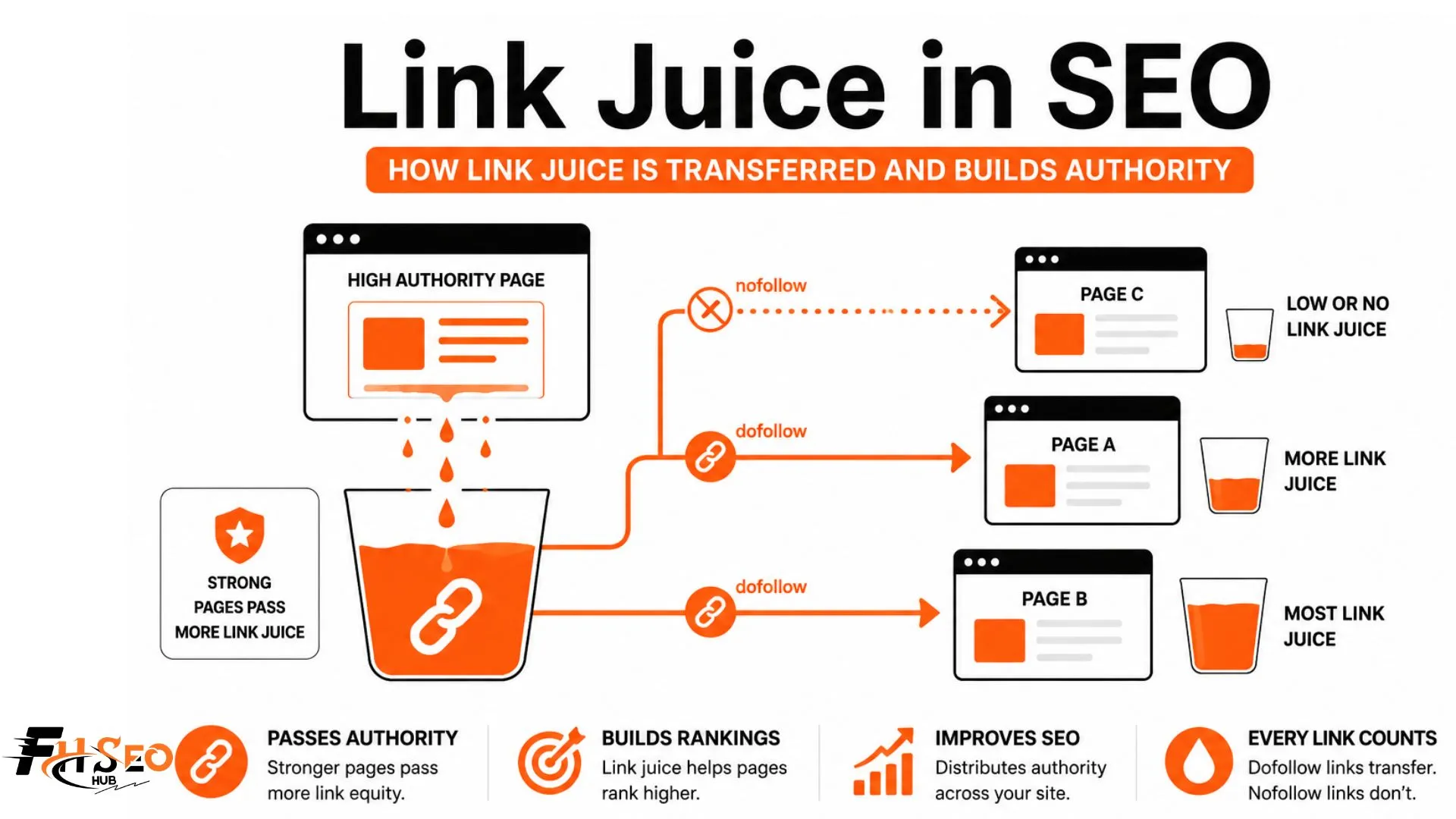
Link juice in SEO is the ranking value or authority that passes from one page to another through a hyperlink. When a credible page links to yours, it transfers a portion of its own accumulated authority, helping your page rank higher in search results. The stronger and more topically relevant the linking page, the more ranking power it passes to you.
What is link juice in SEO?
Link juice in SEO is the informal but widely used term for the authority and ranking value that passes from one webpage to another through a hyperlink. When a trusted, high-authority page links to yours, Google treats that connection as an endorsement and transfers a portion of that page’s authority to your page.
The simplest way to understand link juice is to think of it as a weighted vote. When page A links to page B, it is not only creating a navigation pathway. It is transferring some of its own accumulated trust and authority. The more authoritative and relevant page A is, the more link juice it passes.
That juice raises the ranking potential of the destination page. A page that accumulates strong link juice from multiple credible sources builds greater authority in Google’s assessment and tends to rank higher for related queries than a page with few or no inbound links.
Link juice passes through both external backlinks (links from other websites) and internal links (links between your own pages). External backlinks from established, niche-relevant sources deliver the strongest juice transfer, but internal linking plays a critical role in directing that earned juice to the pages that need it most.
A link is only effective if the destination page is crawlable and indexable. If Google cannot crawl the page receiving the link, the juice transfer does not complete regardless of how authoritative the source is.
Where the term link juice originally came from
“Link juice” was never a Google term. It originated as informal slang within the early SEO community in the 2000s. Bloggers and practitioners used it to describe what PageRank technically calculates: the numerical authority a page accumulates through its inbound links and then distributes through its outbound links.
Before September 2019, a nofollow tag was a hard directive, meaning Google would not pass any link juice through a nofollow link. Google reclassified nofollow as a hint rather than a directive after that update. This means Google may still pass partial link juice through nofollow links from credible domains in some contexts, particularly when strong topical relevance exists. Prioritize dofollow placements for deliberate link building, but do not treat nofollow links from high-authority, topically aligned sites as completely worthless in 2026.
Why link juice is still a relevant concept in 2026
The term may sound dated, but the mechanism behind it is actively confirmed. The 2024 Google API leak revealed that Google still runs multiple PageRank variants internally. These include RawPageRank (the baseline link authority calculation), PageRank2 (an updated version with unspecified improvements), and PageRank_NS (the Nearest Seed variant, which measures a page’s topical proximity to trusted seed domains). The public Toolbar PageRank score was retired in 2016, which led many to conclude the system was abandoned.
What is the difference between link juice and link equity?
Link juice and link equity are two names for the same concept. Link juice is the informal term. Link equity is the professionally accepted equivalent used in industry publications and technical SEO discussions. Neither is an official Google term, but both describe the transfer of ranking value through a hyperlink.
Link juice vs link equity: same concept, different terms
The distinction between link juice and link equity is entirely linguistic, not technical. Link juice emerged from early SEO blog culture as a memorable and approachable way to describe what PageRank was calculating. Link equity became the preferred term as the field matured and moved toward more precise language that clients and executives could take seriously.
Why SEOs use both terms interchangeably
The SEO industry never standardized its terminology precisely because Google does not use either term publicly. Google’s documentation refers to links as “signals” and acknowledges that high-quality backlinks contribute to its assessment of page authority. With no official vocabulary to anchor to, practitioners adopted whatever terms they encountered first.
Which term Google actually uses in 2026
Google’s public documentation uses phrases like “link signals” and “quality backlinks” without formally adopting link juice or link equity as defined terms. John Mueller, a Google Search Advocate, has referenced “link equity” informally in Webmaster Hangout sessions, but the term has never appeared in official Search Console help documentation as a named, defined concept.
For your practical purposes, either term communicates the right meaning to any SEO audience. The important thing is understanding the mechanism behind the vocabulary, which leads directly to PageRank and how it distributes link value across the web.
What is PageRank and how does it relate to link juice?
PageRank is Google’s foundational algorithm for assigning an importance score to pages based on the quantity and quality of links pointing to them. Link juice is the colloquial shorthand for what PageRank distributes: the authority that passes from one page to another through each hyperlink.
PageRank was developed by Larry Page and Sergey Brin at Stanford University and became the foundation of Google’s original search ranking system. The core principle mirrors academic citation: pages that receive more links from trusted, authoritative sources are considered more important and deserve higher visibility in search results.
In practice, every page on the web carries a PageRank value. When that page links to another page, it passes a fraction of its own PageRank to the destination. The more inbound links a page receives from trusted sources, the more PageRank it accumulates, and the more link juice it can distribute through its own outbound links.
How PageRank distributes link value across pages
PageRank distributes proportionally across all outbound links on a page. If a strong page links to three other pages, each receives approximately one-third of the available equity. If the same page links to thirty pages, each receives a much smaller fraction.
This proportional distribution explains why the outbound link count on a linking page matters when evaluating an opportunity. A link from a page that links selectively to only a handful of external destinations passes more juice than a link from a page packed with hundreds of outbound links to unrelated domains.
Link juice vs domain authority: what is the difference?
Domain authority and link juice measure fundamentally different things. Domain authority is a third-party score estimating domain-wide ranking potential. Link juice is the page-level value transferred through individual hyperlinks. One is a site-wide average estimate; the other is a specific transfer event at the link level.
How DA and link juice measure different things
Domain authority aggregates an entire domain’s backlink history into a single score. A DA of 70 tells you that the domain as a whole has a strong link profile, but it says nothing about whether any individual page on that domain carries strong page-level link juice.
Link juice operates at the page and link level. A specific page on a high-DA domain that has no referring domains pointing directly to it carries low page-level authority and passes minimal juice through its outbound links. This is the critical distinction most SEOs miss when evaluating link opportunities.
A concept worth naming here is link juice decay. When the page that links to you loses its own referring domains over time, or when its traffic declines, the juice it passes to your page weakens proportionally. A link from an actively maintained, well-cited specialist page holds its juice value longer than a link from a page on a declining domain that is steadily losing its own authority. Always check the URL Rating of the specific referring page in Ahrefs, not just the site’s Domain Rating, to assess the actual juice potential of any opportunity.
How does link juice affect SEO rankings?
Link juice affects rankings by increasing the page-level authority of the page that receives it. Pages that accumulate strong incoming link equity from high-authority, topically relevant sources consistently outrank pages with weak or no incoming link equity, even when their content quality is comparable.
The direct relationship between link juice and page rankings
Google uses link juice as external validation for page quality. When multiple credible, topically relevant pages link to yours, Google interprets that pattern as evidence your page deserves visibility. A single high-authority contextual backlink from a niche-relevant source can push a page from position 8 to position 3 within 60 to 90 days, because that link provides the authority signal Google needed to resolve the ranking tie between similar competing pages.
Why pages with more link juice tend to outrank competitors
Pages that receive the most link juice from the most relevant sources consistently occupy the top positions in competitive searches. According to Incremys research (March 2026), Googlebot explores approximately 20 billion pages daily, meaning competition for crawl frequency is real. Pages that accumulate stronger link equity get crawled more frequently, indexed more reliably, and ranked more prominently than those with weak or fragmented link profiles.
The counterintuitive insight that practitioners learn from running link audits: the page-level authority of the specific linking page matters more than the domain-level score. A link from the most-cited, most-trafficked article on a mid-sized specialist site often passes more juice than a link from an obscure, uncrawled page on a major news domain. Always check the URL Rating of the referring page rather than stopping at the domain’s overall rating.
Link juice signals Google uses to evaluate page authority
Google evaluates link juice through several intersecting signals simultaneously: the topical relevance between the linking page and your page, the page-level authority of the linking page, the anchor text used, the placement within the content (body copy outperforms footers and sidebars), and whether the link is dofollow.
In 2026, link juice also connects to AI search visibility. Research from LinkWhisper (February 2026) found that sites with coherent internal linking that directs link juice toward topical hubs consistently see 30 to 40 percent higher visibility in AI-generated search answers compared to sites with fragmented link structures. Understanding link juice now means optimizing for both traditional ranking signals and AI citation probability simultaneously.
Conclusion
Link juice, link equity, PageRank and domain authority are related but distinct concepts. Link juice and link equity are two names for the same transfer of ranking value through hyperlinks. PageRank is the confirmed-active internal Google algorithm that calculates and distributes that value. Domain authority is a third-party approximation of domain-wide strength that does not directly measure page-level link juice.
The practical takeaway: earning quality, topically relevant backlinks that carry genuine link juice in SEO is the most direct lever for improving the ranking potential of specific pages. Domain authority improves as a byproduct of getting page-level link juice right.
Now that you understand what link juice is, the next step is understanding exactly how it passes technically through your site. Read how link juice works for the complete technical breakdown covering link equity flow, internal link architecture and anchor text strategy.


