
How to Build Healthy Link Velocity: The Safe Scaling Framework for SaaS

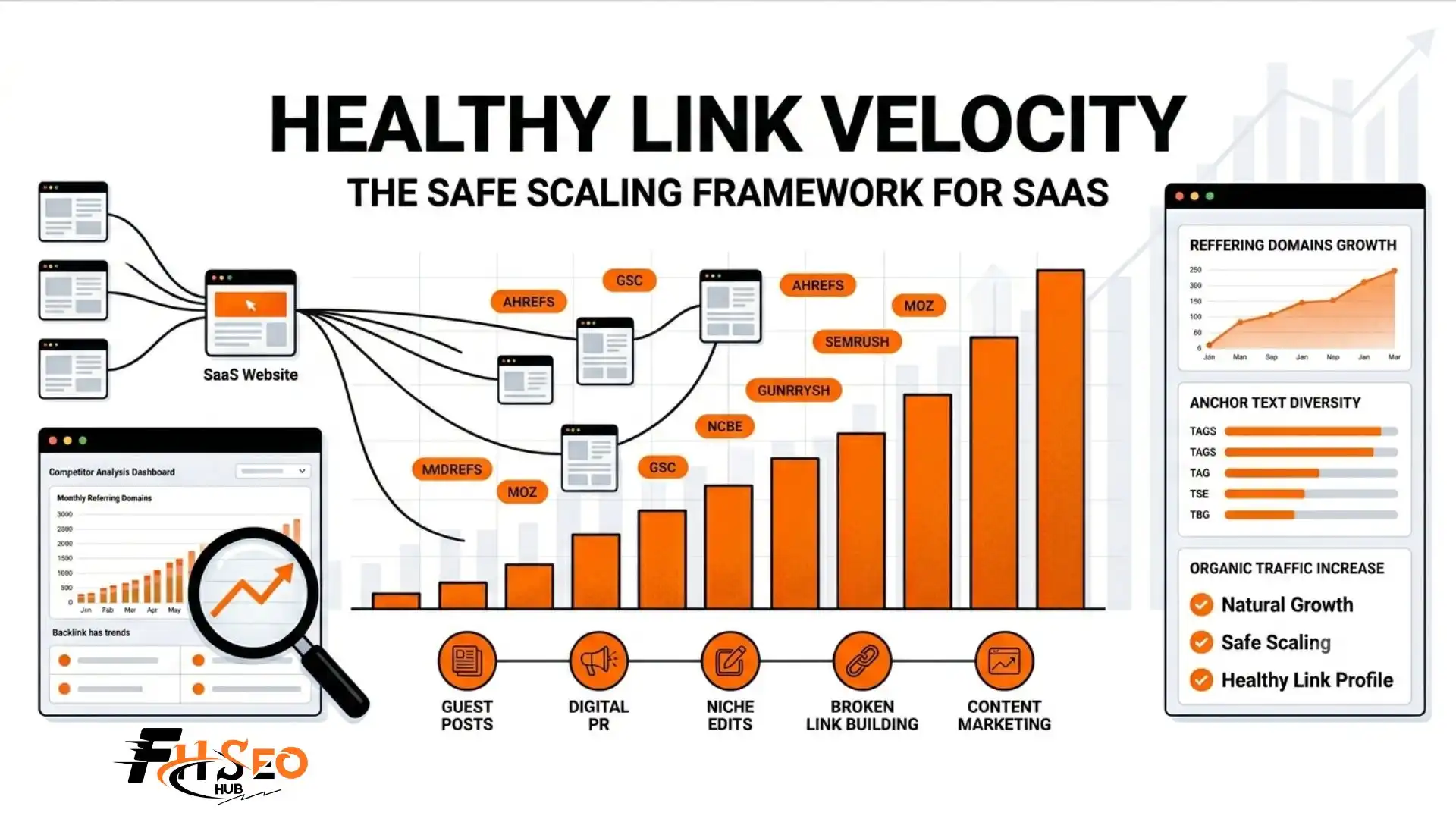
You need links to rank. But build them too fast can destroy your rankings. So how do you scale link building without triggering Google’s spam detection?
Learning how to build healthy link velocity means following a framework built on real competitor data, gradual ramp-up rules and the right link mix. This article gives you exact numbers, monthly milestones and tool-specific instructions.
If you are new to the concept, read our foundation guide on what is link velocity first. If you have already experienced a spike problem, check the link velocity red flags to avoid before scaling further.
Why a Natural Link Building Pace Matters More Than Raw Link Count
The number of backlinks on your site matters far less than how you acquired them.
Steve Morris, CEO of NEWMEDIA.COM, documented a FinTech SaaS client that counted the new referring domains competitors earned over a 3 to 12 month period, matched that cadence through deliberate outreach, and generated a 312% increase in monthly organic leads over 24 months. The target: 14 to 18 new referring domains per month, which matched the market average for that niche.
Chris Kirksey, CEO of Direction.com, points out that tech brands often see justified velocity spikes after product launches, while local businesses grow more steadily through directories and local citations. The definition of “healthy” differs by niche and domain history.
Older, established sites can accelerate faster without raising red flags. A 3-year-old SaaS platform with 100 referring domains has the historical context to justify higher monthly acquisition. A brand-new site with 5 referring domains does not.
The principle is simple: your backlink growth rate should match your brand footprint, your marketing activity and your content publishing cadence. Here are few steps to build a comprehensive strategy for a healthy link velocity to keep natural your backlink profile.
7 Steps to Build a Health Link Velocity
Step 1: Run a Competitor Link Velocity Analysis First
Before building a single link, understand what a natural growth rate looks like in your specific niche.
In Ahrefs: Go to Site Explorer, enter a top competitor’s domain, click Referring Domains, and set the date range to the last 12 months. Count the new referring domains added each month. Repeat for your top 5 competitors.
In Semrush: Go to SEO > Link Building > Backlink Analytics, enter a competitor’s domain, and click the Competitors tab to compare monthly acquisition patterns side by side.
In LinkResearchTools: Use the CLV (Competitive Link Velocity) tool to compare up to 11 domains on a heatmap that shows seasonal growth trends and velocity direction.
FinTech SaaS benchmark: The market average sits at 14 to 18 new referring domains per month. Top outliers reach 25 or more, typically tied to product launches or major press coverage.
Set your starting target: Begin at 60 to 70% of your competitor average. If competitors average 15 new referring domains per month, start at 9 to 10. Scale up from there once you have 3 consecutive months of stable growth.
Step 2: Set Monthly Velocity Milestones by Site Stage
Not every site should build at the same pace. Here is a practical milestone framework based on domain age and current referring domain count.
| Site Stage | Domain Age | Current RDs | Target Monthly New RDs |
| New site | 0 to 6 months | 0 to 20 | 3 to 8 |
| Growing site | 6 to 18 months | 20 to 50 | 8 to 15 |
| Established site | 18+ months | 50 to 100 | Match competitor average |
| Authority site | 3+ years | 100+ | Scale to top competitor rate |
The ramp-up rule: Never jump acquisition speed suddenly. If you currently earn 2 links per week, scale to 4 to 5 per week first, hold that for 6 to 8 weeks and then move toward 7 to 10. A sudden jump from 2 to 50 links per week with no business event to explain it is a textbook red flag.
Random daily distribution matters too. Rather than delivering all links at once, spread acquisition naturally across the month. A realistic pattern looks like: Day 1 (1 link), Day 3 (2 links), Day 6 (1 link), Day 11 (3 links), Day 17 (5 links), Day 22 (3 links), Day 27 (6 links), Day 30 (2 links). This mirrors how editorial links naturally appear.
Rick Pendrick of Prism Agency uses one original industry study per month as his anchor content. This creates a steady flow of new links spread throughout the month rather than an artificial concentration.
Step 3: Build the Right Link Mix for Natural Sustainable Acquisition
Tactical diversity is what makes your backlink growth rate look natural. A profile built entirely from one tactic, for example 100% guest posts, is itself a pattern signal.
Guest Posting (Editorial Links)
Target DA 40+ niche-relevant publications. For new sites, aim for 1 to 3 guest posts per month. Established sites can manage 6 to 8. Rotate your anchor text between branded, partial-match, and generic phrases. Avoid using the same exact anchor across multiple placements. Our guest posting service can place you on vetted DA 40+ sites with editorial control.
Digital PR (Earned Media Links)
Tie press releases to genuine news: product launches, funding rounds, data studies and industry commentary. Use HARO (now Connectively), Help a B2B Writer, Featured.com, and Qwoted to respond to journalist queries and earn editorial backlinks from high-authority media. Pitch 3 to 5 queries per week across these platforms.
Niche Edits (Curated Contextual Links)
Niche edits insert your link into existing published articles with relevant context. Because the page already has a backlink history and indexed traffic, these links often carry more topical signal strength than links from brand-new guest posts. Our niche edit service targets pages with existing authority and topical alignment.
Broken Link Building
Use Ahrefs Content Explorer or the Check My Links Chrome extension to find broken links on relevant pages in your niche. Pitch your content as a replacement. This earns editorial links and solves a real problem for the site owner.
Content-Driven Link Earning
Original research, in-depth guides, and data-backed infographics earn passive links over months. Before publishing any piece of content, ask one question: if this page disappeared tomorrow, would anyone miss it? If the answer is no, it will not earn links. If yes, it will compound over time.
Step 4: Manage Anchor Text Diversity
Anchor text distribution is one of the clearest signals Google uses to evaluate whether link building is natural or manipulative.
The hard rule: Exact-match keyword anchors should appear on no more than 10 to 15% of your referring domains. When exact-match exceeds 20%, it raises a clear manipulation signal.
Here are the target ranges for a healthy anchor profile:
| Anchor Type | Target Percentage |
| Branded (brand name) | 30 to 40% |
| Partial-match (keyword + other words) | 20 to 30% |
| Generic (“click here,” “read more”) | 15 to 20% |
| Exact-match (target keyword only) | Maximum 10 to 15% |
| Naked URL (domain or full URL) | 10 to 15% |
How to check your current distribution:
In Semrush: Go to SEO > Link Building > Backlink Analytics and click the Anchors tab. In Ahrefs: Go to Site Explorer and click Anchors in the left menu.
If any single anchor type is out of range, adjust your next set of outreach placements to rebalance.
Step 5: Use Internal Link Velocity to Amplify External Authority
External backlinks get all the attention, but your internal linking cadence directly affects how well Google distributes the authority those external links pass to your site.
Every new article you publish should include:
This delivers three compounding benefits:
At FHSEOHub, we see the internal linking pattern because internal link velocity is one of the first things we audit. Most sites have entire content clusters that are completely isolated from their strongest pages. Fixing that alone produces ranking improvements within 4 to 6 weeks.
Step 6: AI Content Publishing and Backlink Growth in 2026
AI tools have made it possible to publish content significantly faster. But publishing frequency alone does not earn links.
Ivan Vislavskiy, CEO of Comrade Digital Marketing Agency, puts it directly: natural link velocity comes from content that genuinely serves your audience. Publishing 50 thin AI-generated articles per month creates more link targets on paper. In practice, none of those pages earns backlinks because none of them offer anything worth citing.
The Google Helpful Content Update specifically targets content that exists for search engines rather than people. If a page earns no backlinks and generates no engagement, it signals filler content and can drag down your entire domain’s performance.
The right approach in 2026 is augmentation, not automation. Use AI for structure, drafts and research speed. Add your own data, original insights and expert perspective. Use Clearscope to identify link-building opportunities within AI-assisted content by finding gaps competitors are missing.
Sustainable link acquisition comes from fewer, stronger pieces of content, not a flood of forgettable ones.
Step 7: Monitor, Adjust and Scale
Building a healthy backlink growth rate is not a set-and-forget process. It requires weekly monitoring and 6-week checkpoints.
Weekly monitoring checklist:
6-week checkpoint:
Scaling rule: Only increase your monthly acquisition target after 3 consecutive months of stable, clean growth at your current level. Chasing faster numbers before stability is established is how sites end up with profiles that need disavowing.
Monthly task: Run a Semrush Backlink Audit to catch toxic or suspicious links before they accumulate. Early detection is far easier to manage than a full disavow process. To learn exactly what to measure and how, read our guide on how to measure your link velocity for a full tool walkthrough.
When Faster Is Actually Safe
Accelerating beyond your normal cadence is not always a red flag. Sites with 3 or more years of history and 100 or more referring domains have the authority baseline to justify higher monthly acquisition without raising suspicion. Google has enough historical context on these domains to interpret velocity spikes accurately.
Certain events justify fast acquisition at any domain age:
The Notion Mail launch in early 2025 is the recent example. Hundreds of links arrived in a matter of weeks from publications including TechCrunch, TechRadar and Tech in Asia. Google did not penalize that spike because it was tied directly to real brand activity and came from topically relevant, high-authority sources.
The rule is not never spike. The rule is spikes need a real reason. For the full breakdown of how this applies to SaaS sites specifically, read our guide on link velocity strategy for SaaS.
The Core Takeaway
Building a healthy link velocity is not complicated. Match your competitor benchmark, ramp up gradually, diversify your tactics and anchors, and monitor every 6 weeks. That approach, applied consistently over 12 to 24 months, is what produces compounding organic growth rather than penalty risk.
The FinTech SaaS case from NEWMEDIA.COM is proof. Fourteen to 18 new referring domains per month, sustained for 24 months, delivered 312% more organic leads. Start with your competitor analysis, set your first monthly milestone and build from there.


