Gov Backlinks: Do They Really Help Your SEO?

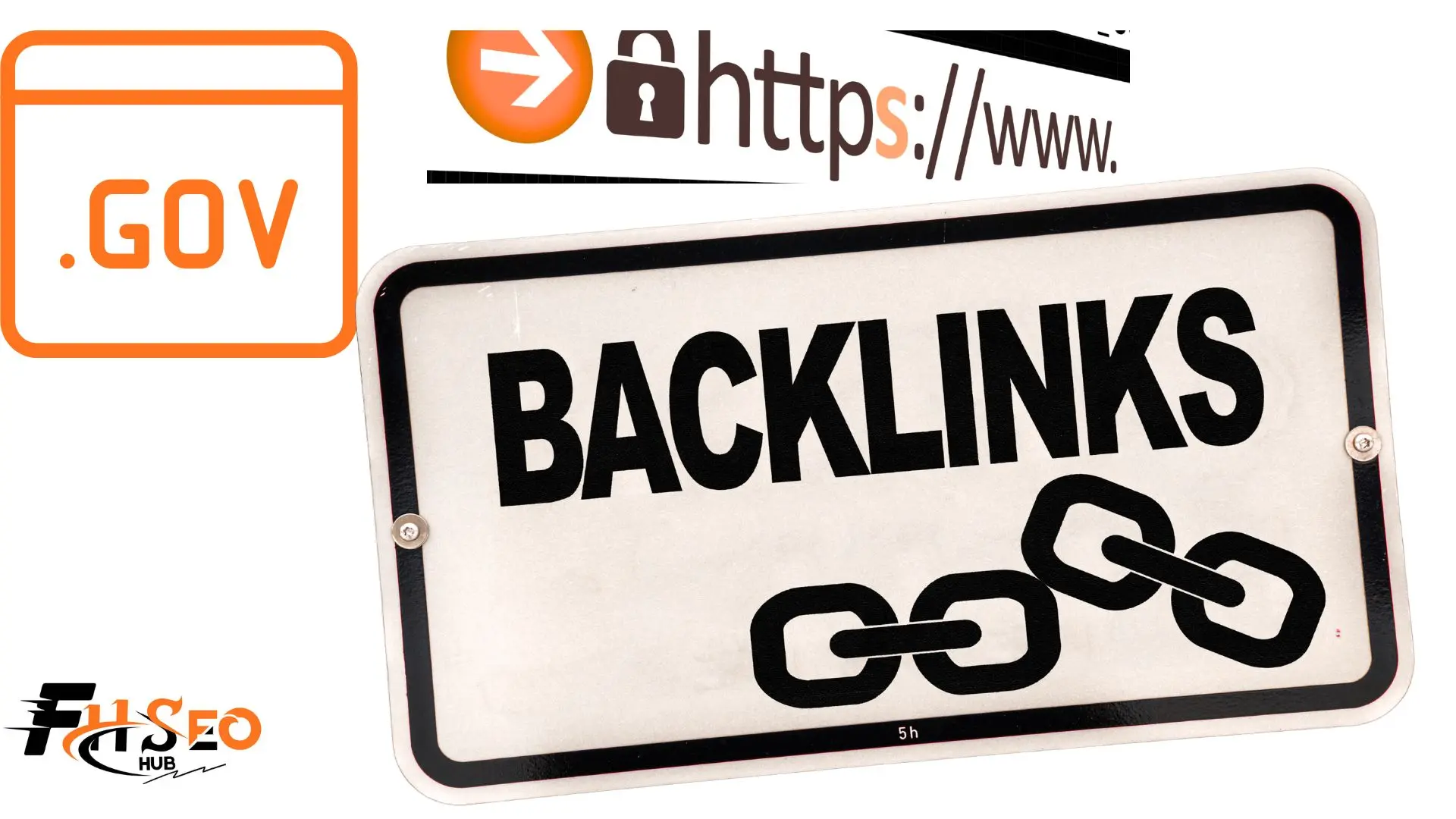
Gov backlinks are links pointing to your site from a government website, a .gov domain at the federal, state, or local level, and they get treated by a lot of SEO content as an automatic authority boost. The honest 2026 answer, grounded in what Google Guidelines actually say rather than SEO folklore, is more specific: they can genuinely help, but not because of the .gov suffix itself, and believing otherwise is exactly what’s caused Google to actively discount a meaningful share of them.
What Are .gov Backlinks?
This means any link from a website using the .gov top-level domain, restricted in the US to legitimate federal, state, and local government agencies rather than available for general registration the way .com or .net domains are. That restriction is part of why these domains carry inherent trust with users, a .gov address confirms the site belongs to an actual government entity, not a marketing claim from a private business. This is distinct from a general directory link or business listing, since the .gov restriction requires actual government status to register at all.
This trust signal is real, but it’s a trust signal for human visitors and for the government’s own verification process, not a direct instruction to Google’s ranking systems to weight the link, or the resulting domain authority, differently because of its domain ending.
Why Are .gov Backlinks So Valuable?
Government sites tend to be genuinely difficult to earn links from, genuinely relevant to specific industries (health data from CDC.gov, space and science content from NASA.gov, weather and climate data from NOAA.gov), and genuinely well-trusted by users, three qualities that make any link valuable regardless of its domain extension. The value comes from that combination, not from the .gov suffix acting as a special ranking multiplier, which is the distinction most content built around this topic gets wrong.
Referral traffic is a real, underappreciated benefit too. A link placed on a genuinely relevant government resource page or cited as a data source in an agency report can drive qualified visitors who trust the government source enough to click through, a benefit that exists independent of whatever ranking value the link carries.
The 3 Types of .gov Backlinks
Government links break down into three tiers, each with meaningfully different acquisition difficulty and realistic opportunity volume.
Federal
Federal government websites, agencies like CDC.gov, NASA.gov, and NOAA.gov, carry the strongest inherent trust and typically the highest domain rating, but they’re also the hardest tier to earn a link from, since these sites answer to strict editorial and accessibility standards and rarely link out to private commercial sites without a genuine, well-documented reason. Realistic opportunities here usually come through being cited as a data source, contributing genuinely useful research an agency references, or being included in an official resource list after a formal vetting process.
State
State government websites offer more realistic opportunity volume than federal sites while still carrying strong regional authority, particularly valuable for businesses with a genuine state-level presence, licensing requirement, or regulatory relationship. State agency directories, business resource pages, and industry-specific state program pages are the most common realistic entry points.
Local
Local government websites, city and county-level sites, represent the most accessible tier and pair naturally with local link building for businesses with genuine local ties. Chamber of commerce partnerships, local business directories maintained by a city government, and community program sponsorships are realistic, achievable opportunities here that don’t require the extensive vetting a federal placement does.
Do .gov Backlinks Really Matter for Rankings?
Not because of the TLD itself, and the record on this is unusually clear and long-standing. Matt Cutts stated directly, and Google has never walked back, that a link’s top-level domain doesn’t factor into how much ranking weight it carries, a link is evaluated on the authority and relevance of the linking page, not whether it ends in .gov, .edu, or .com. John Mueller went further, confirming that Google actively ignores a large share of .edu links specifically, precisely because the widespread belief that these links are automatically powerful has caused so much spam targeting them that Google had to start discounting them heavily to keep results clean.
This creates a genuinely self-defeating loop worth understanding directly: believing gov and edu links carry special ranking power is exactly what drives the spam campaigns targeting government resource pages and university directories, which then forces Google to treat a growing share of those links as untrustworthy, undermining the very premise that started the spam in the first place. The honest current framing, consistent across current 2026 sources, is that government sites are often valuable specifically because they’re hard to earn links from and genuinely trusted, the same standard that makes any backlink valuable, not a special exception carved out for one TLD.
This sits inside a broader 2026 shift worth keeping in mind too: Google quietly removed the word “important” from its own documentation describing links as a ranking factor back in 2024, and Google’s Gary Illyes has stated publicly that the search engine needs very few links to rank a page well, with link importance trending down over time generally. None of this means links or the link juice they’re assumed to pass don’t matter, they still do, but it’s worth calibrating expectations for any single link-building tactic against that broader trajectory rather than treating one tactic as a guaranteed ranking lever.
How to Find Government Websites Relevant to Your Niche
Ahrefs Site Explorer lets you filter a competitor’s backlink profile specifically for .gov referring domains, a genuinely useful way to see which government sites already link to businesses in your space, since a site that’s linked to a direct competitor has demonstrated willingness to link to your exact industry.
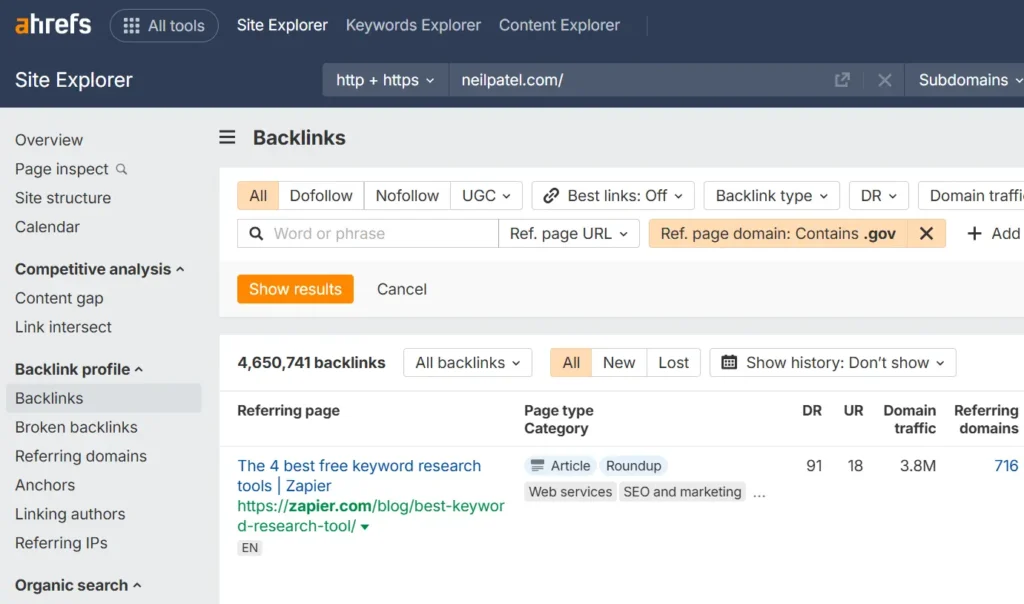
Here is a thing when you click the button show results then only those URLs appears which consist on the .gov.
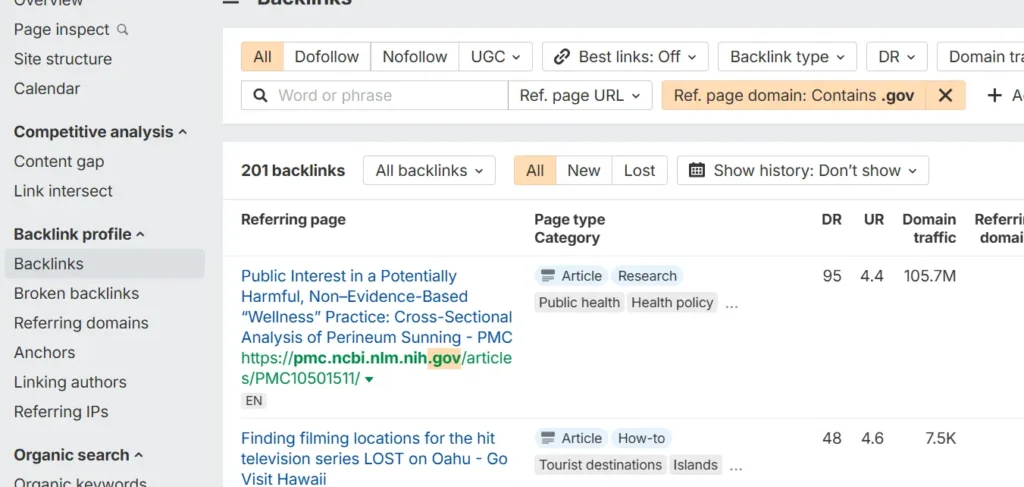
Competitor gap analysis run this way consistently surfaces more realistic opportunities than starting from a generic list of “top .gov sites,” since those lists often turn out far harder to actually earn a placement on than they initially appear.
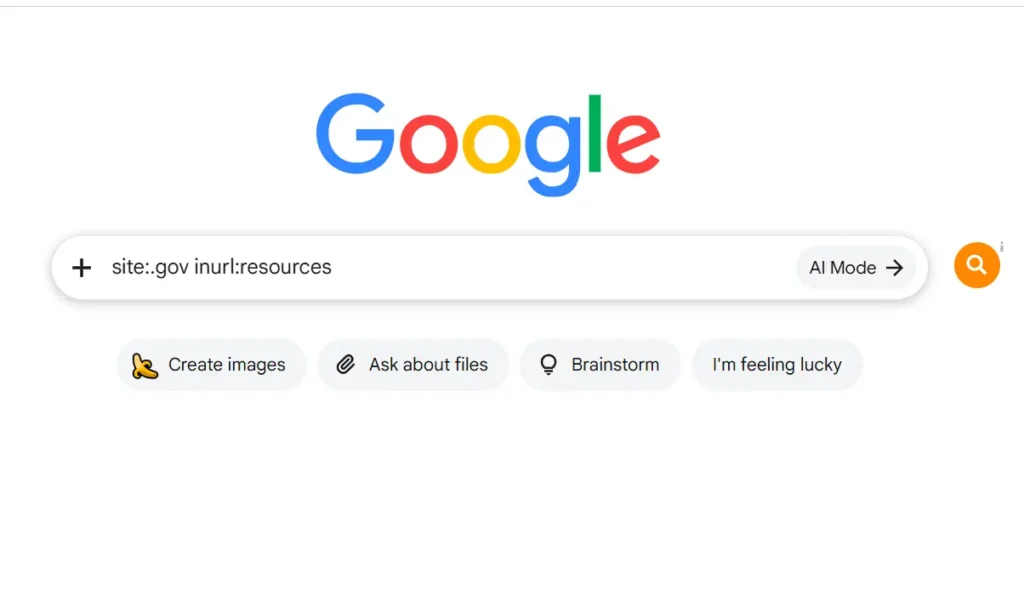
Advanced search operators are a genuinely practical, free complement to paid tools: a search like site:.gov inurl:resources combined with your industry term surfaces government resource pages actively curating outside links in your specific space.
Screaming Frog and the Semrush Broken Link Checker both help identify broken outbound links on government pages you’ve already identified as relevant, the foundation of the broken link building tactic covered next, and the Wayback Machine is worth checking against any promising resource page to confirm it’s still actively maintained rather than an abandoned page that stopped updating years ago.
Proven Strategies to Earn .gov Backlinks
Broken link building works particularly well on government resource pages specifically, since these pages accumulate dead links over time as businesses and nonprofits they once referenced shut down or move, and a government webmaster genuinely wants their resource page to stay useful, giving you a legitimate reason to flag the dead link and suggest your genuinely relevant, live resource as a replacement. This tends to be one of the more realistic tactics on this list precisely because it solves a real problem for the linking site rather than asking for a favor.
Guest posting opportunities exist on some government blogs and agency publications, though they’re far rarer and more tightly vetted than commercial guest posting, usually requiring genuine subject-matter credibility rather than a standard pitch. Building genuine linkable assets, original research, data visualizations, or resources a government agency would cite on its own initiative, tends to outperform direct outreach for the hardest-to-reach federal and state tiers, since it positions your content as something worth citing rather than something you’re asking to be linked to.
Government partnerships and sponsorship arrangements, sponsoring a local government program, event, or initiative your business has a genuine connection to, can produce a legitimate link as a natural byproduct of the partnership itself rather than the primary goal, which also tends to hold up better under scrutiny than a link acquired purely for SEO purposes. Realistic timelines here run longer than most commercial link building: expect federal and state placements to take months of relationship-building and genuine contribution before a link materializes, while local-tier opportunities through chambers of commerce or community directories can move considerably faster, sometimes within a few weeks of genuine outreach.
Why You Shouldn’t Buy .gov Backlinks
Any offer to sell you a guaranteed government link should be treated as a serious red flag rather than a shortcut worth considering. Legitimate government domains don’t sell link placements, full stop, so a vendor offering this is almost always doing one of a few things: running the link through a compromised or spam-infiltrated government subdomain, placing it on a look-alike site designed to resemble an official government directory without actually being one, or violating the linking government site’s own policies in a way that gets the placement removed once discovered. Marketing language claiming these links “pass serious ranking juice” or promising a dofollow link with never a nofollow link in the mix is exactly the kind of overconfident, unverifiable claim that should prompt skepticism rather than trust, especially given what Cutts and Mueller have both said directly about TLD carrying no special ranking weight in the first place.
Scholarship link building deserves specific mention as a well-documented, named link scheme: the practice of creating a nominal “scholarship” purely to get listed on university financial aid resource pages, which typically link out to scholarship providers, has been widely recognized and actively screened against for years now. Many universities currently vet scholarship submissions specifically to filter out this pattern, reject or nofollow suspicious submissions, or have removed their scholarship pages entirely in response to the abuse, meaning the tactic carries a genuinely low success rate today even before considering that Google’s own guidelines treat participation in link schemes as grounds for a manual penalty. Buying links generally, gov-branded or otherwise, violates Google’s guidelines on link schemes directly, and a manual penalty resulting from a pattern of purchased or scheme-based links can take significant time and a formal reconsideration request to recover from, a real risk that outweighs whatever shortcut a purchased .gov link seemed to offer.
Final Thoughts
Gov backlinks can genuinely help a site’s authority and referral traffic, but only when they’re earned the same way any high-quality link is earned: through genuine relevance, real difficulty, and a link that would make sense on the linking page even without the SEO motive behind it. Treat the .gov suffix itself as irrelevant to ranking weight, since Cutts and Mueller have both said so directly, and put the effort instead into the broken link building, genuine linkable assets, and real local partnerships that produce links government sites would have reasonable cause to add regardless of who’s asking. Skip anyone selling guaranteed .gov placements entirely, since the offer itself is usually the clearest sign something about it isn’t legitimate.
FAQs
The claim that .gov links carry special ranking power purely because of the domain ending is a myth Matt Cutts directly debunked. They can still help because government sites tend to be genuinely authoritative and hard to earn links from, the same quality bar that makes any backlink valuable.
Broken link building on government resource pages, contributing genuine research or data an agency would cite, and building real local partnerships or sponsorships are the most realistic paths, typically requiring genuine relevance and patience rather than a fast pitch.
No. Legitimate government domains don’t sell link placements, so any vendor offering this is likely running the link through a compromised subdomain, a look-alike site, or violating the linking site’s own policies, and it also violates Google’s link scheme guidelines directly.
Yes, when the scholarship exists primarily to earn a link rather than genuinely benefit students, this pattern is a recognized link scheme, and most universities now actively screen for and reject or nofollow these submissions.
Because the widespread belief that these links carry automatic ranking power has caused heavy spam targeting university and government resource pages, forcing Google to discount a large share of them to keep results clean, a pattern John Mueller has confirmed directly.
It varies by site and page, government domains don’t follow one universal policy, and some resource or directory pages apply nofollow attributes regardless of the TLD’s general reputation, so this should be checked per link rather than assumed.