
Google’s Unnatural Links Penalty: What to Do

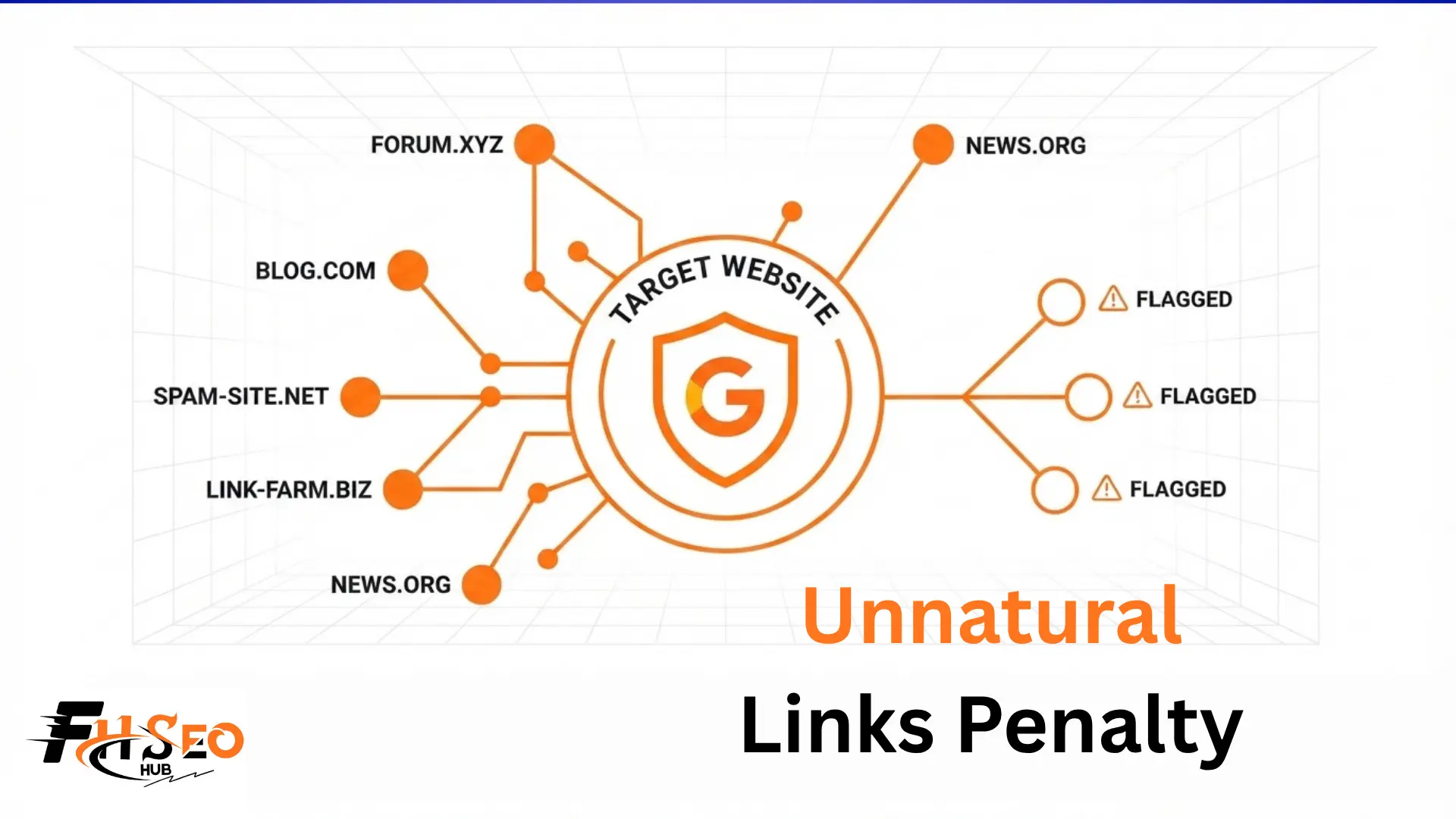
Google’s unnatural links penalty hits when a pattern of manipulative, artificial, or paid backlinks gets flagged by a manual reviewer or Google’s SpamBrain system. It can range from a partial ranking drop on specific pages to a site-wide traffic collapse. The fix depends on which type you’re dealing with, and treating a manual action like an algorithmic problem, or the reverse, wastes weeks chasing the wrong recovery process.
What Are Unnatural Links?
Unnatural links are backlinks created specifically to manipulate search rankings rather than earned through genuine editorial merit, covering paid links, link exchanges, PBN links, and any placement that exists mainly to pass ranking credit. Google’s own test is simple: would this link exist if search engines didn’t exist?
The category is broader than most SEOs assume. It’s not just obvious spam. A legitimate guest post that pays for placement without disclosure, a sitewide footer link exchanged for a discount, or an exact-match anchor inserted purely for SEO value all count as unnatural links under Google’s webmaster guidelines. That’s true even when the site hosting the link looks completely legitimate.
What separates an unnatural link from a natural one isn’t always visible from the link itself. Context matters: who placed it, why, and whether money, product, or service changed hands specifically for that placement.
Why Google Penalizes Unnatural Links
Google penalizes unnatural links because they corrupt PageRank as a relevance signal, letting sites with bigger budgets outrank genuinely better content simply by buying their way up. Left unchecked, this breaks the core promise search results are supposed to keep: that ranking reflects merit, not spend.
The policy isn’t new, but enforcement has gotten sharper. SpamBrain now cross-references hosting footprints, anchor text patterns, and link timing across a site’s entire referring domain profile, not just individual links in isolation. A single paid link rarely triggers anything. A pattern across dozens of links does.
Google’s stated position, reinforced through multiple algorithm updates since the Penguin algorithm first launched in 2012, treats link manipulation as a trust problem, not just a ranking problem. A site willing to fake authority through purchased links raises questions about what else it might misrepresent, which is why penalties here tend to hit harder than most other technical SEO issues.
Types of Google Penalties for Unnatural Links (Manual vs. Algorithmic/Penguin)
Unnatural link penalties
Unnatural link penalties come in two distinct forms. A manual action is issued by a human reviewer and visible in Google Search Console. An algorithmic penalty happens where Penguin-era detection systems quietly devalue links without any notification at all. Confusing the two leads to the wrong recovery process.
Manual action
A manual action shows up explicitly under Search Console’s Security and Manual Actions report. Google tags it specifically as either “unnatural links to your site” or “unnatural links from your site,” two distinct categories depending on whether the problem is your backlink profile or links you’re pointing outward. Recovery requires removing or disavowing the flagged links, then filing a reconsideration request.
Algorithmic penalties
Algorithmic penalties are quieter and, in a real sense, harder to diagnose. There’s no message, no specific list of flagged links, just rankings that stop responding to a link profile that used to move them. Recovery here means cleaning the profile and waiting for Google’s systems to reassess it on their own schedule, without ever filing a reconsideration request, since there’s no manual action to reconsider.
| Penalty Type | How You Know | Recovery Process | Typical Timeline |
| Manual Action | Explicit message in Search Console | Remove/disavow links, file reconsideration request | Several weeks after submission, longer for severe cases |
| Algorithmic (Penguin-era) | No notification, rankings quietly stagnate or drop | Clean the profile, build new clean links, wait | 4-12 weeks after remediation |
Types and Examples of Unnatural Links
The most common unnatural link types are paid links without disclosure, PBN links, excessive link exchanges, sitewide links, and links injected into hacked or compromised sites. Each carries a different detection signature and a different fix.
Paid links without a rel=”sponsored” or rel=”nofollow” attribute are the most widespread violation, since the payment itself isn’t the problem, the missing disclosure is. Private blog networks, PBNs, sit at the higher-risk end. A PBN is a controlled network of sites built specifically to link to a target, with no real audience or editorial purpose, and an entire network gets penalized together if SpamBrain identifies it.
Blog comment spam, forum link spam, and low-quality directory submissions are lower-effort, lower-risk violations individually, but they accumulate. Injected links, ones inserted into a site through a hack rather than by the site owner, are a distinct case. Google generally doesn’t blame the linking site for these, but they still need cleanup. A hacked site full of spam links pointing at you can still contribute to a negative SEO problem targeting your domain.
Redirected domains carry their own risk. Buying an old, previously-legitimate domain purely to redirect its accumulated link equity to a money site is a pattern Google’s systems watch for specifically. The redirect itself doesn’t erase the artificial intent behind the original link acquisition.
How to Tell If You’ve Been Hit by an Unnatural Links Penalty
Check Google Search Console’s Security and Manual Actions report first, since a manual action will show there explicitly with a description of the violation. If nothing appears there but organic traffic has dropped without an obvious cause, an algorithmic devaluation is more likely. That requires checking your backlink profile directly rather than waiting for a notification that isn’t coming.
A sudden, sharp ranking drop across many pages at once points toward a site-wide manual action. A drop limited to specific pages, or specific keyword clusters, points toward a partial manual action or a more localized algorithmic effect tied to a subset of your link profile.
Cross-reference the timing. A traffic drop that lines up with a known Google core or spam update is more likely algorithmic. A drop with no clear update correlation, especially one that follows a burst of new link acquisition, points more toward a manual review catching something specific you did.
How to Audit and Find Unnatural Links in Your Backlink Profile
Audit your backlink profile by exporting your full referring domain list, then flagging links by pattern: shared hosting footprints, exact-match anchor concentration, temporal clustering, and low-relevance linking domains. A one-by-one manual review of every single link rarely scales, so start with pattern detection, then investigate flagged clusters individually.
Temporal clustering is one of the more reliable red flags. A batch of 20 or 30 new links appearing within a short window, especially from sites with no prior connection to your niche, reads as purchased rather than earned. Anchor text concentration is another: if a meaningful share of your exact-match commercial anchors trace back to a small number of vendors or a similar site template, that’s worth investigating as a cluster, not link by link.
Don’t disavow reflexively. John Mueller has said publicly that old, random links accumulated over years without your involvement generally don’t need disavowing, only links you know were actively and unnaturally placed. Over-disavowing can remove links that were quietly helping you, so audit for genuine risk patterns, not just anything unfamiliar.
Best Tools for Detecting and Monitoring Unnatural Links
Ahrefs and Semrush both offer backlink toxicity scoring that flags high-risk links based on spam signals, referring domain quality, and anchor text patterns. That gives you a starting shortlist rather than requiring a fully manual review of a large link profile. Neither tool’s toxicity score is a Google metric, so treat flagged links as candidates for investigation, not an automatic disavow list.
| Tool | Best For | Key Limitation |
| Ahrefs | Backlink audit, toxicity flagging, historical link data | Toxicity score is a third-party estimate, not a Google signal |
| Semrush | Backlink Audit tool with toxicity scoring and outreach tracking | Same limitation, requires manual judgment on borderline links |
| Google Search Console | The only source for actual manual action notifications | Doesn’t show which specific links triggered a manual action |
Google Search Console remains the only tool that confirms whether a manual action genuinely exists. Third-party toxicity scores are estimates, not confirmation. Use Ahrefs or Semrush to build your audit shortlist for potential link scheme violations, then use Search Console to confirm whether you’re dealing with a real Google penalty or working proactively on an algorithmic concern.
How to Remove Unnatural Links (Manual Outreach)
Removing unnatural links starts with direct outreach to the site owner or webmaster requesting the link’s removal, documented in writing, before turning to the disavow tool as a fallback for links you can’t get removed. Google explicitly wants to see removal attempts, not just a disavow file, especially when filing a reconsideration request.
Keep a log of every outreach attempt: the date, the contact method, and the response, since Google’s reconsideration process asks for evidence of genuine removal effort, not just a list of disavowed domains. A reconsideration request built entirely on disavows with no documented outreach reads as less thorough to Google’s reviewers.
For links you can’t get removed, sites with no working contact method, unresponsive webmasters, sites that have gone dark, the disavow tool through Google Search Console is the correct fallback. Submit at the domain level for broad, clearly toxic sources, and at the URL level for specific pages on otherwise legitimate domains where only one link is the problem.
How to Submit a Reconsideration Request
Submit a reconsideration request through Google Search Console only after completing link removal outreach and disavowing what couldn’t be removed, since a request filed before genuine cleanup work is the most common reason for rejection. The request should document what was found, what was removed, what was disavowed, and what changed in your link acquisition practices going forward.
Be specific and honest in the request itself. Vague language claiming the links “must have come from a previous SEO vendor” without documented outreach or disavow evidence reads as an excuse, not a fix. Google’s reviewers see this framing constantly, and specificity, exact numbers of links removed, exact outreach dates, is what separates a request that gets approved from one that gets rejected and resubmitted.
Expect the review itself to take several weeks once submitted, and understand that a rejected request usually means the underlying cleanup wasn’t thorough enough, not that the request was written poorly. Fix the actual link profile before resubmitting, not just the wording of the request.
Step-by-Step Recovery Timeline: What to Expect
Recovery timelines differ significantly by penalty type. A manual action typically takes several weeks for Google to review a reconsideration request once submitted, though severe or repeat violations can take considerably longer. An algorithmic penalty has no formal review step. It typically shows measurable improvement within four to twelve weeks of genuine profile cleanup, depending on how contaminated the profile was and how much clean, earned link signal you’re able to build in that window.
The full process, from discovering a problem to full recovery, usually breaks into four stages. Auditing and identifying the scope of the problem can take one to two weeks depending on profile size. Outreach and disavow takes another two to four weeks depending on how many sites need contacting. The reconsideration review itself takes several weeks for manual actions. A final stabilization period follows, where rankings gradually return as Google’s systems reassess the cleaned profile.
Don’t expect immediate results even after a successful reconsideration request or algorithmic cleanup. Rankings typically recover gradually over subsequent weeks rather than snapping back immediately, since Google’s systems rebuild trust incrementally rather than restoring a site to its exact pre-penalty position overnight.
How to Prevent Future Unnatural Links Penalties
Prevent future unnatural link penalties by monitoring your backlink profile on a recurring schedule, not just after something goes wrong. Build link acquisition practices that would survive scrutiny even if a Google reviewer looked at every single link individually. Diversify anchor text, vet every paid placement for proper disclosure attributes, and avoid vendors promising guaranteed link volume at a flat low price.
Set up backlink monitoring through Ahrefs, Semrush, or a similar tool with alerts for sudden spikes in referring domains. Catching an unusual pattern early, whether from your own team’s mistake or a negative SEO attempt from a competitor, is far cheaper than recovering from a manual action months later. Review new links monthly, not just during a crisis.
Keep records of every paid placement and every link building campaign, including which vendor placed it and whether it carries the correct disclosure attribute. This audit trail makes any future reconsideration request faster to build and gives you a clear answer when a toxicity tool flags something you placed deliberately versus something that showed up on its own.
Real-World Examples of Unnatural Links Penalties
JCPenney’s 2011 manual action remains one of the most cited cases in SEO. An outside agency built a large network of paid links from irrelevant, low-quality sites to boost rankings for competitive retail terms. The pattern was exposed publicly before Google issued a manual action that cost the retailer significant rankings and traffic.
Overstock faced a similar penalty around the same period. The company offered students and faculty a discount in exchange for university websites linking to specific Overstock product pages using exact-match commercial anchor text like specific product category terms. The links were unnatural precisely because the anchor text and placement were engineered for SEO value, not because a .edu link is inherently suspicious.
Interflora received manual action warnings in 2013 tied to paid advertorial content that functioned as disguised link placements. All three cases share the same underlying pattern: link placement driven by SEO intent rather than editorial merit, at a scale and pattern that was eventually detected, whether by a journalist, a competitor, or Google’s own systems.
Conclusion
Google’s unnatural links penalty is recoverable. Treating every situation the same way, disavowing everything, filing a reconsideration request without real cleanup, guessing instead of auditing, is what turns a fixable problem into a drawn-out one. Confirm which penalty type you’re dealing with first. Audit for genuine patterns rather than reflexively disavowing anything unfamiliar, and document real outreach before leaning on the disavow tool as a fallback. Build a recurring monitoring habit once you’ve recovered. The cheapest fix for an unnatural links penalty is never having one in the first place.
FAQs
A manual action recovery typically takes several weeks for Google to review a reconsideration request once submitted, though severe cases can take longer. An algorithmic penalty has no formal review step but generally shows measurable improvement within four to twelve weeks of genuine profile cleanup.
No. Disavow links you have genuine evidence were unnaturally placed, not everything a toxicity tool flags. Random, old links you had no involvement in generally don’t need disavowing, and over-disavowing can remove links that were quietly helping your rankings.
A manual action is issued by a human reviewer, appears explicitly in Google Search Console, and requires a reconsideration request to resolve. An algorithmic penalty happens silently through systems like Penguin, with no notification and no formal review process, just links that quietly stop passing value.
It’s possible but less common than most site owners assume, since Google’s systems are generally designed to recognize and discount links a site owner didn’t build themselves. If you suspect negative SEO, disavow the suspicious links as a precaution, but don’t assume every unexplained ranking drop is an attack rather than an issue in your own link profile.
Not necessarily for a smaller, well-documented case, though the audit and outreach process is time-intensive regardless of who does it. Larger, more complex profiles, or repeat violations, benefit from a specialist who has handled multiple reconsideration requests and knows what level of detail Google’s reviewers expect.


