Corporate Level SEO: The Complete Enterprise SEO Guide

Corporate level SEO applies search engine optimization at organizational scale. It coordinates technical SEO, content governance and link building across hundreds or thousands of pages. That means managing stakeholder approval, legal compliance, and cross-departmental alignment that smaller sites never have to navigate. The tactics look familiar. The coordination problem is what makes it genuinely hard.
What Is Corporate SEO?
Corporate SEO, often called enterprise SEO, is the practice of managing search engine optimization across a large organization’s website, typically thousands to millions of pages. It requires coordination between SEO, legal, brand, IT, and content teams that don’t exist at smaller scale. The core disciplines, technical SEO, content, and link building, stay the same. The organizational complexity around executing them doesn’t.
A corporate SEO program answers to revenue attribution models, brand governance policies, and multi-stakeholder approval chains a five-person startup never encounters. Getting a single page’s title tag changed can require sign-off from legal, brand, and a content management system with a two-week release cycle. That workflow reality shapes corporate SEO strategy as much as any algorithm update does.
The History and Evolution of Corporate SEO
Corporate SEO evolved from a marketing side-task into a dedicated organizational function. Large websites grew past the point where a single marketer could manage technical health, content quality, and link building manually. Early enterprise sites treated SEO as a checklist applied after launch. Modern corporate SEO treats it as infrastructure built into content management systems, development workflows, and executive reporting from the start.
The shift toward SEO governance as a formal discipline tracks closely with Google’s own move from isolated ranking factors toward holistic quality evaluation. E-E-A-T, Core Web Vitals, a steady sequence of Google Core Updates, and now AI-generated answer visibility have all pushed enterprise sites toward standing infrastructure rather than periodic cleanup. A corporate SEO function today needs standing relationships with engineering and content teams, not a periodic audit handed off and forgotten. The pace of both algorithm change and internal site change has made one-time interventions insufficient.
How Corporate SEO Differs from Traditional SEO
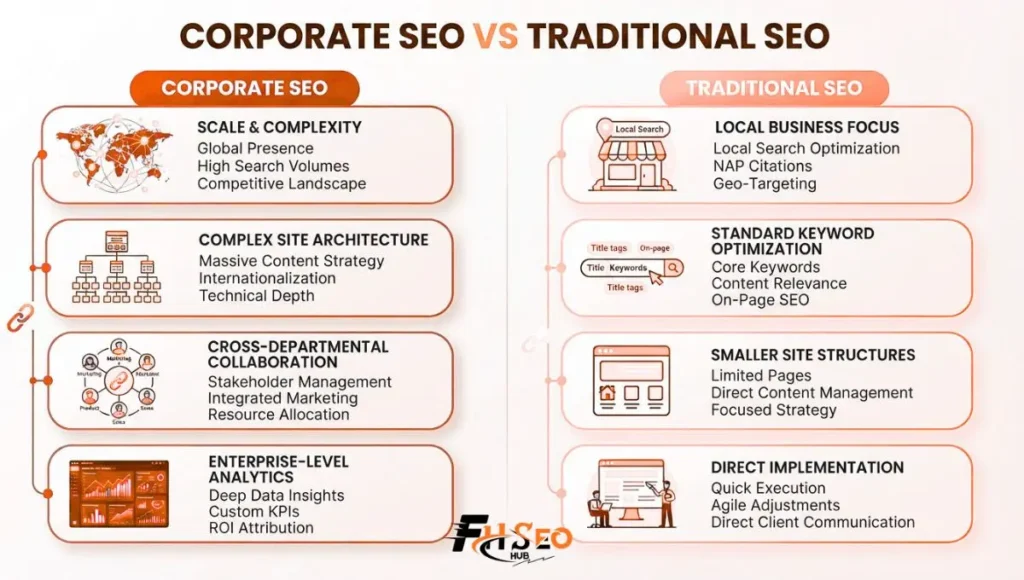
Corporate SEO differs from traditional SEO primarily in scale and coordination cost, not in the underlying tactics. Technical fixes that take an afternoon on a small site can take months at enterprise scale. That’s once you account for legal review, brand approval, and a development queue shared across dozens of other business priorities.
Crawl budget becomes a genuine constraint only at scale. A site with a few hundred pages rarely runs into indexation problems. A site with millions of URLs can see important pages crawled infrequently if the site architecture wastes budget on low-value pages. Content governance similarly only becomes a real discipline once dozens of contributors across regions and departments are publishing simultaneously. That’s when index bloat and content cannibalization risks show up, risks a small team never produces by accident.
Types of Enterprise SEO by Business Model
Enterprise SEO priorities differ meaningfully by business model, whether that’s a B2B SEO program or a SaaS SEO one. B2B SaaS companies prioritize content-led topical authority and trial conversion paths. Multi-location and franchise businesses prioritize local SEO consistency across hundreds of listings. Ecommerce and marketplace platforms prioritize crawl efficiency and product feed accuracy, and publishers prioritize content velocity and Google Discover visibility.
A B2B SaaS enterprise site typically runs a smaller page count than a retailer. It needs deep topical authority and careful internal linking to move visitors from informational content toward trial or demo conversion. A multi-location or franchise business, healthcare systems, retail chains, restaurant groups, needs NAP consistency and local SEO management across potentially thousands of individual location pages. A single formatting error replicated across locations becomes a scale problem instantly. Ecommerce and marketplace platforms deal with faceted navigation, product variant pages, and crawl budget challenges that a content-focused enterprise site rarely faces. Publishers and media sites optimize for a different cycle entirely, content freshness, Discover eligibility, and rapid indexing, over the slower-moving technical and link building work other business models prioritize.
Core Components of a Corporate SEO Strategy
A corporate SEO strategy’s core components are technical SEO at scale, scalable site architecture, and content governance. Enterprise-level keyword research, link building and digital PR, and international or multi-location SEO round out the list where applicable. All of these get coordinated through formal SEO governance rather than ad hoc effort.
Each component requires its own owner or working group at enterprise scale. No single person can manage crawl budget optimization, content approval workflows, and link building outreach simultaneously across a large organization. Standard operating procedures and content templates exist specifically to keep quality consistent once contribution scales beyond what any one SEO lead can personally review.
Technical SEO at Scale (Crawl Budget, Site Speed, Indexation)
Technical SEO at scale means managing crawl budget deliberately. Large sites can waste crawl activity on low-value parameter URLs, thin pages, or redirect chains that starve important pages of crawl frequency. Log file analysis becomes essential at this scale, since it shows exactly how often Google crawls a site, not what a sitemap claims it should crawl.
Redirect chains accumulate quietly on large sites through repeated migrations, URL restructures, and acquisitions. Each additional hop in a chain both wastes crawl budget and dilutes link equity passed through it. Site speed and Core Web Vitals matter at the same technical level as smaller sites. Diagnosing and fixing a shared template issue affecting millions of pages requires engineering coordination a small site’s speed fix never needs. Indexation bloat, thousands of low-value or duplicate pages sitting in Google’s index, is a distinctly enterprise-scale problem. It dilutes the site’s overall quality signal and wastes crawl budget that could reach genuinely valuable pages instead.
Scalable Site Architecture and Internal Linking
Scalable site architecture means building a URL and category structure that stays navigable and crawlable as page count grows into the thousands or millions. It relies on topical authority clusters and consistent internal linking patterns rather than ad hoc linking decided page by page. A flat, shallow architecture that works for a hundred pages breaks down without deliberate planning once a site reaches enterprise scale.
Internal linking at this scale needs a systematic approach, template-level linking rules built into the content management system, rather than manual link insertion on every page. Manual linking simply can’t keep pace with enterprise publishing volume. Canonical tags require the same systematic discipline, since large sites generate duplicate and near-duplicate content constantly through faceted navigation, print versions, and regional variants. Inconsistent canonicalization at scale creates the kind of index confusion that’s far harder to untangle after the fact than to prevent upfront.
Content Strategy and Governance
Content governance at enterprise scale means establishing content templates, standard operating procedures, and a clear approval workflow. Together these keep quality and brand voice consistent across every contributor, region, and department publishing to the site. Without formal governance, large sites accumulate content cannibalization, duplicate topics competing against each other, and inconsistent quality that undermines topical authority overall.
Content gap analysis and content audits become a recurring operational necessity, not a one-time cleanup project. New contributors and departments continuously add content that may duplicate or contradict existing pages without governance catching it before publication. Legal and compliance review adds a layer smaller sites rarely need, particularly in regulated industries, financial services, healthcare, where content claims require sign-off before publishing. That step needs to be built into the content calendar from the start rather than treated as a bottleneck to route around.
Keyword Research at Enterprise Scale
Keyword research at enterprise scale means prioritizing topic clusters and business value over individual keyword volume. A large site can realistically target thousands of keywords simultaneously and needs a systematic prioritization framework rather than manual keyword-by-keyword decisions. Cross-departmental alignment matters here specifically, since multiple business units targeting overlapping keywords without coordination creates internal competition for the same rankings.
Build keyword prioritization around topical authority clusters mapped to actual page inventory, then flag genuine gaps where the business has commercial intent but no corresponding content. This keyword mapping work also surfaces cannibalization risks before they happen, catching cases where two departments are independently planning content targeting the same core topic.
Enterprise Link Building and Digital PR
Enterprise link building leans more heavily on digital PR and brand-driven earned coverage than smaller-scale guest posting and niche edits. A recognizable brand name has genuine newsworthiness a smaller site doesn’t, and journalists actively seek expert commentary and original data from established companies. Domain authority at enterprise scale also compounds differently, since a single high-authority domain accumulates link equity across every page it publishes.
The trade-off is coordination overhead. Digital PR campaigns at enterprise scale typically require legal review of any public data or claims before pitching. Brand teams often want approval over which publications and contexts the company name appears in. That adds real time to a process that moves faster at smaller organizations with fewer stakeholders to satisfy.
International and Multi-Location SEO
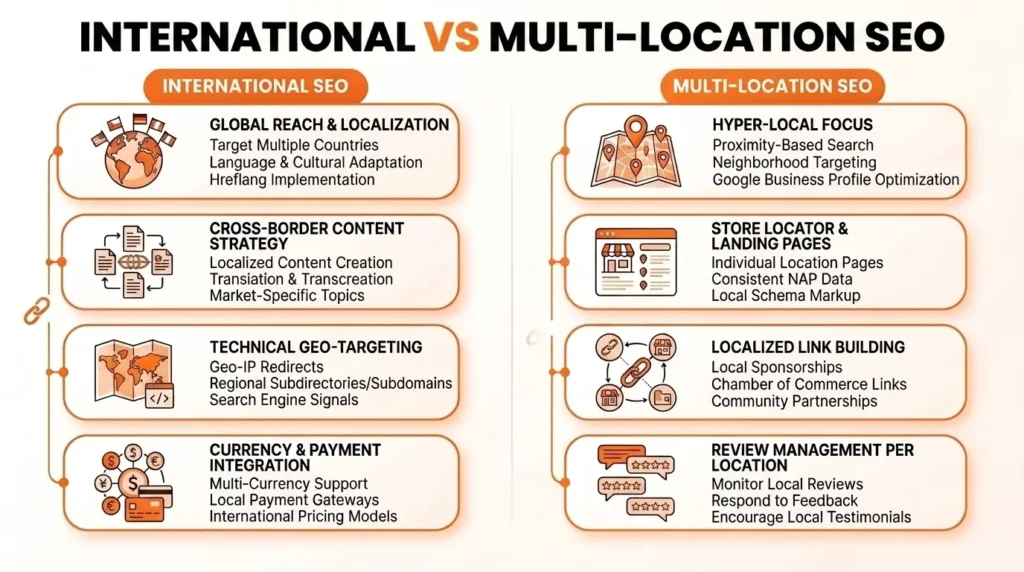
Multi-location SEO for corporate sites means implementing hreflang tags correctly across language and region variants, and maintaining NAP consistency across every physical location listing. Both become genuinely difficult to manage accurately once a business operates across dozens of countries or locations. A single hreflang implementation error can affect an entire regional site’s visibility, not just one page.
Multi-location businesses specifically need a scalable local SEO process, not a one-off setup. Google Business Profile data, local citations, and location-specific content all require ongoing maintenance as locations open, close, or change details. International SEO adds translation quality and cultural relevance on top of the technical hreflang implementation. A mechanically translated page rarely performs as well as content genuinely adapted for that market’s search behavior and intent.
Common Corporate SEO Challenges and Solutions
The most common corporate SEO challenges are slow implementation timelines caused by multi-stakeholder approval, index bloat from ungoverned content growth, and keyword cannibalization across departments. Executive buy-in fading when results take longer to show than a quarterly reporting cycle expects rounds out the list.
| Challenge | Root Cause | Practical Solution |
| Slow implementation | Legal, brand, and dev approval chains | Pre-approve standard SEO changes as templates, escalate only genuine exceptions |
| Index bloat | Ungoverned content growth across departments | Recurring content audits, clear content governance policy |
| Keyword cannibalization | Departments targeting overlapping topics independently | Centralized keyword mapping and cross-departmental alignment |
| Executive buy-in erosion | SEO timelines mismatched with quarterly reporting expectations | Set realistic timeline expectations upfront, report leading indicators alongside traffic |
Realistic SEO timelines at enterprise scale often run six to twelve months before major initiatives show clear ranking and traffic movement. That’s longer than the timeline many executives expect based on smaller-scale SEO experience. Setting this expectation explicitly during initial buy-in conversations prevents the program from losing support before compounding results have time to materialize.
Common Misconceptions About Corporate SEO
The most common misconception is that corporate SEO is just traditional SEO applied to a bigger site, when the actual difference is organizational coordination, not technical complexity. A second misconception treats SEO tools as a substitute for governance, assuming an enterprise platform’s automated recommendations replace the need for human content and technical strategy decisions.
A third misconception assumes bigger budgets guarantee faster results, when a large budget poorly coordinated across departments often underperforms a smaller, well-governed program. The fourth, and possibly most damaging, misconception treats SEO as a project with an end date rather than ongoing infrastructure. This leads organizations to defund SEO teams once an initial push shows results, then wonder why rankings decline once maintenance stops.
Building the Right Team: In-House vs. Agency vs. Hybrid Model
Choosing between an in-house team, an enterprise SEO agency, and a hybrid model depends on two factors. How much ongoing technical coordination your organization needs, and how much specialized execution capacity you need to scale quickly, both matter. An in-house team offers deeper institutional knowledge and faster internal coordination, while an agency brings broader tool access and specialized skill sets without a full-time headcount commitment.
A genuinely capable in-house enterprise SEO function typically requires multiple specialized roles: technical SEO, content strategy, link building or digital PR, and analytics. One generalist can’t realistically cover all of it. That reality pushes real in-house costs well past what a single senior hire’s salary suggests once the full team and tooling are counted. An enterprise SEO agency engagement commonly runs into five figures monthly for genuinely comprehensive service at large-site scale, though pricing varies enormously by scope and site complexity. The hybrid model, an in-house SEO lead managing strategy and stakeholder relationships while an agency or specialized vendor executes technical audits, content production, or link building, is increasingly common. It balances institutional knowledge against execution capacity without requiring a fully-staffed internal team.
Enterprise SEO Tools and Technology Stack
The enterprise SEO tools stack typically includes an all-in-one platform like BrightEdge, Conductor, or seoClarity for reporting and content intelligence. It also includes a dedicated technical crawler like Botify or OnCrawl for log file analysis and crawl budget management at scale. Enterprise tiers of tools like Ahrefs or Semrush round out the stack for backlink and keyword data.
| Tool Category | Example Platforms | Best For |
| All-in-one enterprise platform | BrightEdge, Conductor, seoClarity | Cross-team reporting, content intelligence, workflow orchestration |
| Technical crawl specialist | Botify, OnCrawl, Lumar | Large-scale log file analysis, crawl budget diagnostics |
| Enterprise tier of SMB tools | Ahrefs Enterprise, Semrush Enterprise | Backlink data, keyword research, competitive intelligence |
| Site-level crawling | Screaming Frog | Spot audits and technical checks, remains cost-effective even at enterprise scale |
Pricing at this tier varies enormously and most platforms don’t publish rates publicly. Reported enterprise contracts commonly range from the low tens of thousands to several hundred thousand dollars annually depending on scale, modules, and negotiated terms. Technical crawl specialists like Botify generally suit sites with several hundred thousand URLs or more. The depth of log file analysis they provide is overkill, and not worth the cost, for a smaller enterprise site.
Corporate SEO Pricing and Cost
Corporate SEO costs span in-house team salaries, enterprise agency retainers, and tool licensing. The total typically runs well into six figures annually once all three are combined for a genuinely comprehensive program. An enterprise agency retainer alone commonly starts in the $10,000 to $30,000 monthly range for large-site work, similar to a standard SEO monthly retainer structure scaled up. Highly complex, multi-market programs run considerably higher.
Budget realistically for tooling on top of team or agency costs. A genuinely capable enterprise tool stack, one all-in-one platform plus a technical crawler, commonly adds tens of thousands of dollars annually even before accounting for team or agency fees. Organizations underestimating total program cost by focusing only on agency retainer or salary numbers run into a common surprise. The tooling and internal coordination overhead adds a meaningful percentage on top of whatever number they budgeted initially.
Measuring ROI, Forecasting and Reporting
Measuring corporate SEO ROI means connecting organic traffic and ranking movement to actual revenue attribution, not just traffic volume. Executives evaluating SEO investment need to see business impact, not vanity metrics. SEO forecasting at enterprise scale uses historical performance data and competitive analysis to set realistic expectations before a major initiative launches, protecting the program from unrealistic timeline assumptions.
Report leading indicators, indexation health, technical issue resolution, content publishing cadence, alongside lagging indicators like traffic and rankings. Leading indicators demonstrate program health during the months before ranking movement becomes visible. This dual reporting approach directly addresses the executive buy-in erosion problem covered earlier, giving stakeholders concrete progress signals during the realistic six-to-twelve-month window before major initiatives show full results.
Real-World Examples of Corporate SEO in Action
Corporate SEO programs commonly show measurable impact through large-scale technical fixes. Consolidating thousands of thin, duplicate product or location pages into fewer, stronger pages typically recovers crawl budget and consolidates link equity that was previously split across near-identical URLs. A content governance rollout that catches and prevents keyword cannibalization before publication is another consistently reported pattern across enterprise SEO case studies. That beats fixing cannibalization after competing pages have already diluted each other’s rankings.
No single named case study is cited here. Specific company results depend on variables, starting technical health, competitive landscape, existing content quality, too particular to generalize into a universal benchmark. The consistent pattern across genuinely successful corporate SEO programs is the same one this guide has emphasized throughout. Technical foundation and content governance get fixed first, with link building and expansion layered on top once that foundation is stable.
The Future of Corporate SEO: Search Everywhere and Brand-Led Strategy
The future of corporate SEO extends beyond Google into what the industry increasingly calls Search Everywhere Optimization, building visibility across AI assistants, YouTube, social platforms, and marketplaces alongside traditional search. A growing share of discovery now happens outside a conventional Google results page entirely. This shift treats SEO as one layer of a broader discoverability discipline, not a self-contained channel.
For corporate SEO programs specifically, this means answer engine optimization and generative engine optimization matter as much as brand-led strategy did in isolation. AI systems and platforms outside Google increasingly cite and reference brands based on overall reputation and topical authority, not just individual page rankings. Cross-departmental alignment becomes even more critical under this model. Visibility on YouTube, Reddit, and AI platforms often falls outside a traditional SEO team’s direct ownership. That requires coordination with social, content, and PR teams that corporate SEO governance structures need to formally include rather than treat as adjacent functions.
Conclusion
Corporate level SEO succeeds or fails on organizational coordination more than on any single technical tactic. The underlying SEO work barely differs from smaller-scale practice once you strip away the approval chains, content governance, and cross-departmental alignment enterprise scale demands. Build technical foundations and content governance before scaling link building and expansion efforts. Set realistic timeline expectations with executives upfront, and treat SEO as ongoing infrastructure rather than a project with a finish line. The organizations that get this right treat coordination as the actual discipline being managed, with SEO tactics as the tools that discipline gets applied through.
FAQs
The terms are generally used interchangeably to describe SEO managed at large organizational scale. Some practitioners use “corporate SEO” to emphasize the internal governance and stakeholder coordination side specifically, while “enterprise SEO” more often refers to the technical scale of the site itself. There’s no strict industry-wide distinction between the two.
Total program cost, combining in-house team or agency fees plus enterprise tooling, commonly runs well into six figures annually for a comprehensive program. Agency retainers alone often start in the $10,000 to $30,000 monthly range for large-site work, with enterprise tool licensing adding tens of thousands more per year.
It depends on how much ongoing technical coordination versus specialized execution capacity the organization needs. A hybrid model, an in-house lead managing strategy while an agency executes technical audits or content production, is increasingly common since it balances institutional knowledge against execution capacity.
Major initiatives at enterprise scale typically take six to twelve months to show clear ranking and traffic movement, longer than smaller-scale SEO experience often leads executives to expect. Setting this timeline explicitly during buy-in conversations helps prevent programs from losing support before results materialize.
The most common causes are index bloat from ungoverned content growth and keyword cannibalization across departments working in isolation. Executive buy-in eroding when results take longer than a quarterly reporting cycle expects rounds out the list. Most of these trace back to coordination gaps, not technical or content quality failures.
It depends on site size and technical complexity. Standard tools like Ahrefs or Semrush work fine for many mid-sized enterprise sites. Dedicated technical crawlers like Botify or OnCrawl become genuinely valuable once a site reaches several hundred thousand URLs. Crawl budget diagnostics at that scale require deeper log file analysis than standard tools provide.